Showing posts with label some kind of a think piece. Show all posts

Wednesday, August 15, 2012

Thinking Like a Director in the Documentation of One's Own Life

BROOKLYN, N.Y.—One byproduct of having so many easily accessible forms of media at our disposal every day is that we sometimes find ourselves making decisions as to which form is better at capturing a given moment in our daily lives. Or, at least, I do.

This past Sunday offered a case in point. The Dominican Day Parade was held here in New York on Sunday, and it proceeded up Sixth Avenue, past my office building. And certainly no one who was working at the News Corp. building that day could avoid hearing the festivities outside; that's how raucous it was. But hearing the din from my indoor aural vantage point was nothing compared to stepping outside my office and experiencing all that noise blasting into my face, as occurred when I went out to grab some lunch.

Here's where the personal decision-making came in. I wanted to capture a sense of this scene and share it with all of my Twitter followers/Facebook friends, so I instinctively took out my iPhone and took a photo. But then I realized that no photograph, however lively or colorful, could do justice to just how loud it was out there. So, after I had grabbed my lunch, I took out my iPhone again and, while walking past the parade on the way back to my office, shot this video:


I think that better captures the moment, don't you? (I didn't keep the photo I took, in the interest of saving space on my iPhone.)

There have been other times, though, where I went the other way and settled for still images rather than videos. Back in June—on June 20, the day of the summer solstice, to be exact—Times Square was transformed into a massive yoga studio of sorts, with four 90-minute sessions scheduled throughout the day for yoga enthusiasts all over the city could participate. I didn't participate, but I did drop by during the last session of the day to see what it was like. Again, I wanted to share what I was observing with friends online. To that end, I snapped these photos:


Then I thought about whether taking some video might further enhance my audience's sense of the scene. I did shoot one, actually, but I wasn't satisfied with the result (I think it was just a matter of me just missing an exciting moment before I turned my iPhone camera on and not finding anything of much interest subsequently). In the end, though, I decided that those photos above were enough to convey at least a measure of the sheer vastness of the scene; there wasn't anything about the event that I thought was special enough to lend itself exclusively to video. (The only thing I wish I had on hand, really, was a panoramic lens that would have done an even better job of capturing the full breadth of the army of yogis doing their thing in Times Square. I could have given even that old French filmmaker/madman Abel Gance—in Napoléon mode, of course—a run for his money in the widescreen-panorama department!)

Even when sticking with one visual medium, however, there are possible choices to be made thanks to phone applications and such. Consider Instagram. Instagram, for those who don't know much about it, is an app that allows users not only to share photographs they take on the go with their smartphones, but also to apply filters to give your photos a special look to them; one could theoretically make your photos look much older than they actually are, for instance. Many friends of mine add a filter to just about every single photo they take. I, however, tend to be more selective. So sure, an image of Sailboat Pond in Central Park on a sunny Saturday afternoon arguably deserves to be enhanced a bit with a filter, as this one was...


...but I'm not so sure even the snazziest filter could turn this trash heap into gold:

Yes, this is the desk of an editor with whom I work at The Wall Street Journal. This is probably not the messiest state in which it's been seen.

In our media-saturated world, and with social media seemingly inspiring all of us to turn our lives into entertainment to share with the masses, the choices which face us all as far as how we engage in this public documentation are seemingly limitless. Have any of you dear readers ever found yourself having these kinds of private debates about the best way to capture a real-life moment in digital amber, so to speak? If so, I'd love to hear your stories in the comments section!

(Of course, one could also simply give all this digital and social media the finger and just, you know, live life in the moment. There's that option, too.)

Wednesday, June 15, 2011

On Character Motivations in Movies

BROOKLYN, N.Y.—The line between opaque character motivations and merely underimagined characters can be a fine one indeed.

Sometimes in a drama, you might come across an action that a given character undertakes that strikes you as either inconsistent with that character's previous behavior, or simply unclear as to his/her motivation behind said action. Do you immediately chalk up such confusion on the viewer's part to bad screenwriting—a possible failure on the screenwriter's part to fully imagine these characters? Or are you, like me, more often than not inclined to give that particular screenplay the benefit of the doubt?

I've been thinking about this issue a bit more than usual recently, inspired by two films I've seen: Béla Tarr's Sátántangó (1994) and Radu Muntean's Tuesday, After Christmas (2010). As far as subject matter goes, these two films are worlds apart; stylistically, however, they are startlingly similar, with both directors committed to extremely long takes and a starkly realistic (if not downright depressive, at least in Tarr's case) atmosphere in dissecting the physical and emotional environments they inhabit. In aiming for this fly-on-the-wall approach, however, they also both end up taking a more detached perspective on the human behavior they portray, not always bothering to make clear the motivations behind the behavior.


One of the most infamous sequences in Sátántangó involves a young girl (Erika Bók) who, finding herself bored while waiting around for her brother, hides in an empty space away from the rain, picks up a pet cat and proceeds to torture and eventually kill it. (This turns out, believe it or not, to be not the worst thing she does in her section of the film.) Why does she commit this appalling act, which Tarr, of course, shoots in unnervingly prolonged takes without any cutaways to spare us the worst? Is it just an indication of how bored she is? Does she truly believe she's just playing around with it? Is she that determined to exercise her power over something—a power that she perhaps is otherwise unable to exercise in her regular life? Or is her attitude toward this poor creature a product of the loveless environment in which she lives: an isolated, failed farm collective in Hungary in which most of the inhabitants exhibit variations of boredom, selfishness and general spiritual bankruptcy? Tarr doesn't bother to give us any clear indications of the reasons behind her actions; he—with the invaluable assistance of cinematographer Gábor Medvigy—simply looks on impassively.


Or take the pivotal moment in Tuesday, After Christmas when Paul (Mimi Branescu) finally decides, a couple days before Christmas, to fess up to his wife Adriana (Mirela Oprisor) about the affair he's been carrying on with their daughter's dentist, Raluca (Maria Popistasu). Following in Tarr's footsteps, Muntean shoots both the build-up to this bombshell moment and the resulting emotional fall-out in one single take; just as there is now nowhere for Paul to hide from Adriana's knife-edged glare, Muntean and cinematographer Tudor Lucaciu don't give us the relief of edits or changes in camera angles to shortchange the emotional brutality of the moment. And yet, there may still be lingering questions regarding that moment in your mind: Why does he choose that day, of all days, to let out his secret? What makes him decide to let that secret out in the first place? (He never vocalizes his thoughts, and Muntean never lets us in on them through any sort of voiceover.) Other than that one tension-filled scene at the dentist's office—in which, by happenstance, his wife and his mistress find themselves in the same room, his wife knowing nothing about his relationship with Raluca in the moment—he seems to have his double life under reasonable control. It almost comes off as an implicit bit of self-awareness on Muntean's part that, throughout Adriana's meltdown in that scene, the one question she never bothers to ask her philandering husband is "Why?"

Why, indeed. Neither director seems all that interested in providing explanations for behavior so much as just showing us that behavior and leaving it to audience members to come up with his/her own explanations, based on the evidence presented onscreen. Some might find this a frustrating approach and conclude that a screenplay simply hasn't been fully imagined enough by all parties involved. But is it quite that simple?


A lot of the mainstream films and television dramas I've seen over the years seem to have a marked preference for tidy explanations for the ways characters behave; legal dramas and police procedurals like the many Law and Order and CSI series, especially, probably wouldn't be so popular if they didn't satisfy an audience's desire for closure, psychological or otherwise, in their mysteries. But are motivations ever that easy to parse in real life? Even after New York Representative Anthony Weiner finally admitted that he sent those explicit photos to other women through Twitter that accidentally found their way into the public eye, people are still discussing the whys of this situation, such as: Why do people in positions of power like Weiner—or like Bill Clinton as president of the United States in the 1990s—feel this compulsion to risk wrecking their reputations and home lives? There may be lots of speculation among "experts" in the media, but usually that's all they amount to: lots of speculation, rarely a consensus explanation.

Of course, the Anthony Weiner story (which seems to get both more catastrophic and less interesting as it wears on) is a real-life event; Sátántangó and Tuesday, After Christmas are wholly fictional constructs—both imbued with the patina of cold, hard reality, but fictional nevertheless. It's probably natural for all of us to approach works of fiction with different expectations than we do works of non-fiction.

I guess, as is often the case with a complex issue like this, one's stance on this matter will depend on a given film. For the most part, I'm willing to go along with the elliptical characterizations in Sátántangó and Tuesday, After Christmas because I do feel that each filmmaker sketches in just enough detail, whether character-based, plot-based or environment-based, for us to solidly draw our own conclusions as to, say, why the girl tortures the cat, or why Paul cheats on his wife for the younger female dentist.


Sometimes, though...well, I suppose my ability to suspend disbelief can go only so far in some cases. For instance, personally (and I seem to be in a minority on this), I've always had trouble reconciling the decision Maggie, the boxer played by Hilary Swank in Clint Eastwood's Million Dollar Baby (2004), makes by asking her beloved mentor Frankie (Eastwood) to let her die after an accident during a crucial match leaves her paralyzed. This woman, full of life and pluck, so driven that she's willing to cast off her extravagantly ungrateful family to realize her dreams, suddenly decides she would rather give up on life than do what we've seen her do throughout the rest of the film: fight to live like she fought to become a boxing champion? Yes yes, I know what screenwriter Paul Haggis has her say in the film to justify this twist: that she feels she has accomplished all that she has set out to do in this world, and would prefer to depart on top, now that she's physically unable to box anymore. Nevertheless, for me anyway, the decision doesn't jibe with the way the character's been written and acted up to that point—and if you don't buy Maggie's decision, then that finale can't have the same devastating emotional impact that Eastwood and Haggis surely intend, however much one is willing to accept that decision at face value. (But then, I've always found Maggie to be a rather thinly written role, however beautifully performed by Swank. I don't really buy her motivation because I don't really buy her as a fully fleshed-out character; to me, she's a mere archetypal vehicle to justify Frankie's own casting off of his emotional demons throughout the film.)

Of course, should such matters of character motivations make a big difference in the long run? Often, one will hear people poke such psychological holes at, say, your standard Hollywood action extravaganza, but such niggles will usually be dismissed with, "If he/she didn't act this way, there wouldn't be a movie." Are dramas somehow more worthy of such scrutiny? Should we necessarily hold a drama such as Million Dollar Baby to a different standard of dramatic logic?


Jean Renoir famously played a character in his own film The Rules of the Game (1939) that uttered, "The awful thing about life is this: Everybody has his reasons." Some of cinema's greatest artists—Renoir himself, Robert Altman, Eric Rohmer (whose marvelous 1986 film Le Rayon Vert I've just seen, by the way, and which I hope to write about at length eventually), Yasujiro Ozu, among other examples—have used that dictum not as an excuse to try to connect the psychological dots, so to speak, but to, in their own distinct ways, present characters' behavior and the circumstances surrounding their actions, and trust us to be able to intuit the motivations driving that behavior.

When it comes to the mysteries of human nature, maybe ultimately the most honest approach for an artist is to merely stand back and observe people in all their messy complexities. Whether it all adds up depends on the individual viewer, I suppose. But to try to explain it all would risk reducing our multifaceted human species into a series of easy-to-package psychological profiles. The best art ought to aspire to something more than that.

Thursday, September 02, 2010

Clash of the Generations, or First Exit to Brooklyn

EAST BRUNSWICK, N.J.—I was thinking a lot about generation gaps yesterday, and the reason for this has something to do with that second major development in my life that I alluded to in this recent post.

The development (which I announced on Twitter and Facebook during my vacation, but which of course I will repeat here)? In about a week and a half—and after I sign the lease and pay first month's rent—I am officially moving to Brooklyn!

Yes, folks: After all the complaining I've been doing in person and on Twitter and Facebook about my mother, about my increasingly agonizing commute and about just generally feeling too spoiled and sheltered at home, I finally got off my lazy/hesitant ass and did something to, as Michael Jackson famously sang in "Man in the Mirror," "make a change."

Most of the people I interact with either in person or online support my desire to fly my parents' coop and try to make it on my own. And when I told some of my friends and acquaintances about how much I'll be paying a month to live in this four-bedroom apartment in Crown Heights—$700 a month, plus approximately $50 extra for utilities—just about all of them agreed that that was a pretty reasonable monthly sum for living in New York.

The only dissenter (or maybe not the only one, as you'll see below)? My mother, of course.

But I come here not to trash my mother—I've already done that too often this year, and I don't know if I can take any more guilt over it—but to try to understand where she's coming from. And the more I think about her reasons for believing this to be a bad move on my part, the more I'm convinced that this is probably yet another instance of a clash of generations at work.

***

In the mornings, whenever I'm waiting at a nearby bus stop for a NJ Transit bus to take me to New Brunswick, every so often I will be waiting next to a fairly feisty elderly woman, who looks to be in her 60s, if not older. We usually greet each other, and sometimes we even briefly discuss things pertaining to our lives as we wait for the bus to arrive. 

We saw each other again yesterday, and after I mentioned to her that I was moving to Brooklyn in about a week and a half, and that my mother was less than pleased about the decision, she told me right off the bat that she thought my mother was right in this matter. Even bringing up the $700/month rent figure didn't sway her. "That's a lot of money," she said. "At your young age, you should be saving money, not spending it away on rent. Why would you want to leave home and spend all that money away like that? Doesn't make sense to me."

This is more or less the stance my mother has taken on the matter. Unlike this elderly lady, though—who went so far as to say, "The biggest mistake young people make today is leaving their parents' home too early"—my mother takes pains to make clear to me that her disapproval is not about her wanting to keep me at home. Instead, for her, it's mostly about money: how I should be saving as much as I can while I'm young; and how she's worried that, based on how much money I bring home every two weeks from my job, I will end up like one of those people living paycheck-to-paycheck and struggling.

Believe me, I grasp the parental concern underlying these reasons, and I would be lying if I didn't share some of them, to a certain extent. And I had always assumed that such concerns could be chalked up more to cultural differences than anything else: Asian people are often known (or is it stereotyped?) for being extremely frugal with their spending, as well as for being submissive to the supposed wisdom of their elders.

But if even this elderly American woman is agreeing with my mother on how youngsters should be approaching money and living...then maybe what we have here isn't just a clash of cultures after all. Maybe this difference of opinion can be explained in part by gaps in time, not just gaps in cultural understanding.

***


Coincidentally, the front page of yesterday's Personal Journal section in The Wall Street Journal featured a "Moving On" column by Jeffrey Zaslow discussing generational differences when it comes to how younger folk these days perceive and process advice offered by their elders. This one spoke to me with an especially powerful personal resonance.

As Zaslow writes:

Older people have always offered advice to younger people, with words of wisdom culled from their memories of youth. And, of course, in every era, young people have found advice from elders to be outdated and ineffectual. These days, however, given how fast the world is changing, there's been a clear widening of the advice gap.

It's rooted in a devaluation of accumulated wisdom, a leveling of the relationships between old and young. On many fronts, people from Generation Y—now ages 16 to 32—assume their peers know best. They doubt those of us who are older can truly understand their needs and concerns.

With my mother (less so my father, by the way, who, despite being born and raised in my mother's generation, seems to have a mindset closer to that of mine in matters of how someone my age ought to live), I sincerely wish I could feel comfortable enough to ask for her advice on matters of life and living. More often than not, though, I end up feeling frustrated by seemingly irreconcilable differences in worldviews. Like most other people I know, I consider living on my own and facing whatever difficulties one might have to face in doing so a natural rite of passage in adulthood; my mother, however, seems to be of the mindset that a parent's job is to provide enough for her children so that they don't have to face the same difficulties she might have had to face growing up. Thus I feel like I can't really talk to her about living on my own because all I'll get is disapproval that I'm even thinking about moving out in the first place. And that disapproval stings; she's my mother, after all.

Zaslow's article even features a quote from someone addressing generational differences regarding the idea of renting versus buying:

Dustin Borg, 28, taught English in Japan for two years and saw a culture in which older people are revered, and their advice remains unquestioned. He admired the respect young people showed their elders there, but wondered about the complacency among Japanese youth.

Now an actuarial analyst in Atlanta, Mr. Borg says he often challenges advice he receives from older people. For instance, they've counseled him to buy a house because prices are low. "Older people think renting is throwing away money," he says. "But I think owning a home is throwing away financial freedom. I couldn't pick up and move to a new city. I couldn't go back to Japan to see my old friends. I'd be tied to the house."

Having been pressured by my mother to co-own a house in Perth Amboy, N.J., with her—and going through with it begrudgingly, with the understanding that I would not actually live there—I sympathize with Borg and applaud him for sticking to his convictions. But, of course, his parents's advice isn't wrong or misguided. It just comes from a different set of values, one that perhaps treasures the permanence of a house over the transience of renting.

***

One of the things my mother seems to value highly is the idea of a family as a kind of warm respite from the outside world, a unit in which one can come home every night, have dinner around a table and talk about things that occurred during each member's respective days. This kind of tightly knit familial closeness is important to her, to the point that she will not only ask us if we will be home for dinner, but will give off a faint but unmistakable sense of disappointment if one of us tells her that he will not be coming home to eat with the rest of the family.

Of course, I myself don't really feel that same sense of disappointment whenever that happens (which, on most weekends, is quite often). This right here could be one classic manifestation of a generation gap: Whereas an older generation might have prized family above many other things in life, Generation Y feels less tied down to family roots. That, by extension, makes the idea of fleeing the family home in early adulthood to live on one's own seem natural to us but possibly naïve and foolish to our elders, as it seems to be with my mother and that elderly lady.

There is no right or wrong here. As frustrating as generational gaps can be...well, they are an inevitable part of life, a part of history. The only thing one can really do when faced with such major generational differences is to try one's best to understand the points of view involved and decide for oneself how to proceed.

Who knows? Sometimes those elders whose advice you pooh-pooh now will turn out to have been right all along.
*** 

Will my mother end up being vindicated in her skepticism over my impending move to Brooklyn? Will I end up struggling like crazy to get by? Will this end up being similar to the mistake I made in living in that overly expensive on-campus apartment-style housing during my third and fourth years at Rutgers—a mistake I'm paying for right now through monthly student-loan payments? All I know right now is, this move feels right for me at this moment in time. If it ends up being a mistake...well, at least it will be my mistake to learn from, whether my mother understands such a mindset or not.

Stay tuned, I guess.

Sunday, August 15, 2010

I Want to Believe: Religion, Spirituality and Art

EAST BRUNSWICK, N.J.—A few mornings ago, as I was eating breakfast, my mother once again tried to persuade me to take up religion. This time, however, she had something of an ace up her sleeve, one that, for the moment at least, put me in a more receptive, and thoughtful, frame of mind.

Mind you, I am not by any means a staunch atheist. When it comes to religion, I echo The X-Files's Fox Mulder: I want to believe. I want to believe that there is a Supreme Being who exists to give all of us strength in troubled times, who will provide for us if we only have faith in Him and live by His guiding principles as outlined in the Bible. I have had many a moment of personal struggle where, in the heat of a particularly trying moment, I thought to myself, It would be nice, wouldn't it, if there was a God whose shoulder I could lean on right now. That would just lift a great weight off my shoulder.

I haven't really been able to find it in me to make that leap of faith, though that may be a result less of skepticism than of just not having had the time or inclination to give the whole matter of God's existence much thought. My own experiences in life has taught me that, in general, you can't afford to put circumstances in your life in the hands of some mysterious, invisible presence, and hope that things will eventually turn out all right; you have to actively work to make it so, however difficult it may be.

One of my younger brothers, though, has recently brought religion into his life; he goes to a church every Sunday and has been hanging out more often with people from that church. This past weekend, he and a few others went on a two-day-plus retreat in which they actually read through all of the New Testament.

That in itself is an impressive feat right there. I didn't realize just how impressive it was, though, until I recently talked to him about the weekend, and he recounted his experience on that Sunday when he went to his church's usual service. The priest, he says, was talking about baptism, but instead of saying that one needed to be baptized in order to feel the Holy Spirit enter into him/her, he said that one can feel the Holy Spirit if one lives the right way: exulting in the goodness of God, keeping Him in one's heart, and the like.

It was at that moment, my brother told me, that he suddenly experienced a transcendent feeling: as he claims, he felt the Holy Spirit entering into him. "It's just something you feel," he even said, when I asked him how he knew.

And that feeling moved him to the point of shedding tears.

I mus confess, my friends: When I heard that, I began to experience feelings of my own—awe, amazement...and a little bit of envy. Is there anything I can point to in my own life that can inspire such emotion, passion and reverence?

Well...there is art...

***

It's funny: I'm not a religious person—I'm inclined to look at all organized religions with skepticism—and yet when it comes to the films I watch, the music I hear, or the books I read, I am almost invariably moved when an author/artist tackles religion as a subject, or simply inspires a spiritual feeling with his/her art.


Recently, for instance, I introduced myself to Hector Berlioz's Grande Messe des morts (Requiem) via a 1959 RCA recording by Charles Munch, the New England Conservatory Chorus and the Boston Symphony Orchestra. Within the first few notes of its opening "Requiem et Kyrie"—a progression of notes that at first seems like a regular scale until it reaches a half-step that injects a sense of doubt—I knew this was going to be one of those devotional works that would inspire with its vivid sense of religious fervor. It’s a feeling that Berlioz successfully sustains throughout the work's 80-some minutes, perhaps most memorably in a boldly dramatic passage in its "Dies irae" second movement, in which the composer unleashes four additional brass bands in a musical illustration of trumpets announcing the day of judgment at hand. That is not to lessen the impact of quieter movements like "Quid sum miser," "Quarens me" and "Offertorium," all just as impressive in its feeling of contemplation and, in its concluding "amen," serenity.


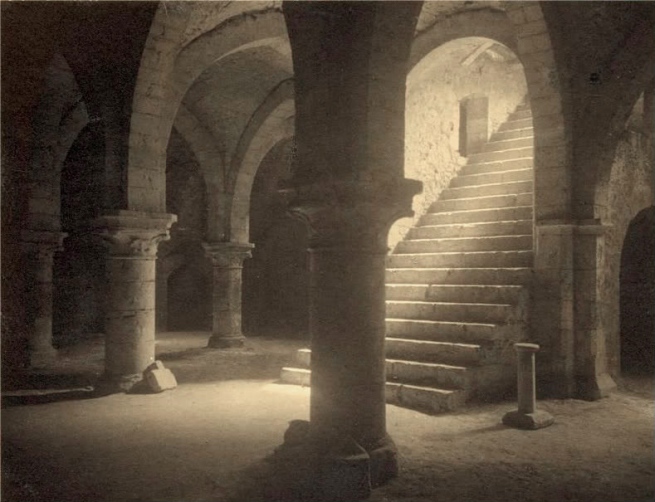
At the Getty Center in Los Angeles a few months ago, I had another quasi-spiritual experience at an exhibit featuring the photographs of British photographer Frederick H. Evans (1853-1943). Evans is best known these days for photographing cathedrals. One look at the image above, and perhaps you can see why: The earthy colors and the light illuminating the space impart a genuine you-are-there feeling, as if you yourself were walking in the church, standing in awe of God’s presence.


Of course, this feeling of spirituality is present in many films as well—even in films you may not expect. Last year, in preparation for Werner Herzog’s The Bad Lieutenant: Port of Call New Orleans, I acquainted myself with Abel Ferrara’s 1992 Bad Lieutenant, and even though I myself am not a Catholic, I nevertheless found myself deeply moved by the unnamed lieutenant’s guilt and anguish—to the point that, when Harvey Keitel melts down in a church towards the end of the film, crying out for a God that he fears is not there, I was on the verge of tears. Never mind whether the Lieutenant deserved to be redeemed for his many crimes; Ferrara, with brute force and gritty artistry, had made one man’s tortured religious fervor immediate and real.

That is just the tip of a huge iceberg. Michelangelo's Sistine Chapel, Mahler’s “Resurrection” Symphony, Dreyer’s The Passion of Joan of Arc (1927)—all of these, and plenty more, are examples of works of art that deal with religious belief in ways that inspired someone even as questioning of religion as I.

And the more I thought about these pieces of film, music and visual art, the more I realized that maybe I do have a religion of sorts: Art is my religion, and maybe it is there that I find something that one could call God’s presence, speaking through these artists. Maybe my brother is right that that kind of feeling of fervor in art is merely “fleeting” compared to the sustained spiritual food provided by churchgoing and living one’s life in a religious manner.

But perhaps that is why I maintain this blog: to crystallize those moments of fervor I feel at the movies, to keep the faith.

Thursday, July 22, 2010

Inside the Mind of a DVD/Blu-ray Collector...Or, At Least, This One

EAST BRUNSWICK, N.J.—


Barnes & Noble currently has a sale going on in which all Criterion Collection DVDs/Blu-rays are selling at a 50% discount, with an additional 10% off in-store purchases for B&N members.

Understand, all you non-cinephile readers of mine: This is a big deal. The Criterion Collection is one of the few home-video outfits in the U.S. committed to bringing the best and brightest of art-house and international cinema, old and new, to DVD/Blu-ray in the highest-quality editions possible, with immaculate digital restorations struck from the best prints available, and with comprehensive supplementary materials to further one's appreciation of a given film. Many consider The Criterion Collection the best in the home-video business, and they've certainly had a lot of practice; the organization first cut their teeth during the laserdisc era from 1984 onward.

Of course, as a result of the attention they lavish on the films to which they acquire distribution rights, their DVDs are priced at a premium; two-disc editions regularly go for an MSRP of $39.99, and sometimes that's the price of even a one-disc edition! Thus, any chance to grab these treasures of the DVD format at reduced prices is welcome.

But 50%, with an extra 10% for B&N members? That's a steal (relatively speaking)!

So yeah, it's a big deal...as well as the source of the possibly unwelcome temptation to do something my mother would surely disapprove: the temptation to splurge. On DVDs.

***

A selection of my personal home-video library

A few weeks ago, my mother was in my bedroom at home while I was sitting in front of my computer (I can't remember why exactly she was there in the first place), and out of nowhere, she blurts out: "I've been meaning to talk to you about this: Do you really need all these DVDs? You have so many DVDs, but do you actually watch them?"

I replied in my usual exasperated manner, "Yeah. They get watched. Believe me. I use them more than once."

Not that that swayed her, of course (though, to be fair, I imagine just leaving it at that probably wouldn't have swayed anyone). She went on along these lines: DVDs aren't good for keeping, they're only good for renting. You watch it once, and then return it. At least, that's what she does. Who needs to keep it forever?

"They get watched," I hopelessly insisted, and my mother then waved her hand, said "Okay" and dropped the matter.

***


Not that she would have understood the reasons behind my impulse to collect movies and TV series on DVD and Blu-ray. But what are some of those reasons? I've been thinking about that in recent days, and here is what I've come up with...for myself, at least:

1) I, for one, enjoy occasionally taking a DVD off my shelf and either re-watching the whole film or just revisiting favorite scenes/sequences. The latter, in fact, is all I did as a younger cinephile in high school with DVDs or VHS dubs of films as varied in quality as the first four Friday the 13th flicks, the Die Hard flicks, Mean Streets (1973) and Pulp Fiction (1994). (Yes, those were some of my personal touchstones back in the day.) Most of the time, I just re-watched to savor. I don't see anything wrong with that; imagine having to go to a local library repeatedly and re-renting a film just to see these favorite scenes more than once! But, of course, there are some movies that are rich enough to yield multiple meanings and angles of interpretation even after the umpteenth viewing.

2) Then, of course, there is all that supplementary material that some DVD packages cram into a two- or three-disc set. Thing is: Unless you are, say, a critic who reviews DVDs as part of his/her day job, who has that much time to devote in a single day to, for instance, watching an entire film again with a DVD commentary track, then wading through multi-part making-of features/featurettes, myriad trailers, critical video essays and the like? (Criterion even goes the extra mile and includes booklets with critical essays and such in their packages—thus giving you great material to read as well as watch.) I once tried to cram in as many of the exhaustive supplements on this older DVD edition of Terminator 2: Judgment Day (1991) as I could in one day...and even after three hours or so, I probably wasn't even close to taking it all in.

Granted, you can certainly have supplementary discs delivered to you through Netflix; that would probably be the cheaper option. But what if you are someone like me and are constantly playing cinephile catch-up with your Netflix queue? Getting those extra discs just delays you from being able to get to that next classic of international cinema that you have been eagerly awaiting for weeks, months, or maybe even years to finally see for yourself. If you fall in love with a film hard enough that you really want to learn all the background there is to know about it, I figure, you might as well bite the bullet and buy the whole DVD package, so it'll be easily accessible when you actually do find time to explore.

3) As someone who every so often feels a great desire to capture a screengrab of a particular film frame in order to better illustrate a certain point or argument in my blog posts, I can't tell you how convenient it is to have that DVD right on my shelf for instant access to that frame. With Netflix or some other rental service, you'd have to wait a few days for the DVD to arrive in order to get that screen capture. I imagine those enterprising film critics dabbling in the critical-video-essay form feel a similar desire to have quick-and-easy access to certain clips.

4) Because I am generally pretty selective about what I decide to purchase for my private home-video collection, I see it as a kind of ever-transforming personal canon, reflective of my belief that the films I have chosen to include in the Kenji Fujishima collection are films that I believe will yield the most pleasure for me in the years to come. They are also films that define me in some way—films that often contain something in them that moves me, intrigues me, and/or makes me look at something in the world in a fresh light. An example: Goodfellas (1990) has a place in my collection because I value the ambivalence Martin Scorsese shows toward the gangster lifestyle he depicts so masterfully: you feel the glamor Henry Hill envies, but you also feel the senselessness of the tragedies it causes. I don't quite feel that same personal attachment to the first two Godfather films, classics though they are; thus, I haven't felt a driving thirst to purchase them in any format.

In the same way I consider my writing on film to be an autobiographical extension of myself, even if a piece isn't explicitly framed in that manner, so it is with the collection of films/TV series I've amassed on home video. You want to get a sense of my personality, my interests, my tastes? Peruse my collection of DVDs and Blu-ray discs. That might say more than I myself could ever tell you.

In fact, even though you aren't in my home, you can peruse that collection right here!

***

Well, those are some of the reasons I can think of for being as much of a DVD/Blu-ray collector as I am (my mother's admittedly reasonable skepticism be damned!). Of course, I don't presume to speak for everyone who makes DVD/Blu-ray collecting a hobby. What makes you decide to buy a film on DVD, even if—or especially if—you've already seen it in a theater? I'm curious.

Comment away!