BROOKLYN, N.Y.—Yes yes, I know, I've been neglecting this blog for about a month and half now. With the combination of my Wall Street Journal day job, my In Review Online editor-in-chief duties, and some unexpected personal stuff (I won't go into much detail about it here except to say that it was basically a sadly short-lived romance), such neglect was bound to happen. Yesterday, though, I was struck by something I saw at work, and I realized that there was no way I was going to be able to articulate my thoughts and feelings about that something in a mere 140 characters on Twitter...so here I am.
This image was on the front page of Friday's Wall Street Journal Asia edition:
Now, I see photos like this pretty often not only in the pages of the Journal, but in many other forms of news media, print, online or otherwise. I suppose you could say I've become somewhat numb to the suffering such photographs portray. And yet somehow, this one hit me a lot harder than I expected when I saw it at work on Thursday.
It wasn't simply the grief inscribed in the woman's crying face that got to me, though. Look at how the photographer seems to have pointed his/her camera lens directly at this woman's face. There's no escaping her heartache; we're forced to stare right back at it and confront it, without any obstructive artiness to distance us from the raw emotion of the moment. As I kept staring at this photograph, I couldn't help but wonder: What was the photographer thinking when taking this shot at this straight-ahead angle. Was the photographer as shaken by this as I was?
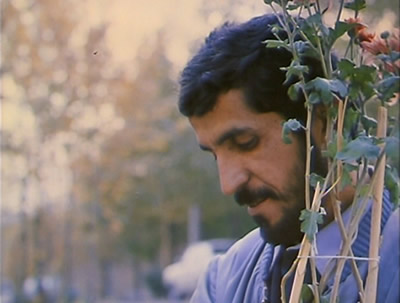
Not that that really matters in the long run; the photographer got the shot, and there you go. But about a week ago, I finally saw Abbas Kiarostami's 1999 film The Wind Will Carry Us at Film Society of Lincoln Center's recent complete retrospective of the great Iranian filmmaker, and couldn't help but think of Behzad Dourani, the photographer at the heart of the film, when contemplating the photograph above. In the film, Behzad is a man so devoted to his craft that he basically camps out in a remote Iranian village waiting for a particular individual to die just so he can snap a few shots of townspeople in the midst of funeral rites. Sounds callous, right? And the Behzad that's presented in the film isn't always easy to read; mostly, we see him coolly observing and reacting rather than emoting. Kiarostami, however, doesn't go for simplistic moralizing; his approach to storytelling and characterization is too patient, elliptical and exploratory for us to pass easy judgment on Behzad. The Wind Will Carry Us gradually reveals itself to be partly a meditation on the distance between an artist and his subject, and as such I couldn't help but think about Behzad as I gazed at that picture above.
At the very end of the film, Behzad—in his car, all by himself, camera in hand—snaps the photographs for which he came in the first place and simply drives away...and Kiarostami refuses to follow him, leaving us to wonder what might be going through his mind as he makes his exit. We've seen Behzad, during the course of the film, make gestures toward developing a kind of affection toward the town and its inhabitants, to the point where he's even desperately summoning townspeople to come help a villager who has fallen into a hole. Does that sense of emotional involvement and human empathy end for some photographers when they wield their cameras and snap their precious shots? Maybe that photograph above is as much implicative of the photographer's gaze as it is of our own.
Showing posts with label Abbas Kiarostami. Show all posts
Saturday, February 23, 2013
Friday, November 04, 2011
Video for the Day: The Sun Setting on Ocean Beach in San Francisco
BROOKLYN, N.Y.—As a result of a couple of leftover writing obligations (one of which I highlighted on this blog yesterday, another which I admittedly have not started yet), I haven't gotten around to sifting through the many photos and videos I took while vacationing in San Francisco last week. So I'm not sure when I'll post something further about the trip here at My Life, at 24 Frames Per Second.
To tide you all over until that happens, though...I posted this video:
Here are two shots I took while a few friends and I were walking along the Ocean Beach shore on Sunday, Oct. 30, as the sun set in the distance.
I don't know if it comes across at all, but I did have in mind Abbas Kiarostami's Five Dedicated to Ozu when I took these shots on my iPhone—particularly its opening shot following a piece of driftwood floating along the shore. To wit:
There are no drifting objects in my shot, though—just waves crashing and water falling back, creating patterns of their own. And, in my recollection (which should be relatively fresh, because I just saw this film recently for the first time—and wrote about it here, by the way), none of Kiarostami's five long takes take place as the sun sets.
So, uh, take that, Abbas Kiarostami! (Your film is still gorgeous, though.)
To tide you all over until that happens, though...I posted this video:
Here are two shots I took while a few friends and I were walking along the Ocean Beach shore on Sunday, Oct. 30, as the sun set in the distance.
I don't know if it comes across at all, but I did have in mind Abbas Kiarostami's Five Dedicated to Ozu when I took these shots on my iPhone—particularly its opening shot following a piece of driftwood floating along the shore. To wit:
![]() |
| Screengrab courtesy of DVDBeaver |
There are no drifting objects in my shot, though—just waves crashing and water falling back, creating patterns of their own. And, in my recollection (which should be relatively fresh, because I just saw this film recently for the first time—and wrote about it here, by the way), none of Kiarostami's five long takes take place as the sun sets.
So, uh, take that, Abbas Kiarostami! (Your film is still gorgeous, though.)
Tuesday, September 27, 2011
From One Filmmaker to Another: Abbas Kiarostami's Five Dedicated to Ozu (2003)
NEW YORK—

Amidst my attempt to balance New York Film Festival coverage for The House Next Door with my day job and even the occasional night out at the movies, this was published recently: a piece I wrote about Abbas Kiarostami's experimental 2003 film Five Dedicated to Ozu as my contribution to the site In Review Online's near-complete retrospective of the legendary Iranian filmmaker. Enjoy, and then by all means, go check out the other articles in this exhaustive series!
Hopefully my New York Film Festival reviews—or, rather, the two I've completed so far—will be going up soon (the festival starts on Friday).
Friday, October 01, 2010
New York Film Festival 2010: Playing Catch-up
BROOKLYN, N.Y.—My apologies, readers; I've gotten so bogged down with New York Film Festival stuff (in addition to a few socializing detours) that I haven't been able to find time to update My Life, at 24 Frames Per Second...until now.
So, as my way of catching up, here are a few links to recent New York Film Festival dispatches published at The House Next Door:
Film Socialism: review here
Aurora: review here
Black Venus and Post Mortem: reviews here
Not included among these links are reviews of my two favorite films of the festival so far, Abbas Kiarostami's Certified Copy and Apichatpong Weerasethakul's Uncle Boonmee Who Can Recall His Past Lives. I caught up with both after I was forced to miss their respective press screenings Tuesday of last week; Kiarostami's film I caught at a smaller press screening on Monday night, Apichatpong's at its public screening on Saturday.
That was a fun experience, by the way, watching Uncle Boonmee at that public screening. First of all, I was able to score $10 rush tickets, half the price of a regular-admission ticket; even better, I got a seat all the way in the first row of the Alice Tully Hall auditorium! (Some people don't like sitting all the way in the front, but generally I don't mind; in this case, it allowed me to be better able to completely immerse myself in Apichatpong's wondrously surreal imagery and bask in its amazingly evocative sound design. I felt like I was staring up at an IMAX movie in complete awe.) And secondly: Apichatpong was there to discuss the film with film critic Melissa Anderson. I was so enthralled by the experience that, after the Q&A was over, I went up to him on the stage and asked for an autograph.
He obliged! Thus...
Maybe someday this will become very valuable? (I would have taken a photograph of him, but I didn't have my camera on me, and the camera on my cellphone doesn't seem to have the ability to turn off the flash.)
Anyway, I hope to write about both Uncle Boonmee and especially Certified Copy—an intellectually dense yet deeply moving achievement—in the near future. (Those two, Manoel de Oliveira's The Strange Case of Angelica and Olivier Assayas's Carlos would probably constitute the highlights of my festival experience so far.) In the meantime: Tonight I will finally be introducing myself to the work of avant-garde filmmaker James Benning through his latest work, Ruhr, playing in a program of its own at the festival's Views from the Avant-Garde series going on throughout this weekend. It's about time I delved more deeply into experimental cinema, methinks!
Labels:
Abbas Kiarostami,
Abdellatif Kechiche,
anecdotes from my life,
Apichatpong Weerasethakul,
Cristi Puiu,
films seen in theaters,
James Benning,
Jean-Luc Godard,
Manoel de Oliveira,
New York Film Festival 2010,
Olivier Assayas,
Pablo Larraín,
self-promotion,
The House Next Door
Thursday, April 01, 2010
Spring Awakenings
EAST BRUNSWICK, N.J.—I have just returned from a day in New York—much of it spent taking in a scintillating double bill at both New York's IFC Center and Film Forum, but some of it spent walking around in the glorious sunshine. And thankfully, today I had my Canon PowerShot SD400 with me to take a couple of snaps of the day's beautiful weather.
If you needed any more proof that spring is indeed finally here...well, here you go (both of these taken while walking up 6th Avenue in Greenwich Village):
I could have basked in this weather all day long. But alas, I have boring practical things I had to take care of at home—like, say, filing those pesky 2009 tax returns...
That scintillating double bill, by the way, included Catherine Breillat's latest film Bluebeard and Abbas Kiarostami's 1990 film Close-Up, the latter in a new 35mm restored print. Both films, by the way, are excellent. Breillat's film takes the famous story of the wealthy aristocrat with a blue beard and a murderous past and dissects—with her usual cool precision, intelligent provocation and atmospheric sense of danger—the emotional and sexual complexities underlying not only this fairytale, but perhaps of all the fairytales we hear as children but whose real-world implications we can never fully grasp until we are older and more mature. (Its final image is particularly stunning: gruesome and chock full of devastating implications.)
It's the Kiarostami I'm especially dazzled by, however (for one thing, it's a far warmer picture than the Breillat, though that's hardly meant as a criticism of Bluebeard). Believe it or not, this is the first film by the famous Iranian auteur I've seen, and I'm still reeling from its incredibly dense interplay between fiction and reality, its humanism and its sheer love of cinema. Inspired by an actual incident of a poor man entering into the lives of a well-to-do family by pretending to be Iranian filmmaker Mohsen Makhmalbaf, Kiarostami—who appears as himself in this film—uses documentary techniques to explore the circumstances behind this ruse, using many of the real people involved and even filming the man's trial. What he uncovers is utterly fascinating and, in the end, deeply moving; turns out, the man was fueled by a passion for Makhmalbaf's films, which he says spoke to him in deeply personal ways few other artists have been able to articulate for him. Who knew that, 18 years before Juliette Binoche confided to Fang Song in Hou Hsiao-hsien's Flight of the Red Balloon that her film "touche[d] on very deep things I thought I'd forgotten," that Abbas Kiarostami had already made a feature-length ode to the power of cinema to touch on recognizable human memories and emotions? And yes, by its beautiful conclusion, Close-Up turns out be nearly as wondrous and inspirational as that Hou film. (This is the last day of its run at New York's Film Forum, but the Criterion Collection is scheduled to release a two-DVD set of the film on June 22. It's very much worth the investment!)
If you needed any more proof that spring is indeed finally here...well, here you go (both of these taken while walking up 6th Avenue in Greenwich Village):
I could have basked in this weather all day long. But alas, I have boring practical things I had to take care of at home—like, say, filing those pesky 2009 tax returns...
***
That scintillating double bill, by the way, included Catherine Breillat's latest film Bluebeard and Abbas Kiarostami's 1990 film Close-Up, the latter in a new 35mm restored print. Both films, by the way, are excellent. Breillat's film takes the famous story of the wealthy aristocrat with a blue beard and a murderous past and dissects—with her usual cool precision, intelligent provocation and atmospheric sense of danger—the emotional and sexual complexities underlying not only this fairytale, but perhaps of all the fairytales we hear as children but whose real-world implications we can never fully grasp until we are older and more mature. (Its final image is particularly stunning: gruesome and chock full of devastating implications.)
It's the Kiarostami I'm especially dazzled by, however (for one thing, it's a far warmer picture than the Breillat, though that's hardly meant as a criticism of Bluebeard). Believe it or not, this is the first film by the famous Iranian auteur I've seen, and I'm still reeling from its incredibly dense interplay between fiction and reality, its humanism and its sheer love of cinema. Inspired by an actual incident of a poor man entering into the lives of a well-to-do family by pretending to be Iranian filmmaker Mohsen Makhmalbaf, Kiarostami—who appears as himself in this film—uses documentary techniques to explore the circumstances behind this ruse, using many of the real people involved and even filming the man's trial. What he uncovers is utterly fascinating and, in the end, deeply moving; turns out, the man was fueled by a passion for Makhmalbaf's films, which he says spoke to him in deeply personal ways few other artists have been able to articulate for him. Who knew that, 18 years before Juliette Binoche confided to Fang Song in Hou Hsiao-hsien's Flight of the Red Balloon that her film "touche[d] on very deep things I thought I'd forgotten," that Abbas Kiarostami had already made a feature-length ode to the power of cinema to touch on recognizable human memories and emotions? And yes, by its beautiful conclusion, Close-Up turns out be nearly as wondrous and inspirational as that Hou film. (This is the last day of its run at New York's Film Forum, but the Criterion Collection is scheduled to release a two-DVD set of the film on June 22. It's very much worth the investment!)
***
But wait a minute, some of you might be wondering: Aren't you supposed to be working today? In fact, thanks to the Asia and Europe editions of The Wall Street Journal not publishing on Friday and Monday, I have Thursday and Sunday off. Four-day weekend, woo-hoo!
Thus, I am planning on doing a lot of cinephile catch-up this weekend, taking in a wide variety of films ranging from the new 35mm print of F.W. Murnau's Sunrise (1927) at Film Forum, to as-yet-unseen new releases like Bong Joon-ho's Mother and Marco Bellocchio's Vincere. We'll see what else I can fit in, while trying to do something outdoorsy in between it all. (Weather.com forecasts sunshine and 70°-range temperatures—a real "beaut," as former New York mayor Fiorello LaGuardia might have said).
Spring is in the air, and its really getting me high right now. Also, I don't know the last time I've actually felt this excited about a four-day weekend. Maybe all the way back in high school...?
***
And finally: There are no April Fools' jokes in this post. Because I don't believe in that shit.
Subscribe to:
Posts (Atom)