Tuesday, November 15, 2011

Artistic Consumption Log, Nov. 7, 2011 - Nov. 13, 2011

NEW YORK—Forgive my lateness with this, readers.

That's all I'll give you all by way of introduction. Onwards and upwards!

Last Life in the Universe (2003)

Films

DOC NYC 2011, all films seen at IFC Center in New York:
★ Minka (2011, Davina Pardo)
★ The Tsunami and the Cherry Blossom (2011, Lucy Walker)
★ The Interrupters (2011, Steve James)
I wrote about the first two short films for The House Next Door; here's the link. As for The Interrupters...well, believe the hype: This is as inspiring as true-life stories get, without sugarcoating. Steve James—inspired by an article written by Alex Kotlowitz (who gets a co-directing credit) that was published in The New York Times Magazine—stays enough out of the way of the four main "interrupters" he documents to allow us to draw our own conclusions as to how much they are succeeding in their attempts to prevent violence in an inner-city Chicago neighborhood; still, it's hard to deny the heroic nature of their efforts, and this film is a worthy tribute to them.

★ Dead Birds (1965, Robert Gardner), seen at Film Forum in New York
I had never heard of Robert Gardner before hearing about Film Forum's ongoing week-long retrospective of his work, but since I had been on something of a documentary kick before then, I decided to take a chance on this one film of his, at least.

Based on what I've read about him in addition to this one feature documentary of his, Gardner is a documentary filmmaker with a strong ethnographic bent; to wit, Dead Birds is an engrossing, unsparing look at a tribe in New Guinea that seems to exist out of time: a Stone Age group of people with their own customs and traditions, especially regarding war. By itself, that sounds like a reasonably interesting subject for a documentary feature; Dead Birds, however, is enhanced by a voiceover narration that occasionally verges on the poetic (or at least, poetic enough to get me to wonder whether Gardner actually spoke to these tribespeople—there are no talking-heads interview scenes in this—or whether all of his psychologizing is merely speculative). I wouldn't necessarily call this a "humanist" film in the usual sense; it's too anthropological in its approach. But, whether Gardner intended this or not, one could see Dead Birds as a disturbing reminder of how far humanity has come as a species, and perhaps even how much of the Stone Age we may still have in all of us, deep down. (I mean, we still engage in warfare after all, do we not?)

On a tangentially related note, Dead Birds seems like the kind of documentary that Ruggero Deodato tried to evoke in Cannibal Holocaust. Also, like Cannibal Holocaust, it shows graphic, un-simulated animal slaughter onscreen. No turtles get killed and mutilated, but pigs do get slaughtered, gutted and cooked. Warning: Animals were definitely harmed during the making of this film.

★ J. Edgar (2011, Clint Eastwood), seen at Regal Union Square Stadium 14 in New York
This film isn't as bad as some of its advance press might have led you to believe. Yes, some of the acting is uneven (some of the real-life supporting characters—like Jeffrey Donovan's Robert Kennedy and Dermot Mulroney's Richard Nixon—are played like risible caricatures for no reason I could determine), and some of the aging make-up effects are dreadful (the old Clyde Tolson especially looks ghoulishly wooden Indian-like in his make-up). But Eastwood is working with a worthy screenplay from Milk scribe Dustin Lance Black that is as multifaceted in its far-from-reverent take on Hoover as it is structurally ambitious in the way it weaves its way between past and present, truths and half-truths. Leonardo DiCaprio at first seems like he's giving a bad performance, especially with that blatantly fake-sounding accent...but then, look at the way he plays off so effortlessly against Armie Hammer's Clyde Tolson, and one starts to wonder if DiCaprio isn't being bad elsewhere on purpose—mirroring a character who lived much of his life giving a performance for the public eye in the service of the federal organization he created and continued to hold dear until his last days. I'm not sure this film will necessary bring Eastwood skeptics back into his good graces (all of his trademarks as a director are here, for better and for worse, especially his damned penchant for washed-out colors, courtesy of cinematographer Tom Stern), but it's an interesting film in unexpected ways.

★ Last Life in the Universe (2003, Pen-ek Ratanaruang), seen at Museum of Modern Art in New York [third viewing]
Apparently the Region 1 DVD of this film I've been watching all these years has featured a sped-up PAL transfer and I didn't know it!

PAL, for those of you who aren't, like, home-video nerds, refers to one of three different analogue television systems that exist in the world, the others being NTSC and SECAM. One of the major differences between all three systems has to do with video frame rates; PAL televisions operate at 25 frames per second, while NTSC TVs play 30 frames/second video. (Most U.S. televisions are NTSC, for instance; most European televisions are PAL.) Since most films are shot at 24 frames per second, for their eventual home-video releases they have to be converted to run at the appropriate frame rate—and for the DVD format, at least, there is no way to make video transfers compatible for both NTSC and PAL formats at the same time. In the case of transfers for the PAL system, though—well, unlike with NTSC, where there is a way to transfer a 24-frames-per-second film to 30 without having to speed up the film's frame rate, there is apparently no way to transfers a 24fps film to 25 without speeding up the whole film, not only making the film play with a shorter running time, but also speeding up the soundtrack so that its pitch throughout is a semitone sharp. Most people, I suspect, won't notice that sharp pitch...but I have perfect pitch, so I do notice such things, and it can potentially distract me from the film itself if I'm aware that I'm not watching it at its correct pitch.

Or, at least, I though I had perfect pitch...but maybe not? I usually pride myself at being able to pick up, just by looking at a DVD image or listening to a soundtrack, whether it has undergone that "PAL speed-up." So consider me surprised when I sat down to watch Last Life in the Universe at Museum of Modern Art and began to realize that everything sounded slightly flat pitch-wise compared with what I was used to watching on the Palm Pictures DVD I own. This realization only made me treasure the experience of seeing Pen-ek Ratanaruang's film in a theater even more—because I was finally seeing it pure, without any digital-transfer tinkering.

I don't expect most of you to care about anything I just said; I'm just explaining to you all why I enjoyed seeing Last Life in the Universe for the first time theatrically as much as I did. It doesn't hurt that I love this film—a gloriously dreamy meditation on embracing the messiness of life—so much that, on most days, yes, I probably would consider it among my top five favorites of all time. (I elaborate briefly on why I adore this film so much in this old, old House Next Door post.)

Music

★ Shostakovich: Symphony No. 10 (1982, Herbert von Karajan/Berlin Philharmonic) [second listen]
Two Saturdays ago, while wandering aimlessly in Greenwich Village, I encountered a street fair that included a lot of vendors selling different goods. A handful of them were record vendors selling LPs, CDs and DVDs. At one of them, I encountered a copy of the original CD release of this 1982 recording of Dmitri Shostakovich's Tenth Symphony featuring the Berlin Philharmonic led by the legendary Austrian maestro Herbert von Karajan. It was only $5, so I decided to buy it.

I hadn't heard this performance in years, and barely remembered it save for the orchestra's awesome virtuosity in dispatching its demonic second movement, a whirlwind scherzo that, according to the composer in his memoir Testimony, was meant to be a portrait of Stalin. So it was good to reacquaint myself with this recording, which turns out to have other pleasures and insights to offer in this, his first symphony after he was denounced for a second time by the Soviet government in 1948.

Shostakovich (1906-75) spent much of his career struggling to find a balance between expressing his private pains and publicly toeing the party line, so to speak; this led him to compose just as many works of empty Communist rhetoric (hear, for instance, his notoriously bombastic Twelfth Symphony, as close to musical Soviet poster art as any composer ever got) as he did deeply, sometimes mystifyingly personal works of musical and emotional substance. His Tenth Symphony is considered one of the latter, however, and in this 1982 recording it found a surprisingly sympathetic interpreter in Karajan, who captures the full measure of its tragic pathos and wounding ironies. The third and fourth movements of the Tenth features a four-note motif that Shostakovich considered his own "musical signature"; the aural spectacle of hearing that four-note signature triumphantly, demonically tap-dancing on Stalin's grave at the exhilarating end of this symphony is worth waiting for.

★ Vespertine (2001, Björk)
★ Medúlla (2004, Björk)
With its gorgeous toy-chest sonorities and fairy-tale lyricism, Vespertine is probably my favorite Björk album so far. Medúlla is a far more earth-bound achievement compared to it; an experiment in a cappella music-making with a certain measure of electronic manipulation, it's less immediately appealing but still fresh and interesting.

Theater

★ Satyagraha (1980, Philip Glass/Constance de Jong), seen at Metropolitan Opera House in New York
Yes, I paid a fortune to see this, a revival of a celebrated Metropolitan Opera production of Philip Glass's 1980 opera from a couple of years ago...but it was totally worth it.

Glass's famously minimalist musical style is by now perhaps too familiar: rippling patterns repeated almost endlessly with minor variations that, in the right frame of mind, could induce a genuinely hypnotic state in a listener. You might not think that such a style might work all that well in an operatic work like this one...but Satyagraha is no ordinary opera. It isn't so much a drama as it is an abstract meditation on political and philosophical themes, taking Mohandas Gandhi's development of his philosophy of nonviolence as its starting point. The brilliance of Glass's Satyagraha score is that it has just enough variety and lyricism in its patterns and repetitions to be stimulating on a "conventional" musical level, but is also nondescript enough to allow both a listener enough room to intellectual contemplation, and a stage director enough creative wiggle room to illustrate the content with all the imagination he/she can muster. So it proved in this production, where the music was sometimes secondary to director Phelim McDermott's thrillingly imaginative stage effects—newspapers that formed into objects/characters, rear projected text translations (Constance de Jong's libretto is in Sanskrit, based on the Bhagavad Gita), and so on. Satyagraha, in other words, is a complete theatrical experience, the kind of Gesamtkunstwerk Richard Wagner held as an ideal for his operas—and frankly, after seeing it, I wonder whether a standalone audio recording would be half as effective without the visual component to go along with it.

The only possible "flaw" in Satyagraha is a third act—depicting the 1913 New Castle March, in which Gandhi, along with his Satyagraha army, encouraged striking miners to march all of 36 miles to the Transvaal border to protest racially discriminatory laws in India—that rather drags. But even then, there's a purpose to the slower pace: I, for one, gradually began to feel something not only the full extent of the long journey traversed, but also the full weight of their struggle. And the sense of heroic catharsis that greets you as it reaches its concluding "Evening Song" makes it all worth the time it takes to get there.

Literature

★ Boroughs of the Dead (2011, Andrea Janes)
A friend of mine wrote this self-published collection of 10 short horror stories set in an around New York City in both past and present times, so I can't say I read this as a completely unbiased party. So all I'll say here is that, while not all the stories are equally great, generally I enjoyed this breezy and varied collection, and that its final story closes out the slim volume on a deliciously perverse note.

Friday, November 11, 2011

Video for the Day: A Lovely Saturday Afternoon in New York's Columbus Park

BROOKLYN, N.Y.—This past Saturday, I was wandering around in Chinatown (the Manhattan one) with a friend, and we both wandered into Columbus Park. I had never been to this park before; in fact, I don't I had ever even heard of Columbus Park before that day.

But, what with the elderly Asian men playing chess, others doing tai chi, still others singing and playing instruments, and most of them speaking Chinese of some sort...well, the hardcore Asian in me was satisfied—so satisfied that, of course, I took out my iPhone and took some video.

Finally, last night, I edited that video into this form and posted it on YouTube, naturally:


Side note: With all the videos I've been shooting and posting recently, I'm starting to wonder whether I should consider documentary filmmaking in the future, or something along those lines...

Wednesday, November 09, 2011

DOC NYC 2011: Two Short Films About Japan

NEW YORK—The Kenji Fujishima review-writing train merrily rolls along (for now, at least).

Yoshihiro Takishita, from Minka

On Monday night, as part of the ongoing DOC NYC festival, I decided to check out a program of two short documentaries set in Japan, both made by non-Japanese filmmakers. One of them, Minka, is about the intersection of history and architecture; the other, The Tsunami and the Cherry Blossom, is about cultural symbols and the ways in which many Japanese are projecting feelings of both resignation and hope in the cherry blossom now more than ever in the wake of the devastating earthquake and tsunami in March. Both are good, but both also show the benefits and limits of perceiving a culture from an outsider's perspective. All of this I elucidate in my latest House Next Door review.

The Tsunami and the Cherry Blossom, by the way, is on the shortlist for a Best Documentary Short Subject Oscar nomination...so you may be hearing more about Lucy Walker's film in the near future (a future, it appears, that will not include Brett Ratner as Oscar producer and Eddie Murphy as Oscar host, for those who care about such things).

Monday, November 07, 2011

Congratulations to all the New York City Marathon Runners!

NEW YORK—I shot more video and posted it for all to see on YouTube!


Yesterday's New York City Marathon was the first I got to see up close and personal...so naturally, I decided to commemorate this personal landmark by capturing some of it on video.

It was actually rather inspiring to be part of the crowd, cheering on these millions of runners. Hell, it was so infectious that I even got into the running spirit, however briefly (I ran a few blocks from the Atlantic Avenue MTA station in Brooklyn down 4th Avenue to around Satter Street in Brooklyn in order to try to meet up with a couple of friends and spot another friend of mine actually running the marathon; then I ran back up to the Atlantic Avenue station in order to try to rush to work).

Amidst the cheering, I briefly flirted with the idea of maybe running this marathon one of these years. We'll see if that ever becomes a reality...

In any case, congratulations to all the intrepid people who ran, and successfully finished, the marathon yesterday. You all are more awesome than I will probably ever be!

Artistic Consumption Log, Oct. 31, 2011 - Nov. 6, 2011: Shifting Priorities(?) Edition

BROOKLYN, N.Y.—An anecdote, to start this log.

At around 5 p.m. on Saturday, I was sitting on a bench across from Lincoln Center, waiting around for a 6:15 p.m. screening of Robert Altman's California Split, a film I had never seen before. Suddenly, I received a text message from a friend of mine who had recently passed the New York bar exam and had planned on celebrating that evening; she informed me in her text that she and her friends had decided, as part of the celebration, to skate at the ice rink in Bryant Park. After maybe a minute of deliberation, I decided to do something I rarely do when it comes to films: I decided to forgo the movie and go join them. (Sorry, Bob.) My decision was influenced in part by the fact that one of my roommates has a copy of the out-of-print DVD of the film—albeit a DVD that is apparently missing about three minutes of footage that had to be cut as a result of music-rights issues. Apparently, the possibility of seeing a print of the film that would be considerably closer than its home-video counterpart to Altman's original vision wasn't quite enough to stave off the lure of socializing.

I recount this little anecdote to suggest the way I've been feeling about my usually rabid moviegoing habits since coming back from San Francisco: I haven't felt quite the same drive to see a film theatrically here in New York virtually every day, the way I was doing throughout, say, this past summer. Have I started to burn out on moviegoing in general? I don't think so, but...let me put it this way: I ended up seeing only one film, theatrically or otherwise, all weekend, and for once I was totally okay with that.

Where are my priorities, man???

Anyway...a side note: A friend of mine recently curated this pop-up art exhibit that went up at a space in the Meatpacking District last week; I omitted it from the log below only because, while I did get to see most of the show, I arrived at the tail end of its closing reception and ended up having my experience cruelly cut short when someone began shutting down the exhibit while I was being mesmerized by a video of one of the artists—a female, mind you—standing around in the nude and more or less melting an entire ice sculpture on her back (it was supposed to be a representation of the anxiety she felt when, a few years ago, she almost killed someone). So I feel like I didn't get as complete an experience as I would have liked. From what I saw, though, it was a pretty interesting exhibit all in all (that video, by an artist named Danielle Riechers, was probably my favorite part of it).

Onto the log!

The Heartbreak Kid (1972)

Films

★ Richard Pryor: Live in Concert (1979, Jeff Margolis), seen at Anthology Film Archives in New York
Before seeing this (in a pink-ish but watchable 35mm print on Thursday night), I had only seen this legendary comedian in a handful of his film roles; I had never seen his stand-up. After seeing this famous filmed performance...well, I can certainly see why he was considered one of the, if not the, best, in the business. This is stand-up comedy as performance art—and I use the word "art" in the highest sense: the kind of art that has the power to illuminate aspects of the human condition. Seriously. In Richard Pryor: Live in Concert, Pryor riffs on everything from parenting to boxing with Muhammad Ali to sex, and he often does so by inhabiting various objects, animals, and even at one point a heart attack; if his ability to go physically and emotionally naked in this way isn't a sign of true artistry, I don't know what is. Most importantly, though, all of his material seems to come from a deeply, and sometimes darkly, personal place. Pryor's delivery is what makes his observations funny, but some of the observations themselves have the power to stick in your throat even as you're laughing maniacally. And make no mistake: Richard Pryor: Live in Concert is truly hilarious stuff all around.

★ The Heartbreak Kid (1972, Elaine May), seen at Walter Reade Theater in New York
Here's another comedy that is filled to the gills with the kind of hilarity that carries an undertone of discomfiting seriousness to it. The perpetually underrated Elaine May's subject here is, to put it simply, the male ego, finding its embodiment in Lenny Cantrow (Charles Grodin), a handsome, callow guy who rushes into a marriage with Lila (Jeannie Berlin, May's daughter, who I also saw just a few weeks ago giving a great performance in Kenneth Lonergan's Margaret) only to find himself dissatisfied with her as a partner; he then meets blonde dream-girl Kelly (Cybill Shepherd) and immediately decides she, rather than Lila, is the one. Through all his machinations to try to win both Kelly and her protective father (Eddie Albert) over, as well as his attempts to break off his marriage with Lila, May observes with a detached but not wholly unsympathetic eye, twisting Lenny's vacuous "determination" for a wealth of cutting character comedy, all the way to a final shot that arguably says more about the limits of American ambition in one facial expression than Paul Thomas Anderson did with that hysterical 10-minute bowling-alley epilogue in There Will Be Blood.

Music

★ Ravel: Orchestral Works (1975, Orchestre de Paris/Jean Martinon)
I've been on something of a Maurice Ravel kick recently...and no, it has nothing to do with Boléro, that perennially popular bonbon which was featured in two films I saw recently (Blake Edwards's 10 and Sion Sono's Love Exposure). Actually, Ravel's Le Tombeau de Couperin—a short solo-piano suite that may or may not have anything to do with French Baroque composer François Couperin, and of which four of its six movements were later orchestrated—suddenly popped into my head one day and marinated there until I was finally driven to download this two-disc collection of Ravel performances from a conductor known mostly for his performances of French classical music. Overall, it's a fine set. The orchestral playing isn't always top-flight (the brass sometimes sounds more recessed than usual, though maybe that's more the result of the recording venue than the playing), but it's always spirited and characterful; and Martinon's interpretations are generally marked by a vivid sense of play and imagination (especially necessary qualities for something like Ravel's Ma mère l'Oye).

Ravel—a 20th-century musical impressionist along with his compatriot Claude Debussy—wrote a lot of gorgeous music. If all you know of his work is the aforementioned Boléro, then you all are missing out on some seriously beautiful stuff.

★ Bossanova (1990, Pixies) [third listen]
★ Car Wheels on a Gravel Road (1998, Lucinda Williams) [second listen]
I visited San Francisco's Amoeba Music record store while I was out in the Bay Area visiting about two weeks ago (has it really been that long?) and decided to pick up these two albums on CD; hey, they were cheap, and I didn't care that they were used copies. Because I had the CDs on hand, I listened through both of them, in succession, on Monday night while unpacking my suitcase. I played them more as background music than anything else, though, so my listing them on this log is more for the sake of completeness than out of anything new I can say about them: Bossanova is still my favorite Pixies album (though this time around, I found it a bit less consistent than I remembered it to be), and Car Wheels on a Gravel Road is still Williams's finest collection of songs.

★ Post (1995, Björk)
★ Homogenic (1997, Björk)
As I expected, Björk gets a bit bolder with her experimentation in her second solo album Post; it's the kind of album that isn't afraid to juxtapose techno beats and trip-hop atmospherics with, say, a big-band jazz number ("It's Oh So Quiet"). Neither Debut nor Post, though, could quite prepare me for Homogenic, which goes deeper and darker with its electronic sonorities, and features the Icelandic pop princess sounding positively angry in some of these cuts, sporting a snarl that is an embodiment of "Hell hath no fury like a woman scorned." I'm impressed more than moved, to be honest, but I found it still intriguing enough to soldier on in exploring Björk's discography.

Literature

★ Miss Lonelyhearts (1933, Nathanael West)
Based on this and The Day of the Locust, West is a writer with a style that will take some getting used to if you go into his works expecting "realism." West isn't afraid to blow up realistically grounded scenarios into something near-mythic in scale; thus the apocalyptic finish of The Day of the Locust, though that certainly didn't come out of nowhere. Miss Lonelyhearts likewise becomes much more than the story of the titular newspaper advice columnist's internal struggle of trying to maintain optimism amidst extreme disillusionment; that internal struggle eventually acquires grand religious overtones, as if Miss Lonelyhearts was trying to move Heaven and Earth to hold onto his belief in the goodness of people and of life. It's also often bitterly funny and ironic, which is partly why West is able to get away with his deliberate overscaling. How much of it is meant to be taken seriously? Maybe some of it. Maybe none of it. The fact that we can't always tell is part of what makes West's novella such a fascinating read. 

★ Howl and Other Poems (1956, Allen Ginsberg)
Yes, I bought a copy of this book at the historic City Lights Bookstore in San Francisco, if nothing else just to say that I bought the famously controversial volume from that actual bookstore. Then I read the poetry. All I can say is: Holy shit. Loads of magnificently boundary-pushing surrealistic imagery tied to a painfully personal vision, but not without a redeeming sense of humanity and even a kind of rough spirituality underpinning it all. Howl is pretty magnificent, but the rest are hardly also-rans ("Sunflower Sutra" is another one that I found particularly memorable).

Another realization: I need to read more poetry! I'm open to suggestions for a poet whose work I should read next.

Friday, November 04, 2011

Video for the Day: The Sun Setting on Ocean Beach in San Francisco

BROOKLYN, N.Y.—As a result of a couple of leftover writing obligations (one of which I highlighted on this blog yesterday, another which I admittedly have not started yet), I haven't gotten around to sifting through the many photos and videos I took while vacationing in San Francisco last week. So I'm not sure when I'll post something further about the trip here at My Life, at 24 Frames Per Second.

To tide you all over until that happens, though...I posted this video:


Here are two shots I took while a few friends and I were walking along the Ocean Beach shore on Sunday, Oct. 30, as the sun set in the distance.

I don't know if it comes across at all, but I did have in mind Abbas Kiarostami's Five Dedicated to Ozu when I took these shots on my iPhone—particularly its opening shot following a piece of driftwood floating along the shore. To wit:

Screengrab courtesy of DVDBeaver

There are no drifting objects in my shot, though—just waves crashing and water falling back, creating patterns of their own. And, in my recollection (which should be relatively fresh, because I just saw this film recently for the first time—and wrote about it here, by the way), none of Kiarostami's five long takes take place as the sun sets.

So, uh, take that, Abbas Kiarostami! (Your film is still gorgeous, though.)

Thursday, November 03, 2011

DOC NYC 2011: Undefeated and Kumaré

NEW YORK—I've recently written things! Things that actually got published somewhere!


My latest published (dual) review, for The House Next Door, are of Undefeated and Kumaré, two documentaries screening as part of the ongoing DOC NYC festival (of which you can find details here), a veritable explosion of old and new documentary cinema that started last night and runs until Nov. 10. Though I'm not unreservedly positive on either film, the latter—an account of Borat-style satirical stunt that, from what I can see, ends up blowing up in filmmaker Vikram Gandhi's face in provocative ways—is considerably more interesting than the former, yet another sports-underdog tale in the mold of Hoop Dreams that contains few narrative surprises and even fewer genuine revelations.

Whether this heralds a new explosion of film-critic creativity on my end remains to be seen. But for now...enjoy!

Monday, October 31, 2011

Artistic Consumption Log, Oct. 24, 2011 - Oct. 30, 2011: Bay Area Edition

SAN FRANCISCO—By the time you all read this, I will most likely be on my way to San Francisco International Airport to fly back to New York after a wonderful week here in the Bay Area!

Because I've been trying to keep busy sightseeing, meeting up with friends and all that, I wasn't able to find much time to give last week's artistic consumption log my usual annotations. So once again, here's a barebones accounting of what I consumed artistically this week. As you can imagine, it's a rather, um, lean list...but a good one, for the most part.

The legendary Castro Theatre in San Francisco

Films

★ A Face in the Crowd (1957, Elia Kazan), seen at Stanford Theatre in Palo Alto, Calif.

★ Black Narcissus (1947, Michael Powell & Emeric Pressburger), seen at Castro Theatre in San Francisco [third viewing]
★ The Red Shoes (1948, Michael Powell & Emeric Pressburger), seen at Castro Theatre in San Francisco [second viewing]

Music

Audium 9 (2008, Stan Shaff), experienced at Audium in San Francisco

Literature

★ Goodbye Cinema, Hello Cinephilia: Film Culture in Transition (2010, Jonathan Rosenbaum)

Friday, October 28, 2011

San Francisco! Days 2 and 3, in Photos

SAN FRANCISCO—

Oh hey, it's Sun Yat-sen!

More Vertigo-related sightseeing! Here are the Brockleback Apartments, where Scottie Ferguson begins tailing Madeleine Elster early on in the film.

On Wednesday, I took a Caltrain down to Palo Alto, Calif., to not only meet up (or, more accurately, "tweet up") with friends/acquaintances, but to visit the lovely Stanford Theatre to see Elia Kazan's A Face in the Crowd for the first time. The company was marvelous, the film even more so.

On Jack Kerouac Alley, one of many alleyways in the Chinatown/North Beach part of San Francisco that has a rich history. Once I passed through that alley, I turned left on Columbus Ave. and encountered...

...this famous bookstore, known as the beating heart of the Beat Movement. It is there that I picked up...

Yeah, I couldn't resist picking up a copy of Allen Ginsberg's famously controversial poem Howl in San Francisco? Fitting, right? I actually read the first section of it, and already find its imagery thrillingly urgent, impassioned and devastating (no, I had never read it before). I read it, by the way, at...

...the Caffe Trieste, which, according to the Lonely Planet guidebook I've been consulting, is where Francis Ford Coppola drafted his screenplay for The Godfather.

This is the Coit Tower, located in Telegraph Hill, and named after its benefactor, Lille Hitchcock Coit (1843-1929), who was apparently a female firefighter back in the day. The top of this building is where I captured...

...this view of the Bay Area.

Fitting to find a memorial erected to Guglielmo Marconi, the inventor of radio, in Telegraph Hill.

This shot was taken in Russian Hill, which took yet another hike to climb. (All these hills in San Francisco sure giving me some exercise even on vacation!) I believe that's Alcatraz in the distance, right? I was considering visiting, but may not have the time. We shall see.

The Dragon Gate—which I guess I considered the entrance into Chinatown. (Taiwan, also according to Lonely Planet, was donated this structure in 1970.)

Covering all the bases: state, country and city, from left to right.

Wednesday, October 26, 2011

Greetings from San Francisco!

SAN FRANCISCO—I suspect posting will be sparse in the coming week as I try to relax here in the Bay Area, but I'll try to keep you all up to date a bit on my adventures here on this blog through photo-driven posts like this one. (And if you can't get enough of these posts...well, there's my Twitter feed, of course.)

Here is a taste of the places I visited yesterday, my first full day in San Francisco:

Clarion Alley, one of many alleys in the Mission district housing all sorts of amazing pieces of street art

The Mission Dolores chapel. Vertigo fans—of which I am most certainly one—might find this a familiar sight...

Is Carlotta Valdes's grave anywhere here? (Another Vertigo reference, for those who didn't get that; this is the cemetery in the Mission Dolores.)

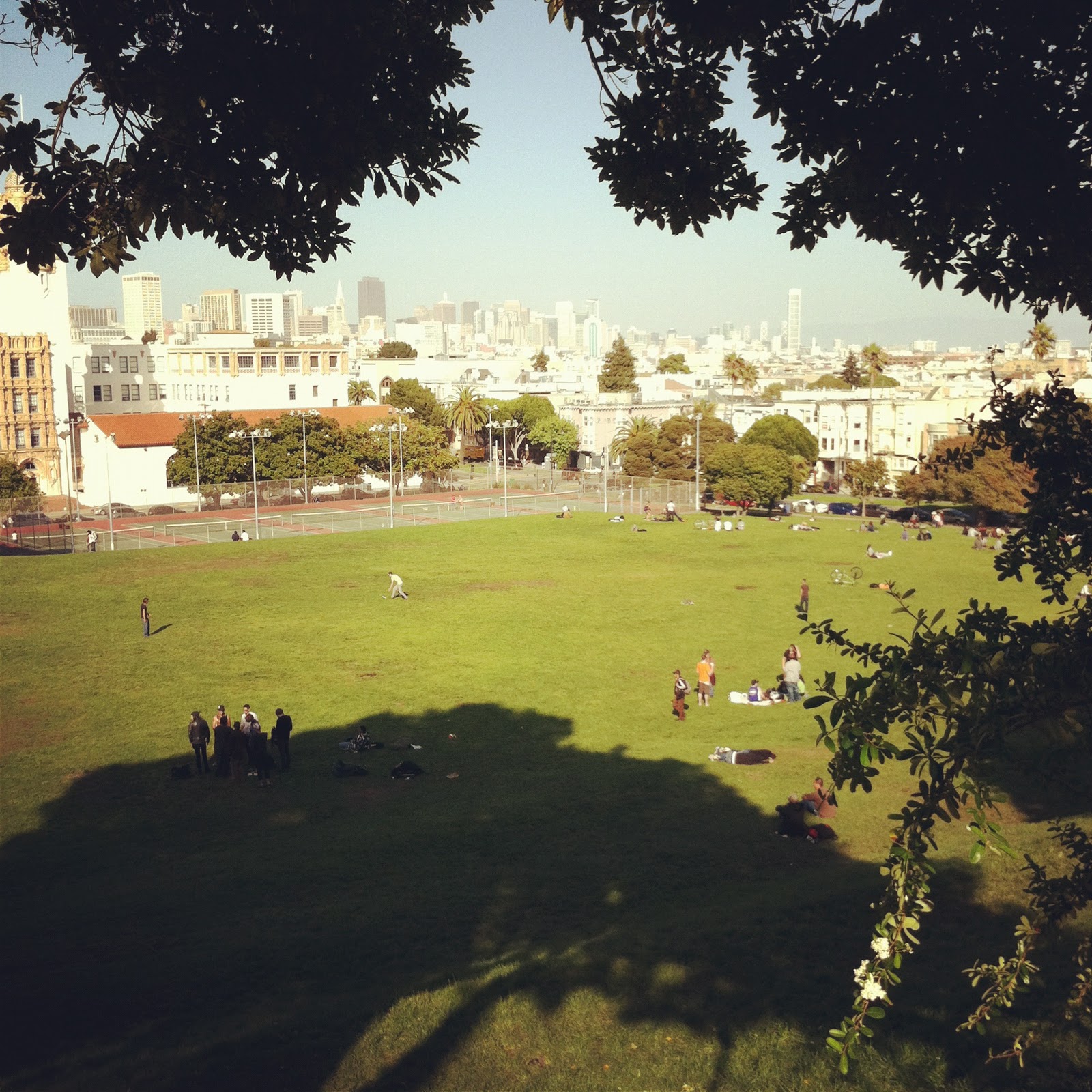
The view of San Francisco from Dolores Park

The rainbow flag in the Castro. This is for all my gay friends.

This is 237 Steiner St. in the Lower Haight district. Fans of the Shut Up Little Man! audio recordings—as well as the recent documentary Shut Up Little Man! An Audio Misadventure—would understand the significance of this address.

Monday, October 24, 2011

Video for the Day: Razor the (Super Hyper) Dog

BROOKLYN, N.Y.—There's one more thing I want to post here on my blog before my Bay Area vacation begins for real.

It's this:


Those of you who follow me on Twitter and Facebook already know a little bit about Razor, the Siberian husky that resides in the Brooklyn apartment in which I and three others live. For the rest of you, though...well, here he is, in a particularly excitable mood one evening last week after I came home from work. (I don't consider Razor my dog, by the way; one of my roommates bought him last year and generally takes care of him. But, after some initial resistance, I've come to embrace the big ol' bugger...especially when he acts like that.)

Oh, and Razor was recently featured on Gothamist! See here!

All right, back to packing for San Francisco now.

Artistic Consumption Log, Oct. 17, 2011 - Oct. 23, 2011: Pre-San Francisco Edition

BROOKLYN, N.Y.—In a few hours, I will be heading to John F. Kennedy International Airport in order to fly out to San Francisco to visit the city for the first time ever.

Why am I going? Well...in this case, just because. No film festival, no film-review or job-related obligations. This trip is just for me—to relax, recharge, reflect. I don't think I've really had that kind of trip in a long while. (And unlike my last venture to the West Coast, last year when I visited Los Angeles, I'm going this one alone. We'll see how that goes.)

So I'm not sure how much art I'll be consuming in the coming week. The Bay Area has a fairly rich alternative-film scene which I intend to explore to a certain extent, so some film-watching will probably be on the menu. Other than that...maybe a concert at Davies Symphony Hall with the San Francisco Symphony Orchestra? 

Until then...here's my latest artistic consumption log for the past week. I didn't come across anything extraordinarily overwhelming on the art front—though the Dardenne Brothers' latest film, The Kid With a Bike, came close.

The Kid With a Bike (2011)

Films

The Skin I Live In (2011, Pedro Almodóvar), seen at AMC Empire 25 in New York
I remember walking out of Pedro Almodóvar's latest film feeling underwhelmed. Days later, upon reflection, I feel a bit more affection for the film than I did immediately afterward. What I remember most from the film is its sometimes exhilarating sense of narrative freedom, with Almodóvar boldly taking his story into unapologetically perverse territory. (I'll give you only one hint as to where this film heads: The Skin I Live In features music by Throbbing Gristle, the British avant-garde band led by Genesis P-Orridge. If you know who Genesis P-Orridge is...) This might have been a truly great film if Almodóvar's characters had been sketched with nearly as much care as he puts into his plotting and his imagery. Still, at its best, The Skin I Live In carries some of the aggressively transgressive charge of his early, pre-All About My Mother work. And hey, at least it isn't boring—which is more than could be said for his last film, Broken Embraces, the rare instance where his taste for melodrama felt, for the most part, fatally rote.

★ Contagion (2011, Steven Soderbergh), seen at Regal Union Square Stadium 14 in New York
The common knock against Steven Soderbergh as an auteur, it seems, is that he doesn't have much of a signature, that he's difficult to pin down, that his films sometimes tend to be chilly theoretical experiments. There is perhaps truth in all of that, and Contagion—a biological disaster film that's shot more for clinical realism than freaky sensationalism—won't do much to lessen those impressions. Maybe the fact that I ended up enjoying the film anyway has to do with the fact that I expected all this going in and thus found Soderbergh's detachment actually somewhat comforting. There are themes to be found in this film if you care to look deep enough, I'm sure—half-formed ideas about self-interest vs. selflessness, old-school journalism vs. new media, and so on; I suspect, though, that Soderbergh mostly focused on telling the story as efficiently as possible and leaving Scott Z. Burns's script to take care of itself. Contagion works as a fairly engrossing thriller in which moments of genuine emotion are allowed to pop up amidst the deliberately drab technological spectacle.

DOC NYC, all films seen at IFC Center in New York
Undefeated (2011, Daniel Lindsay & T.J. Martin)
★ Kumaré (2011, Vikram Gandhi)
I volunteered to review these two films in the upcoming DOC NYC documentary film festival for The House Next Door, so I'll let that piece speak for itself, when I get around to writing it up.

★ The Kid With a Bike (2011, Jean-Pierre & Luc Dardenne), seen at Brooklyn Academy of Music in Brooklyn, N.Y.
More film-festival catch-up! Here, the Dardenne Brothers come up with an affecting coming-of-age fable in which a troubled but headstrong young boy named Cyril (Thomas Doret, amazing) tries to adjust to life without his deadbeat dad (Jérémie Renier, natch after the role he played in L'Enfant) after he leaves him. With their last film, Lorna's Silence (2008), you could sense the Dardennes trying to at least take some baby steps away from their usual emphasis on naturalism; in The Kid With a Bike, they go even further by introducing fairy-tale elements within their realistic style. At least, that's the only way I can explain, say, the near-angelic nature of Cécile de France's surrogate-mother character (we barely get an idea about why this stranger suddenly takes an interest in Cyril; she just kinda does) or the melancholy snatches of the slow movement of Beethoven's Fifth Piano Concerto that the Dardennes include on the soundtrack (placed at strategic moments, as if marking off important stages in Cyril's emotional arc).

That is not to say that the Dardennes are going for a more simplistic version of their previous morality plays; moral ambiguity still plays a major part in their worldview, except this time around, it's filtered through the point-of-view of Cyril, a kid who is only now getting his first, brutal taste of the adult world. But the Dardennes, as ever, somehow manage to adopt a main character's viewpoint without ever fully inhabiting it—and some of its most memorable moments come from the way they look at a particular situation from various perspectives without losing the essential sympathy they have for Cyril.

Good stuff, all in all...though I wonder if, with their next film, the Dardennes will maybe just drop the pretense of realism altogether and do something completely and utterly different from the style they're known for. No more of these baby steps, guys! Just do it!

Music

★ Watch the Throne (2011, Jay-Z & Kanye West)
I finally got around to hearing this much-hyped collaboration between two recent hip-hop giants, and it turns out Watch the Throne lives up to its name in one respect: some of these cuts positively abound in regal, majestic, deliberately overblown sounds and production. And, of course, there's the usual quota of braggadocio you have to put up with from these two. But such ego-tripping coexists fascinatingly with moments of brutal honesty, most notably in Jay-Z's case (listen to the second half of "New Day," for instance). Watch the Throne ends where West's My Beautiful Dark Twisted Fantasy began, and it's far less consistent—but it's generally enjoyable overall.

Debut (1993, Björk)
Thanks to the release of Björk's latest work, the multi-platform Biophilia, I've finally decided to dive into the much-celebrated music of this Icelandic iconoclast. (And yes, this means that I haven't yet watched Lars von Trier's Dancer in the Dark, in which she played the lead role and wrote the songs.) As usual, I started from the beginning: her first solo album, cleverly titled Debut. It's an interesting if somewhat uneven effort; I'm guessing later albums will be even stranger and more experimental than this one, which is, more often than not, tied down to fairly same-y dance beats.

Dance

★ Radio & Juliet (2009, Edward Clug), performed at NYU Skirball Center in New York
This abstract modern take on the Shakespeare classic, set to music by Radiohead and performed by the Slovenian dance troupe Ballet Maribor, has apparently been touring the world for a couple of years now. It finally made it to New York over the weekend, and if you don't mind the hour-long ballet's clinical feel, it's a fascinating trip. Instead of two warring clans, Radio & Juliet basically features one female dancer and six male ones, one of whom takes a romantic interest in the woman...or do all of them take an interest? At a couple points in the ballet, "Romeo" and "Juliet" dance with each other...but then one "Romeo" is replaced with another, then that other is replaced yet another...you get the idea. What does that signify? It certainly doesn't recall anything in Shakespeare's text. But then, a lot of elements in this ballet don't recall anything in Shakespeare's text; it borrows certain elements, but stakes out an identity of its own. What matters, in the end, is that Radio & Juliet works on its own alien terms; even better, it manages to bring out the creepier aspects of Radiohead's music—most of it from Kid A (2000), Amnesiac (2001) and Hail to the Thief (2003), their more experimental albums—that honestly I don't think I had really, truly felt while listening to their music in isolation.

Wednesday, October 19, 2011

My Day Occupying Wall Street

NEW YORK—On Saturday, I finally got a chance to go to lower Manhattan and visit Zuccotti Park, site of the very first Occupy Wall Street demonstration in what has become a world-wide movement.

Don't worry, Wall Street Journal, I didn't go there to either support or condemn the protesters! I was just there to observe and discuss. And observe I did, as this video attests:


As you can see, Zuccotti Park has become something of a virtual community, complete with food bank and library. It's actually rather impressive; I never thought I would see Rutgers University's annual Tent State University movement spread into the outside world in this way!

Whatever you think of the movement's ideas and beliefs, though, I still find it heartening to see regular people (the so-called "99%," as per this movement's characterization of middle-to-lower-class folk) being this passionate and engaged in American political discourse. Who says us young folks are all self-absorbed and apathetic???

Here are some more photos I took from Saturday's tour through Zuccotti Park:


Later that day, some of the demonstrators took the cause up to Times Square for a more conventional kind of rally. I checked out the scene there, too:


As you can see and hear, these demonstrators have hit upon a fairly inventive way of spreading their message across a wide area so everyone can hear: "human microphones" in which everyone in the crowd passes the words of a speaker along, round-robin style. Maybe this has been done in rallies before, but it was the first time I experienced it in person.

And even later, the Times Square demonstrators gathered in Washington Square Park to continue the rally. I checked this out briefly, but didn't stick around too long; all I got from this nightcap was this photo...


...which reminded me somewhat of that famous Eugène Delacroix painting "Liberty Leading the People":


Thus ended my day occupying Wall Street.

Tuesday, October 18, 2011

At Toronto's Yonge-Dundas Square on a Sunday Morning

NEW YORK—Amidst all the New York Film Festival coverage I've done in the past month or so, I wasn't able to put up this video I took of Yonge-Dundas Square while I was at the Toronto International Film Festival in September...until today.


It's not much: just a slow 360° shot (a signature of mine as an amateur videographer, if I was to exalt myself to the level of amateur auteur or something pretentious like that). But this footage was taken at around 8:30 in the morning...and unlike New York's Times Square, apparently Yonge-Dundas Square that early in the morning looks and feels like a dead zone of sorts. Not a whole lot of people, few cars on the roads—frankly, it almost looked as if the apocalypse had already hit, that's how barren it looked!

But hey, what a sunny, beautiful apocalypse, am I right?

Monday, October 17, 2011

Artistic Consumption Log, Oct. 10, 2011 - Oct. 16, 2011

BROOKLYN, N.Y.—Wait...I actually have time to annotate my latest artistic consumption log? Amazing!

Margaret (2011)

Films

New York Film Festival 2011 (all films screened at Walter Reade Theater unless otherwise noted):
Corman's World: Exploits of a Hollywood Rebel (2011, Alex Stapleton)
★ The Descendants (2011, Alexander Payne)
I wrote about the enjoyable if skin-deep Roger Corman documentary Corman's World in my last House Next Door New York Film Festival review here.

The festival ended last night with Alexander Payne's latest film as its closing-night selection...and it turned out to be a pretty good selection. Those who are worried that Payne indulges in his usual penchant for caricature and condescension can rest assured that, in The Descendants, he largely abandons it here...and even when the film threatens to slip into such tendencies with certain supporting characters (Alexandra's dim boyfriend Sid, the philandering real-estate agent), Payne manages to include scenes or moments that humanize even those relatively minor players. What emerges is an often moving portrait of a workaholic father (George Clooney) living in Hawaii who, when faced with the prospect of having to shut off the life-support system of his comatose wife, is forced to not only grow as a father, but also face familial skeletons in the closet that he had long suppressed. Even more so than his last two features, About Schmidt (2002) and Sideways (2004), The Descendants proves that Payne is capable of something approaching genuine human drama, not just the wicked satire of Citizen Ruth (1996) and Election (1999).

And now, thanks to the Toronto and New York film festivals, I think I'm all "film-festivalled" out for the time being!

★ Margaret (2011, Kenneth Lonergan), screened at Landmark Sunshine Cinema in New York
I agreed to write up something about this film for the film- and music-review site In Review Online, so I'll have a chance to flesh out my thoughts on this film later.

For now...well, here is the last line of legendary film critic Pauline Kael's review of Satyajit Ray's Distant Thunder back in 1975: "I don't know when I've been so moved by a picture that I knew was riddled with flaws. It must be that [Satyajit] Ray's vision comes out of so much hurt and guilt and love that the feeling pours over all the cracks in Distant Thunder and seals them up." That's exactly what I would say about Margaret, Kenneth Lonergan's wildly ambitious follow-up to his 2000 chamber drama You Can Count On Me. It's far from perfect—some of its editing rhythms are oddly disjointed, for one thing, especially in its last hour—but it's so intelligent, impassioned and deeply felt in its exploration of one adolescent's response to death and guilt that its flaws, such as they are, are mere piddles in what it successfully accomplishes. It is indeed a staggering achievement, in many ways—and so it's a shame that the film (which was shot way back in 2005 and has a copyright of 2008 on it) only got a token two-week run here in New York as a result of a troubled production history and pending lawsuits over the film's ownership. It deserved far better.

★ Dead Alive (1992, Peter Jackson), screened at 92YTribeca in New York
★ Re-Animator (1985, Stuart Gordon), screened at 92YTribeca in New York
92YTribeca screened these two splatter classics in a double bill on Friday night, so I seized upon the opportunity to fill in two major blind spots in my horror knowledge. Horror? That's just the name of the genre; these two films are more accurately described as gruesome black comedies. These aren't ironic parodies, though; the last thing you could call either Dead Alive or Re-Animator is smug or contemptuous of genre. Dead Alive, for all its extreme bloodletting (this may well be the bloodiest film I've ever seen), works quite beautifully, actually, as a sincere coming-of-age tale about a mama's boy (played by Timothy Balme) who learns to break away from his overcontrolling mother (hey, I can relate!); in this case, though, his maturation requires him to eventually wield a lawnmower and mow down scores of zombies in a masterfully orchestrated half-hour setpiece of blood, guts and mayhem. Jackson's film is full of such witty, bravura blood-soaked setpieces, all shot with a proliferation of exaggerated wide-angle lenses that lend the whole film a comic-book air that takes the brutality out of the grotesque violence.

Dead Alive is a lot of fun, at least for those with strong stomachs (and it's also a welcome reminder of the kind of filmmaker Jackson was before he became all respectable with the Lord of the Rings epics). But Re-Animator—an adaptation of an H.P. Lovecraft short story—is on a whole other plane of greatness. The best way I can think to describe this, for those who haven't seen this film yet, is that it is a serious comedy about the fear of death, its outré humor borne out of a genuinely serious consideration of the ways people deal with mortality—especially the possibility of avoiding it, as Dr. Herbert West (Jeffrey Combs) offers with the shiny green serum he develops. What if you were given a second chance at life? What would you do with it? The answers for some of the re-animated characters here are sometimes outrageously perverse (I sure as heck haven't seen a film in which a live severed head goes down on a naked blonde, have you?), but its morbid undercurrents lend the film a coherence that Dead Alive barely manages (not a knock on the Jackson film, mind you). I wouldn't call Re-Animator disturbing, exactly...but in its own gleefully tasteless way, it's thought-provoking.

One minor quibble with Re-Animator: Are people generally okay with how blatantly derivative of Bernard Herrmann parts of Richard Band's score are? Like, his opening-credits music is pretty obviously a rip-off of Herrmann's Psycho opening; Band doesn't even try to hide it.

Music

★ Scary Monsters (1980, David Bowie)
★ Let's Dance (1983, David Bowie)
As some of you can tell in my previous barebones artistic consumption logs, I've been slowly introducing myself to a good majority of David Bowie's recorded output, at least up to the early 1980s (I hear that it's basically all downhill from Let's Dance onward, so I'm inclined to move on to some other artist at this point...but I'm willing to hear arguments to the contrary). For the most part, it's been an immensely enjoyable and often exhilarating experience, with each album a true musical adventure, for well and ill. These two latest "adventures" aren't quite on the exalted plane of my two personal favorite Bowie albums, Station to Station (1976) and Low (1977), but they all have their moments of brilliance. In fact, "Ashes to Ashes," from Scary Monsters, may well be my favorite Bowie song ever, if only because I find it a rather disturbing song underneath its whimsical oddball surface, especially towards the end, with the arrangement laying on a foreboding bass synthesizer as Bowie's voice, enhanced with a halo-like effect, repeatedly intones, "My mother said to get things done / You'd better not mess with Major Tom." Sounds like an ominous children's nursery rhyme, that. Weird and wonderful: That's Bowie in a nutshell. (Maybe now would be a good time to rewatch The Man Who Fell to Earth, which I found generally boring when I saw it at Film Forum earlier his year...)

Wednesday, October 12, 2011

New York Film Festival 2011, "Confused Young Girls" Edition

BROOKLYN, N.Y.—


My latest New York Film Festival dispatch couples together two films I saw at Toronto International Film Festival: Sean Durkin's tense debut feature Martha Marcy May Marlene and Mia Hansen-Løve's warm and wise third film Goodbye First Love. At first, the only reason I decided to bunch these two together was because I had previously seen them in Toronto; as I started writing this piece, however, I realized that there are some other similarities connecting them—most notably, the fact that both films feature young female heroines under duress, whether extreme in the case of the former or universal in the case of the latter. Similar or not, both are very much worth seeing.

(Both of them have theatrical distribution, by the way, so you won't have to pay, like, $24 to see them in upcoming public screenings. But, hey, far be it from me to discourage you from giving money over to the Film Society of Lincoln Center and their New York Film Festival! Without them, I wouldn't be keeping busy right now and keeping my mind off my stagnant professional career and all that!)

Tuesday, October 11, 2011

New York Film Festival 2011: Catching Up on Some Links

BROOKLYN, N.Y.—


I've fallen behind on linking you all to my recent contributions to The House Next Door's New York Film Festival coverage, so...if you haven't seen them already thanks to my links to them on my Twitter and Facebook pages, here are my reviews of Two Years at Sea, the hypnotic first feature film of British avant-garde filmmaker Ben Rivers; and a dual review of German director Ulrich Köhler's so-so anti-imperialist screed Sleeping Sickness and Turkish director Nuri Bilge Ceylan's slow but rewarding police procedural Once Upon a Time in Anatolia.

Enjoy! I have three more films to review, and then I'll be done with this year's New York Film Festival. Home stretch, baby!

Monday, October 10, 2011

Artistic Consumption Log, Oct. 3, 2011-Oct. 9, 2011

BROOKLYN, N.Y.—It's the home stretch, folks: the last week of the New York Film Festival. I have three more reviews to write up this week, and then it's all over and done with...and maybe then I can go back to more extensive artistic consumption logs!

For now, though, you will all have to make do with another barebones one.

One thing I'd like to explain, though, as a preface. This weekend was Views from the Avant-Garde weekend at NYFF—a four-day showcase of some of the latest and brightest in experimental film. So a lot of the films I saw at the festival this past week were a part of this sidebar—all the Ben Rivers and Ernie Gehr shorts, Jerome Hiler's Words of Mercury, Nathaniel Dorsky's The Return and James Benning's Twenty Cigarettes. With the exception of the last title (not a bad film, by any means, just far less revelatory than Benning's last film, Ruhr), most of the rest was pretty mind-blowing; as I soaked up these images, I felt my conception of cinema literally expand in my head. (I'm almost thankful I didn't see a lot more of this kind of filmmaking this weekend than I did; my mind might have felt like it was about to explode!)

Oh yeah, and Melancholia is damn good—better than Lars von Trier's last film, Antichrist, for my money. It's available to view on demand, but it's certainly worth seeing on a big screen, if you can.

The Return (2011)

Films

New York Film Festival 2011 (all films screened at Walter Reade Theater in New York unless otherwise noted):
★ This Is Not a Film (2010, Jafar Panahi & Mojtaba Mirtahmasb)
★ Melancholia (2011, Lars von Trier), screened at Alice Tully Hall in New York
★ Sack Barrow (2011, Ben Rivers), screened at Francesca Beale Theater in New York
★ Slow Action (2010, Ben Rivers), screened at Francesca Beale Theater in New York
★ Crystal Palace (2011, Ernie Gehr)
★ Thank You for Visiting (2010, Ernie Gehr)
Mist (2010, Ernie Gehr)
★ ABRACADABRA (2009, Ernie Gehr)
★ Words of Mercury (2011, Jerome Hiler), screened at Francesca Beale Theater in New York
★ The Return (2011, Nathaniel Dorsky), screened at Francesca Beale Theater in New York
My Week With Marilyn (2011, Simon Curtis)
Twenty Cigarettes (2011, James Benning)

★ Weekend (1967, Jean-Luc Godard), screened at Film Forum in New York [second viewing]

Music

★ "Heroes" (1977, David Bowie)
★ Lodger (1979, David Bowie)

Theater

Nightlands (2011, Sylvan Oswald), performed at HERE Arts Center in New York

Wednesday, October 05, 2011

New York Film Festival 2011: The Student and This is Not a Film

BROOKLYN, N.Y.—


I didn't have much of an idea going into Santiago Mitre's The Student what I was in for; heck, I didn't even have much of an idea of what other critics were saying about the film, if anything. Turns out, this is a reasonably engaging political drama from Argentina that manages to yield some dividends with its college-as-microcosm-of-Argentinian-politics conceit. It's a solid piece of work overall—as I try to suggest in my latest House Next Door New York Film Festival dispatch. (It screens on Saturday, Oct. 8, at 12:30 p.m. and Wednesday, Oct. 12, at 6 p.m., if any of you in the tri-state area are interested in checking it out.)


Also, I'd be remiss if I didn't mention this in passing: Yesterday, I saw what I would probably consider my favorite film of the festival up to this point: This Is Not a Film (2010), the recent collaboration between Jafar Panahi and Mojtaba Mirtahmasb done while Panahi was still under house arrest and awaiting what would eventually be his sentence to six years in prison and 20 years banned from filmmaking. It's a documentary that doubles as a richly self-reflexive piece of cinema—but, like fellow Iranian filmmaker Abbas Kiarostami's great Close-Up (1990), it balances intellectual concerns with real, heartfelt emotion. The result is a heartening middle finger to a repressive regime and a deeply moving personal testament of an artist maintaining his humanistic stance even in the midst of imminent imprisonment that threatens to completely silence his voice. (Even the story of how the film was smuggled out of Iran is inspiring, being that it was smuggled in a USB drive hidden in a cake.)

I wasn't assigned this film to review, so consider that my (too short) review. Even shorter version: You must see this! (It screens at the New York Film Festival on Thursday, Oct. 13 at 6 p.m.)

Tuesday, October 04, 2011

NYFFing and TIFFing It Up!

BROOKLYN, N.Y.—


Over the weekend, my New York Film Festival review of Le Havre went up at The House Next Door. Le Havre is the latest film from Finnish filmmaker Aki Kaurismäki—yet another well-regarded world-cinema auteur whose work I wasn't really familiar with before undertaking the assignment to review it. So I decided to make my inexperience with Kaurismäki's work a part of my review. I have the freedom to do that kind of thing at The House! The movie's not bad, either.

Oh, and here's a blast from the (recent) past: I contributed a few capsule reviews for In Review Online's recently published wrap-up of this year's Toronto International Film Festival. Surprisingly, I had a pretty easy time of sticking to 90-100 words for each of my contributions; I totally expected to struggle to condense my always complex opinions on films to such a short amount of space, but they just seemed to flow out of me once I got into a groove.

Anyway, enjoy my latest output! I need to keep up this writing thing, seriously.

Monday, October 03, 2011

Artistic Consumption Log, Sept. 26, 2011-Oct. 2, 2011

NEW YORK—

Low (1977)

Films

New York Film Festival 2011 (all films screened at Walter Reade Theater in New York unless otherwise noted):
★ Two Years at Sea (2011, Ben Rivers)
★ The Student (2011, Santiago Mitre)
Sleeping Sickness (2011, Ulrich Köhler)
★ Once Upon a Time in Anatolia (2011, Nuri Bilge Ceylan)
★ Ben-Hur (1959, William Wyler), screened at Alice Tully Hall in New York
★ A Separation (2011, Asghar Farhadi), screened at Alice Tully Hall in New York

★ 10 (1979, Blake Edwards), screened at Brooklyn Academy of Music in Brooklyn, N.Y.

★ The Last Picture Show (1971, Peter Bogdanovich), screened at Film Forum in New York

Music

點解 (1987, 劉美君)

★ Low (1977, David Bowie)