Monday, July 02, 2012

Artistic Consumption Log, June 25, 2012 - July 1, 2012

BROOKLYN, N.Y.—Wow, I guess this was an especially exceptional week as far as artistic consumption goes. There's no way I could match it this week—or is there?

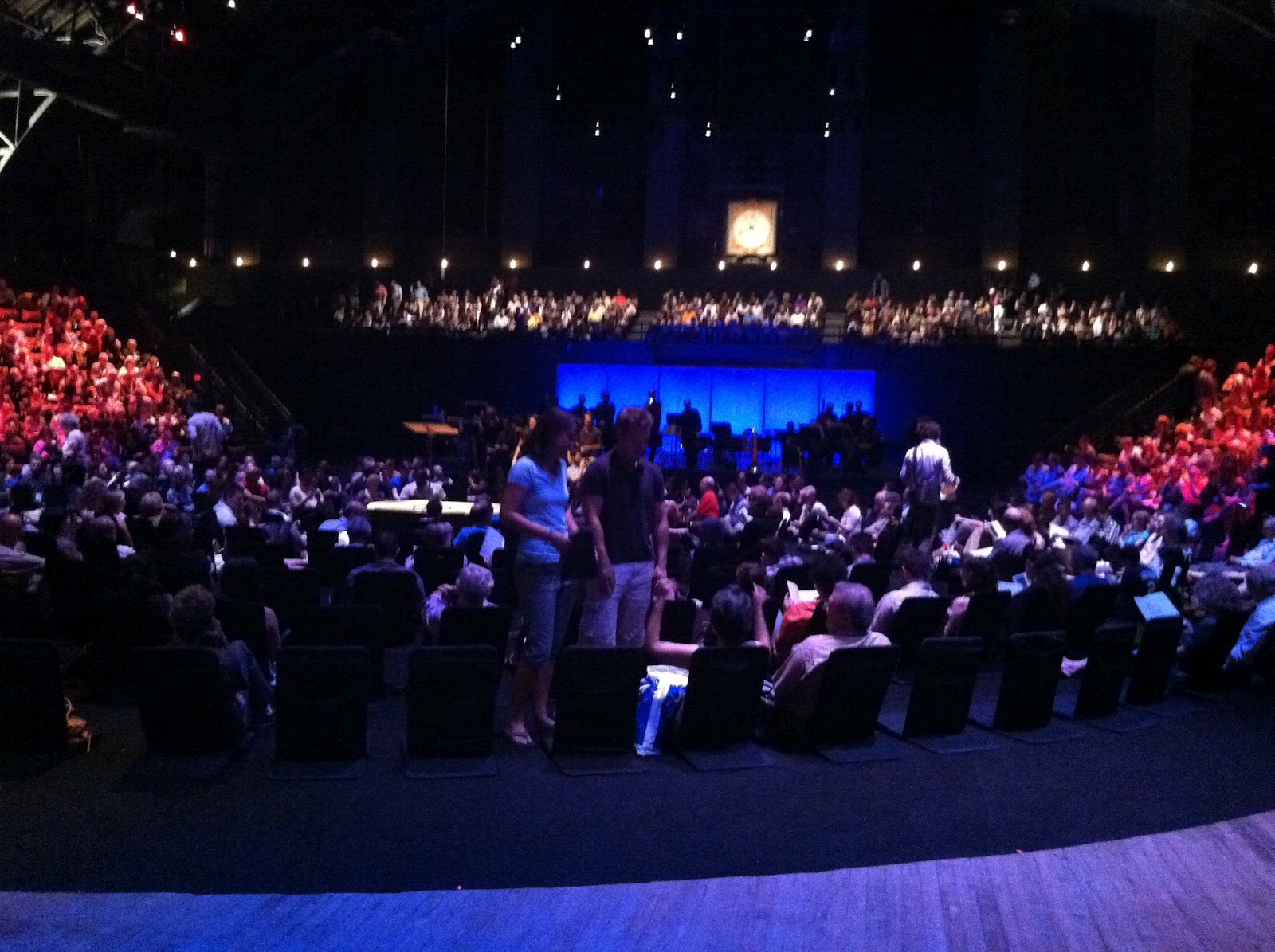
A mere précis of the layout of the Park Avenue Armory's Wade Thompson Drill Hill on Friday night before the Philharmonic 360 concert

Films
  
★ Beasts of the Southern Wild (2012, Benh Zeitlin), seen at IFC Center in New York
Yeah, this is pretty good. If that statement sounds like I'm damning this extravagantly praised indie sensation with faint praise...well, I am and I'm not. Hype can, for better and for worse, be as big a factor in how one receives a theatrical experience as the film itself can be, and while many of the critics who saw Zeitlin's film at its world premiere at Sundance at the beginning of the year saw it cold (no pun intended, considering the venue), I admittedly saw it at an IFC Center members-only preview screening Tuesday night with all the praise and the smattering of finally-coming-out-of-the-woodwork naysayers in my head. Would I be far more enthusiastic about this film if I didn't have all that hype perhaps inadvertently informing my experience? I can only speculate.

My take on this film, basically, is this: Sure, if you examine its politics hard enough, Beasts of the Southern Wild—which could be interpreted as making an argument for U.S. government non-intervention in the wake of Hurricane Katrina, at least if you wish to attach that topical reading to the film—might seem wonky bordering on dangerous. If that's the way you wish to go with examining this film, then it's possible to see Zeitlin's insistence on conjuring a fairy-tale/kid's-fantasy context as an all-too-convenient "out" for such criticisms. And yet, for me, that would deny what strikes me as the film's beating heart: the six-year-old Hushpuppy's (Quvenzhané Walls) relationship with her problematic but well-meaning father, Wink (Dwight Henry). A scene midway through the film—the one that includes the moment in the trailer in which Hushpuppy shouts "I'm the man" to her father—reveals the extent of how Wink has been trying to (over-)protect her daughter all these years. Beasts of the Southern Wild, then, could more charitably be seen as a coming-of-age tale of sorts, as Hushpuppy eventually gains an awareness of a world outside of Bathtub, outside of the seemingly magical haven she once knew and desperately wants to maintain. And on that level, I admittedly found the film affecting. I can certainly see how others might go so far as to find it profoundly moving. Good for them. Me...well, like I said, I thought it was pretty good.

BAMcinemaFest 2012:
★ The Comedy (2012, Rick Alverson), seen at a parking lot on the corner of Fulton Street and Ashland Place in Brooklyn, N.Y.
★ V/H/S (2012, David Bruckner/Ti West/Glenn McQuaid/Joe Swanberg/Radio Silence), seen at Broadway Screening Room in New York
The Comedy is essentially a feature-length series of darkly comic sketches centered around a Brooklyn hipster douchebag (Tim Heidecker, of Tim and Eric Awesome Show, Great Job! fame) interacting with the world around him in ways that are generally abrasive (one of the show-stoppers being an extended scene in which he bribes a cab driver to let him ride a cab). Sounds insufferable—and yet, director/co-writer Rick Alverson hits upon a weirdly empathetic tone that nevertheless manages to maintain a large critical distance from this bored, entitled antihero. Are these moments his endlessly discomfiting way of trying to connect with people around him? Is making crude, irreverent jokes of everything his only way of dealing with the world? The most challenging thing about The Comedy is that Alverson refuses to pass easy judgment on him. I saw the film at an outdoor screening (hosted by Rooftop Films, which hosts outdoor screenings of independent films all over New York), and a funny thing happened the next day: In the midst of the Supreme Court's ruling on President Obama's health-care reform, I didn't feel much like tweeting about this film. It would seem trivial in the face of the more important events going on in the wider world; in other words, I would have felt much like Tim Heidecker's character had I done so. Maybe The Comedy is already having a more profound effect on me than I at first realized.

As for the shot-on-videotape horror anthology V/H/S—well, I don't really have much to say about it beyond what my friend/fellow critic Simon Abrams offered here when he saw it at Sundance earlier in the year. I basically agree with everything he wrote. It doesn't set the found-footage subgenre on fire, but I thought it made for a solidly entertaining time at the movies, especially in that Glenn McQuaid-directed segment with the villain that only appears amidst a sea of video noise. That is some clever shit, given the concept.

New York Asian Film Festival 2012, all films seen at Walter Reade Theater in New York:
★ The Boxer's Omen (1983, Kuei Chih-Hung) 
★ Five Fingers of Death (1972, Chung Chang-Wha) 
★ Nameless Gangster (2012, Yun Jong-Bin) 
I saw Five Fingers of Death the same day I watched Craneway Event, a 2008 film of the late Merce Cunningham in the throes of visionary creation that was screened as part of a New Museum exhibit focusing on British visual artist/filmmaker Tacita Dean (of which more below). Chung Chang-Wha's influential Hong Kong martial-arts classic—just one of many major influences on Quentin Tarantino, if the film's opening use of the same Quincy Jones Ironside theme song Tarantino used often in Kill Bill, Vol. 1 doesn't clue you in—turned out to be the second great widescreen dance film I saw that day, with Five Fingers of Death featuring some of the most exhilaratingly balletic action sequences ever put on film. It helps that Chung's film has a pretty well-told story and genuinely involving human interest, too

If you thought connecting a Tacita Dean avant-garde documentary and a Shaw Brothers-produced Hong Kong kung-fu extravaganza was weird, then hear this. I saw another Shaw Brothers-produced spectacle, The Boxer's Omen, the same night I experienced Pierre Boulez's Rituel in memorian Bruno Maderna and Karlheinz Stockhausen's Gruppen—two 20th-century serialist works—live at Park Avenue Armory's massive Wade Thompson Drill Hall. To my surprise, I think hearing those two works—which, I finally realized that night, is best experienced as a random-on-the-surface procession noises rather than searching for a structure, despite the twelve-tone principles governing them—primed me, in a weird way, for Kuei Chih-Hung's blast of exploitation insanity. Because, really, is it even necessary to follow the increasingly nutty plot of The Boxer's Omen—a film which proudly shifts on a dime from martial-arts saga to gross-out supernatural horror, with daubs of Buddhism thrown in for good measure? The only way to really get anything out of a movie like this one is to just sit back and follow wherever its creative delirium takes you. I submit that that's the same way one ought to approach something like a Boulez or Stockhausen (or John Cage or Edgard Varèse) work. Of course, whether you warm to both Boulez and Stockhausen's atonal language or Kuei's gleefully gratuitous sex and violence is up to you.

And finally, I don't have much to say about Nameless Gangster other than that overall, I found it a pretty gripping gangster/period saga, with Choi Min-sik—the hammer-wielding protagonist of Oldboy, for those who don't know who he is (and who have actually seen Chan-wook Park's brutal revenge saga)—in top form as a gangster who acts like a bigger fish than he is just because he has the right connections. It never really transcends the genre to become a truly exceptional film, but it's entertaining enough.

Music

★ Extraordinary Machine (2005, Fiona Apple) 
★ The Idler Wheel Is Wiser Than the Driver of the Screw and Whipping Cords Will Serve You More Than Ropes Will Ever Do (2011, Fiona Apple)
So yeah, how about Fiona Apple's new album, huh? It's perhaps her most intimate-feeling collection of songs yet, thanks to the stripped-down production/instrumentation. And that "Hot Knife"—quite the infectious, breathtaking closer for an album. Didn't tickets just go on sale for concerts she's doing in October or something? I better go snap that up!

★ Philharmonic 360—Boulez: Rituel in memoriam Bruno Maderna (1974-5) / Mozart: Finale to Act I of Don Giovanni (1787) / Stockhausen: Gruppen (1955-7) / Ives: The Unanswered Question (1906), performed live by the New York Philharmonic, under the direction of Alan Gilbert, at Park Avenue Armory in New York
Imagine, if you will, a work that requires not just one orchestra, but three, in a space big enough so that the composer could imagine all sorts of spatial musical effects—sort of like music traveling across stereo speakers if you have the good luck of sitting in the middle of it all. Well, German composer Karlheinz Stockhausen (1928-2007) imagined just such a work in Gruppen (1955-7). Alas, Gruppen has rarely been performed, most concert halls being architecturally unequipped to pull off the kind of arrangement Stockhausen had in mind.

Enter the Park Avenue Armory's Wade Thompson Drill Hall.

If you don't know of this venue by now...well, take a look at these photos. It's huge—and perfect, it turns out, for a performance of Gruppen close to what Stockhausen had in mind. And leave it up to enterprising New York Philharmonic music director Alan Gilbert to conceive of a program that included not only Gruppen, but also Pierre Boulez's Rituel in memoriam Bruno Maderna, a selection of Wolfgang Amadeus Mozart's Don Giovanni, and Charles Ives's short but brilliant The Unanswered Question. If Gruppen was expressly written for this kind of spatial set-up, the other works were basically re-conceived to take full advantage of this giant performance space.

Case in point: Many have seen traditional performances of Don Giovanni on a proscenium arch of a stage way in front of them, sometimes close-up, sometimes far away. But I would bet that you haven't felt as if you were truly in the opera in the same literal way as I felt in the staging conceived by Michael Counts of the ballroom finale of its first act—with singers walking all around the space, some way in the back of the rafters and slowly progressing forward, others standing right in the center podium, others edging toward the front stage. Forget 3-D: this is practically Don Giovanni in 4-D! Imagine a Wagner epic staged this way!

At the very least, I found it a thrilling experiment—as was the whole concert, really. I already briefly discussed the Boulez and Stockhausen works above, and I don't have much else to add about them (though the Stockhausen has an awesomely eruptive climax of noise from all three orchestras that was the highlight of the night for me). So let's finally touch on The Unanswered Question, which is a six-minute work that features a call-and-response between a solo trumpet and four flutes, in which the trumpet sounds out a motif that gets repeated verbatim, and the flutes respond in ways that become increasingly confused and frustrated until, by the end, they don't respond at all. As this "dialogue" happens, the strings gorgeously drone on softly underneath. Ives offered a program of sorts to explain all of this (for instance, he said the strings represented "The Silences of the Druids—Who Know, See, and Hear Nothing")—but it's all easy enough to hear in the music, and it was all brilliantly emphasized by the way Alan Gilbert staged it at the Park Avenue Armory on Friday night: the trumpet high in the rafters sounding out its "question," four flutists in the middle sounding out their responses, and the strings surrounding the flutists on their sides and behind them.

This, my friends, is the kind of adventurous programming prestigious orchestras like the New York Philharmonic need to do more often to stay fresh and relevant—especially when the results are as triumphant as they were on Friday night. To Alan Gilbert and the New York Philharmonic: I thank you, salute you and wish you even greater successes of this sort in future seasons.
 
Theater

★ As You Like It (ca. 1600, William Shakespeare), performed live at Delacorte Theater in New York
This was my first time ever watching a Shakespeare in the Park production, and I couldn't have lost my Shakespeare in the Park virginity on a better production. Director Daniel Sullivan transposes the action to something like the American deep South, which explains, among other details, the prominence of a bluegrass band that plays some of the songs in Shakespeare's comedy, set in this production to music by Steve Martin (yes, the comedian/actor Steve Martin). Otherwise, though, the text remains intact, ripe for an able cast into which to breathe life. This cast—including elite actors like Oliver Platt (as the court jester Touchstone) and Andre Braugher (doing double duty as Duke Senior and Duke Frederick)—did just that joyously and gloriously.

There was much to commend in this production—it had a beautiful forest set, for one thing (props to John Lee Beatty, the scenic designer)—but for me it all came down to Lily Rabe as Rosalind. It takes a special kind of artistic imagination to not just deliver Shakespeare's poetry in as natural a manner as possible, but to also do so in a way that makes it come alive in stunningly original and unpredictable ways. Every single line of dialogue that came out of Rabe's mouth had me astonished by the sheer sense of spontaneity and freedom in her phrasing. At the risk of hyperbole, this strikes me as the kind of seemingly improvisatory interpretive genius that only the likes of Wilhelm Furtwängler and Leonard Bernstein achieved in the realm of classical-music interpretation. I had never seen Rabe—daughter of playwright David Rabe and the late Jill Clayburgh—act before, though I had heard she stole the show from Al Pacino in a Shakespeare in the Park production of The Merchant of Venice a few seasons back. I am chomping at the bit to see her act again.

Art

★ Klara Lidén: Bodies of Society, seen at New Museum in New York
★ Tacita Dean: Five Americans, seen at New Museum in New York
I had never heard of Tacita Dean before, but a friend of mine I interact with fairly regularly on Twitter recommended this exhibit—her first major U.S. show—to me. So when I was reminded last week that the show was closing after this past weekend, I decided to make time for it. I'm glad I did.

This British artist, it seems, has a certain preoccupation with trying to capture the beauties and mysteries of artists' creative processes. Art about art? Sure, sign me up! The New Museum exhibit showcases a handful of her film/photographic portraits of artists like choreographer Merce Cunningham; painters Cy Twombly and Julie Mehretu; artist Claes Oldenburg; and art historian Leo Steinberg. Steinberg is represented by five photographs of his hand as he writes; the five photographs feature his hand in different positions, and those photographs are arranged in such a way as to suggest a diagonal line that, according to Dean, is an unconscious evocation of his own 1980 essay The Line of Fate in Michelangelo's Painting. I guess the suggestion is, Steinberg could very well be so immersed in Michelangelo's work that he can't help but inhabit his artistic spirit in some ways. I'm not sure I totally buy it, but hey, as a nonprofessional critic myself, it's certainly a nice thought!

Similar conceptual intrigues abound in her film work (and it truly is film, since she's sticks steadfastly to 16mm). For Twombly, in a 29-minute film entitled Edwin Parker (Twombly's original name), she basically observes the late American artist going about his daily routine: reading the newspaper, having lunch, etc. As is the case with the other films featured in this exhibit, she prefers a slow, contemplative long-take observational style, somewhat Frederick Wiseman-like in effect. Does such an approach yield insights into Twombly's artistic mind? Maybe not in a prosaic sense of explanation or analysis; Dean seems less interested in explanation than in evocation. Seeing Twombly, sitting in a room reading a newspaper, framed through a narrow doorway amidst the peace and quiet of his house certainly inspired a similar feeling of personal reflection in me, for instance.

And of course, there's the aforementioned Craneway Event, a 108-minute document of Merce Cunningham at work leading rehearsals for a 2008 dance event in an empty warehouse overlooking the San Francisco Bay. In Dean's film, Cunningham's dancers are often lit as silhouettes, prancing across a wide (2.35:1, so it appeared to my eye) frame appropriate to the giant rehearsal space itself. Cunningham himself is often seen carefully observing his dancers and taking notes. At one point, Dean points her camera not at any of the ballet dancers, but to a pigeon wandering around the building. The natural world intruding on Cunningham's current dance bubble? However it all adds up, the end result—and yes, I did end up watching all 108 minutes of it—is consistently beautiful to behold, on both dance and cinematic levels; and an utterly mesmerizing in its stillness and sense of deep mystery. More people should see this film, seriously; it deserves to be in something other than a makeshift New Museum screening room!

I also ended up wandering to the second floor for the Klara Lidén exhibit. Lidén, so I learned afterward, is a Swedish artist living in Germany who bases much of her art on, well, garbage: repurposing trash to create art that comments on urban living. She also more directly addresses urban life in some of her videos, one of which features a female figure (Lidén herself, I believe) essentially doing a backwards moonwalk for about four minutes with various types of desolate-looking buildings in the background. If anything, I found her videos more affecting in their own odd ways than her Duchampian garbage cans and ad-poster canvases. Overall, though, I found her work pretty intriguing. Sometimes, it's a wonderful experience to simply come upon certain works of art completely cold; who knows what surprises might result?

Sunday, July 01, 2012

Midyear Film Reckoning 2012, in Images

BROOKLYN, N.Y.—2012 is now half over, so allow me to once again take stock in some of the most memorable discoveries I made, cinematically speaking, in the first six months of the year.

All of these are in alphabetical order rather than ranked in order of preference. If I had ranked my "new releases" list, though, my No. 1 would, depending on my mood, be either Jafar Panahi's This Is Not a Film or Wes Anderson's Moonrise Kingdom.

As usual, allowances for blind spots ought to be made.

New Releases (feature length, weeklong run or longer):


Keyhole (review here)


Repertory Discoveries (feature length, seen in theaters):

Bonjour Tristesse (1958) (review here)


The Connection (1962) (review here)

F for Fake (1973) (review here)


Rosetta (1999) (review here)

Seconds (1966) (review here)

Sleepwalk (1986) (review here)


Werckmeister Harmonies (2000)

Miscellany (films of less than feature length; or feature-length films seen on DVD or TV, screened for less than a week theatrically, or seen at festivals and currently without theatrical distribution):

Almayer’s Folly (2011)

The Comedy (2012)

The Last Message (1975) (review here)

Moses and Aaron (1975) (review here)

An Oversimplification of Her Beauty (2012)

Somebody Up There Likes Me (2012)

Tchoupitoulas (2012) (review here)

The Unspeakable Act (2012)

Wu xia (2011) (review here)

Friday, June 29, 2012

A Preview of New York Asian Film Festival 2012

BROOKLYN, N.Y.—

Wu xia (2011)

It's that time of year again: the New York Asian Film Festival is back for its 11th year of rip-roaring, ass-kicking fun!

This year, I decided to act the part of a professional film critic and come up with a preview piece for the festival before the festival officially started tonight. Alas, I see that, compared to the New York Asian Film Festival previews I've seen from others—like, say, Michael Atkinson's Village Voice round-up and R. Emmet Sweeney's summary at Film Comment's blog—mine isn't nearly as deep; I only ended up seeing about five of the 50-or-so films playing at this year's festival, so I can't vouch for some of their recommendations, like The Sword Identity or Scabbard Samurai. (They certainly weren't screened for press; the ones I cover at length in my preview were.)

Nevertheless...well, I hope, for all of those New Yorkers who intend to dive into this insanely wide-ranging festival, my House Next Door round-up will offer something of a starting point.

Monday, June 25, 2012

Artistic Consumption Log, June 18, 2012 - June 24, 2012: "RIP Andrew Sarris" Edition

NEW YORK—First things first:


I would be remiss if I didn't acknowledge the passing last week of Andrew Sarris, one of the giants of film criticism. Among his many achievements, he introduced the auteur theory—previously only espoused by Jean-Luc Godard, François Truffaut and other French Cahiers du cinéma critics—to a wider audience, first with his essay "Notes on the Auteur Theory in 1962," then in his seminal 1968 book The American Cinema: Directors and Directions 1929-1968, in which he applied an auteurist way of thinking to American movies, and changed the way a generation of critics thought about film.

That said, I also admit that I find myself with little else to offer beyond that acknowledgment of his immense influence. I encountered The American Cinema fairly late, during college—years after I had already had my way of thinking about film rocked by Sarris's supposed ideological opponent (not really) Pauline Kael. It was Kael, not Sarris, who was my gateway to film criticism, so she will always have a fonder place in my heart than Sarris, to be honest. I say that, however, as merely a statement of fact, not as a way to elevate one critic over the other. To his eternal credit, Sarris was always treating cinema as a living, breathing thing, subject to reconsideration and revision if need be (for instance, he famously changed his mind on 2001: A Space Odyssey, albeit under the influence of drugs, after categorizing Stanley Kubrick as an example of "Strained Seriousness" in The American Cinema). For him, it was always about the films; such an attitude remains as valuable as ever these days

May he rest in peace and continue to be an inspiration to film critics everywhere.

***

I guess this week was just so packed with artistic consumption that I didn't have time to give each item in this log my usual extensive considerations. Nevertheless—and despite the fact that I'm a bit behind in a couple of writing assignments—I tried to give you all.

The Unspeakable Act (2012)

Films

Guns and Roses (2012, Ning Hao), seen at Walter Reade Theater in New York
★ Wu xia (2011, Peter Chan), seen at home in Brooklyn, N.Y.
★ Monsters Club (2011, Toshiaki Toyoda), seen at home in Brooklyn, N.Y. 
Again, you can all look out for my forthcoming House Next Door preview piece for more about these films. By the way: I only discovered after the fact that the 114-minute version of Wu xia that I watched at home is not the same as the 98-minute U.S. version that, according to the Subway Cinema page for it, will be screening at the New York Asian Film Festival on July 9. I hope the 98-minute version doesn't diminish the longer version's considerable strengths.

★ Spaceballs (1987, Mel Brooks), seen at home in Brooklyn, N.Y. [second viewing]
This is for another future House Next Door piece, so you can all read my detailed thoughts on this film then. For now, I'll just say: I found myself laughing quite a lot this time around, even at a lot of its dumber jokes (a bunch of officers named "Asshole"? Really?). Maybe I was just in the right frame of mind for it at the time. (Who knows if that same mood might have led me to be far more charitable to the obnoxious Medieval Play, of which more below?)

BAMcinemaFest, all films seen at Brooklyn Academy of Music in Brooklyn, N.Y.:
★ Francine (2012, Brian M. Cassidy & Melanie Shatzky)
★ Gayby (2012, Jonathan Lisecki)
★ Welcome to Pine Hill (2012, Keith Miller) 
★ The Unspeakable Act (2012, Dan Sallitt)
Though I wouldn't say that I know Dan Sallitt personally, I have met and conversed with him in person, we have crossed paths many times in New York cinephile circles, and I do know and admire his film criticism quite a bit. So feel free to take this with a grain of salt, but I think his newest film, The Unspeakable Act, is legitimately great, taking a potentially icky premise—the incestuous longing a teenage girl (the astonishing newcomer Tallie Medel) has for his older brother (Sky Hirschkron)—and mining it for sensitive coming-of-age drama instead of mere cheap titillation (don't worry, the girl never actually consummates that longing). The result is as emotionally rich and deeply poignant a cinematic experience as I've seen all year, in addition to being the best of the films I've seen so far at this year's BAMcinemaFest. If this was to get some kind of theatrical release within the next six months, this would surely rank high among my favorite films of the year; it's that good.

Music

★ Shostakovich: Symphonies Nos. 1 & 6 (1972/1965, Leonard Bernstein/New York Philharmonic)
Having acquainted myself with Shostakovich's Sixth Symphony a few weeks ago at that Cleveland Orchestra/Franz Welser-Möst concert at Carnegie Hall (which I wrote about in this previous artistic consumption log), I was curious to hear Leonard Bernstein's 1965 recording of the piece, considered one of the classic performances of the work. It is quite good indeed; his most notable interpretive touch arguably comes with the steady tempo he chooses for the second movement, adding a bit more heft to a movement that normally seems trivial coming after the long, tragic opening Largo. Bernstein's idiosyncratically neurotic reading of Shostakovich's First—which remains a startling musical statement for a first symphony—is also worth hearing.

★ Tidal (1996, Fiona Apple)
★ When the Pawn Hits the Conflicts He Thinks Like a King What He Knows Throws the Blows When He Goes to the Fight and He'll Win the Whole Thing 'Fore He Enters the Ring There's No Body to Batter When Your Mind Is Your Might So When You Go Solo, You Hold Your Own Hand and Remember That Depth Is the Greatest of Heights and If You Know Where You Stand, Then You Know Where to Land and If You Fall It Won't Matter, Cuz You'll Know That You're Right (1999, Fiona Apple)
No, I had not heard anything by Fiona Apple beyond "Criminal" before listening to these albums. Yes, I'm finally catching up with the musical output of singer-songwriter Fiona Apple on the occasion of the release of her latest album, The Idler Wheel Is Wiser Than the Driver of the Screw and Whipping Cords Will Serve You More Than Ropes Will Ever Do. Yes, I'm digging her stylistically adventurous and poignantly personal music so far.

Theater

Medieval Play (2012, Kenneth Lonergan)
This deliberately anachronistic burlesque on, among other things, the Great Papal Schism, period stage plays and the impossibility of moral awakenings in a backward society is about one-third witty and two-thirds irritating, with Kenneth Lonergan casting off his usual insight and sensitivity for a self-indulgent mess of gleefully sophomoric jokes and easy historical condescension. Its final, cynical twist of the satirical knife—suggesting the immorality on display has remained constant throughout history—admittedly carries a certain nasty charge, but considering the lowest-common-denominator pandering of its methods, it strikes me as one of those pot-calling-the-kettle-black scenarios. Well, Mr. Lonergan, at least there's always Margaret (getting a home-video release very soon, and well worth your time if you missed it in theaters—which, I imagine, would be most of you dear readers).

Saturday, June 23, 2012

Video for the Day: A Précis of Erik Satie's Vexations—Live on Wall Street!

BROOKLYN, N.Y.—Who would be crazy enough to conceive of a piece of music which is basically one theme repeated all of 840 times? No, not Philip Glass (at least he varies his repetitions). Actually, French composer Erik Satie came up with it in 1893 with Vexations. (For those who don't think they've heard anything by Satie: Remember the ethereal piano music playing during Philippe Petit's awe-inspiring walk in between two World Trade Center towers in Man on Wire? That's Satie's Gymnopédie No. 1.)

Now, then: Who would be crazy enough to actually perform such a work in its entirety? These folks—on Thursday, from 6 a.m. to midnight, on the corner of Wall Street and Broad Street, right outside the New York Stock Exchange in lower Manhattan:


These musicians—two of whom I know personally (one of them is in the video above, performing the first four repetitions)—are hardly the first to do it. Leave it to none other than that mild-mannered revolutionary John Cage himself to blaze the trail for marathon performances of Vexations, organizing the first of its kind back in 1963.

I decided to check out the last two hours of this feat of musical performance. Satie's original theme is one of the most harmonically complex things I've ever heard, yet played on the vibraphone at night outdoors in that particular milieu, it felt oddly soothing. Additionally, I also found it rather amusing to see the different kinds of reactions from people wandering past these musicians: some minded their own business; others briefly took note of it, stayed for one or two repetitions and then went on their merry ways; and still others stuck around for extended period of times, doing little more than just relaxing to the music.

A couple of random passersby wondered—jokingly, I assume—if this was yet another outgrowth of the Occupy Wall Street movement. Actually, it was part of two different events: a) "Make Music New York," a day-long, city-wide festival of music-making that has been staged for the past six years on the first day of summer; and b) "A Worldwide Day of Vexations," in which musicians from all over the world staged their own 18-hour performances of Satie's piece, all of them streamed online.

It was fun—and the sense of epic finality to the final chord of the 840th and final repetition (played by Amy Garapic, who was the main force behind this massive global musical event) was truly breathtaking to experience in person. Hopefully I was able to capture some of that feeling in the video I shot.

If any of you are interested in seeing some of the rest of the lengthy (to put it mildly!) performance, much of it has been archived at UStream here (but my video looks better, haha).

Monday, June 18, 2012

Artistic Consumption Log, June 11, 2012 - June 17, 2012

NEW YORK—

Jonathan Pryce (left) and Alan Cox (right) in The Caretaker at Brooklyn Academy of Music

Films

★ Predator (1987, John McTiernan), seen on DVD at home in Brooklyn, N.Y.
I revisited this 1980s action classic for an upcoming contribution to The House Next Door, so you will all have a chance to read my full thoughts on the film there when it goes up. For now, I'll just say that, if nothing else, the final showdown between Dutch (Arnold Schwarzenegger) and the Predator remains one of the greats of action cinema. But there is more to the film than its brilliant setpieces...or at least, I think there is.

★ We Won't Grow Old Together (1972, Maurice Pialat), seen at Brooklyn Academy of Music in Brooklyn, N.Y.
This is the kind of detached observational drama that I tend to coldly respect more than outright love, but seeing brutish Jean (Jean Yanne) and his yearning-but-tentative mistress Catherine (Marlène Jobert) play out their seemingly never-ending two-step of break-up and reconciliation does admittedly make for an intriguing viewing experience. And its final moments—in which home-movie footage of Catherine evokes a whole ocean of regret—do pack a sneaky emotional punch. This is my first Pialat film, by the way.

Doomsday Book (2012, Yim Pil-Sung & Kim Ji-Woon), seen at Walter Reade Theater in New York
Again, this is for an upcoming piece of writing, in this case a projected introduction to the forthcoming 11th annual New York Asian Film Festival, which begins on June 29. So fuller thoughts on this three-part anthology film—this year's Centerpiece selection—await. (Really short version: It's a mixed bag, with Kim's middle segment the best of the three.)

★ Oslo, August 31st (2011, Joachim Trier), seen at IFC Center in New York
I finally caught up with this much-praised Norwegian film this Saturday afternoon, after having missed it at New Directors/New Films a few months ago. For the most part, it deserves the plaudits. If We Won't Grow Old Together was about a dance between two characters perhaps desperately trying to delay an inevitable rift, this latest film from Reprise director (and Lars von Trier progeny) Joachim Trier is a dance between a recovering drug addict and his fear of falling back into the abyss of addiction. Trier's film, however, is more experiential in nature (at least, after an opening 15-minute stretch that threatens to sink in its dourness), its highlight being a sequence early on in which its tortured main character, Anders (Anders Danielsen Lie, who was also in Reprise), sits in a café and basically observes the people around him, even imagining the lives of some of the people he observes and overhears. In that sequence, Trier masterfully uses editing and sound to evoke a man's desire to connect with people in the outside world; the rest of the film generates its intrigue on whether he will eventually break through or not. Obviously, I encourage you all to see the outcome for yourselves.

Music

★ Wagner: Götterdämerung (1965, Sir Georg Solti/Wiener Philharmoniker)
A thrilling achievement indeed, this capper to the classic Decca Ring. Birgit Nilsson as Brünnhilde, man—even just on record, she rocked her final Immolation scene! Now I'm officially, um, "Ring-ed" out. Thankfully, the music event below gave me another earworm to replace it, for the time being at least.

★ Beethoven: Overture to Coriolan, Op. 62 (1807) / Korngold: Concerto in D major for Violin and Orchestra, Op. 35 (1945) / Nielsen: Symphony No. 3, Sinfonia espansiva, Op. 27 (1910-11), performed live by Leonidas Kavakos, Alan Gilbert and the New York Philharmonic at Avery Fisher Hall in New York
I went into this concert knowing little about the music of Danish composer Carl Nielsen other than that, despite living through some of the modernist innovations of his 20th-century contemporaries, he generally stuck to a late-Romantic musical idiom. Upon hearing Alan Gilbert and the New York Philharmonic perform his Third Symphony, I found myself intrigued but still a bit under the influence of that all-atonal, all-the-time CONTACT! concert I attended last week; in other words, I found it pleasant but relatively safe and conventional. And then I turned to Spotify, located Leonard Bernstein's famous 1965 recording of the same piece with the Royal Danish Orchestra and streamed it. Now I just can't get enough of the piece! It helps that Nielsen seems to have an ear for lyrical, powerful melodies, most pronounced in broadly uplifting opening salvo of its finale. All right, now I'm interested in hearing more Nielsen. (My invocation of Bernstein's recording is hardly meant as a slight against Gilbert and the New York Philharmonic on Thursday night's performance, which was rousing and gorgeously played.)

Cinephiles will know Austro-Hungarian composer Erich Wolfgang Korngold (1897-1957) from his many Hollywood film scores (The Adventures of Robin Hood perhaps his most famous)...but before he became a famous film composer, he was celebrated by none other than Gustav Mahler for his brilliance as a composer and performer. He wrote his Violin Concerto later in his career, in 1945, and it features melodies from some of his film scores (Another Dawn, Anthony Adverse and The Prince and the Pauper among them). It's a lovely piece, but again, Korngold works in an unabashedly Romantic vein, so I think I responded more positively to it once I gave it another spin on Spotify (this time through a recording featuring legendary violinist Jascha Heifetz, who premiered the work) rather than in the moment. And again, that is no slight on soloist Leonidas Kavakos, who brought a lustrous tone and plenty of virtuosity to his performance.

And, well, Beethoven's Coriolan Overture is...Beethoven's Coriolan Overture. I've heard it a million times before, and Gilbert and the New York Philharmonic's rendition of it didn't necessarily offer any surprises. Still, it offered a terse and dramatic curtain-raiser for this program, at the very least.

★ 太陽出來了 (1991, 蔡琴)
This 1991 album from the great Taiwanese diva Tsai Chin was her last one from her years (1984-91, roughly) at a local record label named UFO. I've been looking to hear this one for a while now—and lo and behold, thanks to Warner Music Taiwan, it suddenly returned to circulation recently! So I bought a copy...and it turns out, this is actually one of her better UFO albums, of new songs at least (though her albums of classic tunes during that period are consistently fine, her records of original songs were far more variable in quality). Here, she gets to show off a heretofore mostly unknown jazzy/R&B side; the album also features some of her saddest and most gorgeous ballads. Apparently she both started and ended her UFO tenure on strong notes (her inaugural UFO album, 此情可待 (1984), is one of her best). Did I mention that Tsai Chin was once married to late filmmaker Edward Yang? 

Theater

★ The Caretaker (1960, Harold Pinter), performed live at Brooklyn Academy of Music in Brooklyn, N.Y. 
This was my first live-theater exposure to Pinter, and I'm still feeling the aftershocks of this initial encounter. The Caretaker is absurd, funny, tragic, poetic and fascinatingly elusive about its themes and effects in ways that challenge and invite an audience to come to it rather than spoon-feeding us ideas and intentions. It takes his time, but in chronicling the mysterious relationships between a mooching vagrant named Davies (Jonathan Pryce); his mentally addled host Aston (Alan Cox) and his younger brother Mick (Alex Hassell), an unspoken sense of numbing stasis and existential crisis eventually, powerfully, indescribably comes through.  And Pryce was in top form; I seriously don't know when I last felt so much joy in watching an actor work onstage. More Pinter, please!

★ Bloomsday on Broadway XXXI (2012, Isaiah Sheffer), performed live at Symphony Space in New York 
Another Bloomsday (it was this past Saturday), another installment of this annual celebration of the imposing monument of literature that is James Joyce's Ulysses (1922). This year, however, instead of a 13-hour-long marathon of scenes from the novel as was the case last year, director Isaiah Sheffer decided to put an emphasis on music in Ulysses, featuring singers performing various operatic arias and traditional airs that Joyce references in his book. Some of it is genuinely illuminating; all of its was at least lovely to hear, and well-performed to boot. That is not to say that Joyce's endlessly inventive prose got short-changed; the comparably abbreviated six-hour evening also featured performances of the complete text of two sections: the "Sirens" sequence, in which Leopold Bloom dines with his uncle while tenor Blazes Boylan meets with Bloom's wife, Molly, as they carry on their secret affair; and the final "Penelope" section, in which Molly ruminates free-form while lying in bed next to her husband. Once again, Irish actress Fionnula Flanagan did the honors with Molly's stream-of-consciousness soliloquy, bringing a rapt intensity to all of its two-and-a-half hours. All in all, the evening accomplished what an event like this ought to accomplish: increase my admiration of Joyce's still-astonishing feats of creative imagination in Ulysses.

Friday, June 15, 2012

Literary Interlude, "Maintaining a Sense of Wonder" Edition

BROOKLYN, N.Y.—

I asked [Al Chung-liang] Huang how he structures his classes.

"Every lesson is the first lesson," he told me. "Every time we dance, we do it for the first time."

"But surely you cannot be starting new each lesson," I said. "Lesson number two must be built on what you taught in lesson number one, and lesson three likewise must be built on lessons one and two, and so on."

"When I say that every lesson is the first lesson," he replied, "it does not mean that we forget what we already know. It means that what we are doing is always new, because we are always doing it for the first time."

This is another characteristic of a [T'ai Chi] Master. Whatever he does, he does with the enthusiasm of doing it for the first time. This is the source of his unlimited energy. Every lesson that he teaches (or learns) is a first lesson. Every dance that he dances, he dances for the first time. It is always new, personal, and alive." 


I've never done t'ai chi...but this sounds like the kind of sense of wonder about art, life and the world around me that I try to maintain on a daily basis (to varying degrees of success; this past week has proven especially trying in that regard, for reasons I won't bore you all with here). Who would have expected a heartening confirmation of my own worldview in, of all things, a book about quantum physics?

By the way: Yes, I am reading a book about physics—a supposedly very accessible book about that scientific field. I blind-bought it a few months ago on a whim (and thanks to a friend's recommendation) and was looking for something else to read after finishing J. Hoberman's An Army of Phantoms, so I decided to pick this up from my unofficial "unread, unseen and unheard" box at home (I literally do have such a box). I'm only about 13 pages into Zukav's book, and already I feel my mind expanding in ways that remind me of how I felt months ago when I read Robin Wood's Hollywood from Vietnam to Reagan...and Beyond for the first time a while back. Science was one of my weaker areas of study in school, but I always had a slightly easier time with physics than with other subjects, mostly on account of how much mathematics was involved (with the exception of calculus, I had an easy time grasping mathematics subjects in grade school)—but so far, The Dancing Wu Li Masters and Errol Morris's 1991 documentary adaptation of Stephen Hawking's A Brief History of Time (I still need to read Hawking's book) have added more philosophical and even spiritual dimensions to the study of physics of which I was never fully aware.

Needless to say, I look forward to seeing what other bits of enlightenment there are to discover in Zukav's book.

Tuesday, June 12, 2012

Two Serviceable Documentaries on Great Subjects

BROOKLYN, N.Y.—


When I reviewed the documentary Gerhard Richter Painting for Slant Magazine back in March, I gave it a 2½-star review, admiring the integrity of its almost wholly observational approach while wondering if the fairly limited insights offered into the German artist's life and creative processes justified that rigor. And yet, when I watched two recent artist-centered documentaries, Marina Abramović: The Artist is Present and Ai Weiwei: Never Sorry, I couldn't get Corinna Belz's film out of my mind. Certainly, neither of those two films have anything like the formal and conceptual daring of Gerhard Richter Painting (and in the case of the Abramović film, director Matthew Akers throws in a lot of annoying visual tricks early on to give things a spuriously "cinematic" flavor), preferring to spoon-feed interpretations of their respective subjects' life and art instead of allowing us to draw our own conclusions. Both films are fine on their own terms (the Abramović documentary, for instance, made me deeply regret missing out entirely on her much-discussed Artist is Present  performance at the Museum of Modern Art two years ago; the film makes it seem like it might have been a near-transformative experience), and I'm sure viewers not too familiar with the work of either artist would find them duly enlightening. Nevertheless, I can't honestly say I feel a whole lot of passion for them; both strike me as merely serviceable films on great subjects.

Anyway, I expounded at length on Akers's Abramović film at Slant Magazine here and on Alison Klayman's Ai Weiwei documentary at The House Next Door here. As for Gerhard Richter Painting...well, the more I think about it, the more I feel that, at the very least, the film may have deserved at least half a star more from me.

Monday, June 11, 2012

Artistic Consumption Log, June 4, 2012 - June 10, 2012: "Fairly Even Mix" Edition

BROOKLYN, N.Y.—This week saw a fairly even mix of consumption among various artistic disciplines—just the way I like it!

Moonrise Kingdom (2012)

Films

★ Moonrise Kingdom (2012, Wes Anderson), seen at Regal Union Square Stadium 14 in New York
As someone who has always wanted to love Wes Anderson's films and have always found myself frustrated by how little I connected with them emotionally, I was stunned to find myself getting thoroughly into his latest film from the first frame onward. Oh, it's still a Wes Anderson film through and through, with its storybook colors (courtesy of his usual cinematographer Robert Yeoman), extravagantly packed mise-en-scène, deadpan sense of humor and deliberate archness. Maybe Anderson so completely identifies with the two kids at the heart of this film—troubled children who run away from home (a literal one in Suzy's case, a figurative one for the technically homeless and parentless Sam) and get into a Pierrot le fou-style adventure yarn—that I found myself likewise getting invested in their adventures, while taking note of the sense of adult disappointment that always hovers around the margins. Maybe kids, not animated foxes (as in his last picture, the stop-motion-animated Fantastic Mr. Fox), really suit him best. His style could be said to exude a genuine sense of childlike play—not always fitting for films about adult compromises, as most of his other films have been about, but just about perfect for this particular tale.

Of course, if you're New Yorker film critic Richard Brody, then you'll think there's something wrong with me for loving Moonrise Kingdom more than his other films. Well, uh, mea culpa, I guess? (Read these tweets and decide for yourself.)


Alps (2011, Yorgos Lanthimos), seen at home in Brooklyn, N.Y. [second viewing]
I recently interviewed Lanthimos for an upcoming Wall Street Journal Speakeasy blog post (as the film comes out here in the U.S. in July, it'll be a while before it's published), so I decided to reacquaint myself with a film toward which I had mixed feelings when I saw it at Toronto International Film Festival last year, but which tilted toward positive upon further reflection. Or, at least, I thought it did. Now that I've seen it a second time, though, I'm still not convinced that the film's cosmic detachment suits this film's more open physical and emotional landscape as well as it did with the inherently closed system of Lanthimos's last film, Dogtooth. As Fernando F. Croce wrote about No Country for Old Men back in 2007, Alps is "all theme and no life;" it's unsettling, but perhaps not in the way Lanthimos intended.

I think the interview went pretty well, though, for what it's worth. If nothing else, he's an intelligent, articulate dude, and there are certainly ideas in Alps worth engaging with.


Music

★ Wagner: Siegfried (1963, Sir Georg Solti/Wiener Philharmoniker)
Wagner's complete Ring cycle is a masterpiece, of course, but I've always found myself partial to this third installment, Siegfried, of the four. Maybe its youthful fantasy-adventure aspects are what I enjoy most about it. (Hey, I'm young and I'm adventurous—maybe I'm a Siegfried at heart!) It certainly made for a fun Saturday afternoon when I saw it at the Metropolitan Opera House in the new Robert Lepage production. In any case, this opera is arguably the one most suited to Sir Georg Solti's excitable interpretive temperament, and under his hands—and with a very fine Wolfgang Windgassen taking on the title role—this proves to be an electrifying experience on record. That's not to say the work's lyrical side doesn't get its due, most memorably during Siegfried's awe at reaching the sunlight-draped mountain summit to wake up Brünnhilde from her fire-surrounded slumber. In fact, I listened to that section right after seeing Moonrise Kingdom, and it just amplified the blissful feelings with which Anderson's film left me.

★ Elliott Carter: Two Controversies and a Conversation (2010-11) / Michael Jarrell: Nachlese Vb: Liederzyklus (2011) / Pierre Boulez: ...explosante-fixe... (1991-93), performed live by members of the New York Philharmonic conducted by David Robertson at the Metropolitan Museum of Art in New York
Apparently, even I have a certain threshold for hearing so much atonal music in one evening; I admit, I was feeling something close to ear fatigue during Boulez's unabashedly severe (and, to my mind, way overlong) ...explosante-fixe.... The real discovery for me wasn't the world premiere of 103-year-old American composer Elliott Carter's brief Two Controversies and a Conversation—though I did find it scintillating enough—but the U.S. premiere of a four-movement cycle by Michael Jarrell, a Swiss composer of whom I hadn't even heard before seeing this concert Friday night, which was a part of the New York Philharmonic's CONTACT! new-music series.

Jarrell's work takes a Spanish poem by Luis de Góngora y Argote and sets not only that poem to music, but also French and German translations of it, plus a wholly instrumental movement for good measure. In a sense, it's four different musical "views" of the same work. Conceptually, that's an interesting idea for a piece, one that I haven't encountered in my own musical experiences—but the music itself is what really sells the concept. The poem speaks, more or less, of a troubled man traveling at night to some vague destination that may just be the End of Life itself; Jarrell's music soulfully embodies the poem's ominous existential despair in its sprechstimme vocal lines and disorienting atonal harmonies. I, for one, would have gladly heard more interpretations, more translations!

By the way, Elliott Carter made an onstage appearance at this performance. He is 103 years old. Even in a wheelchair and in a slightly slurred voice, he still seemed mentally sharp when talking to the concert's host, WNYC's John Schaefer. I should really listen to more of the man's music (Two Controversies and a Conversation was at least enough to pique my interest).

Ghost Pal, seen live at someone's apartment in Brooklyn, N.Y.
A friend of mine is the drummer for this band, and when I found myself with nothing else to do after the Carter/Jarrell/Boulez concert on Friday night, I decided to go hang out with him and see him do his thing. I honestly don't recall many of the songs (other than a fairly inventive cover of The Beatles' "Tomorrow Never Knows" and a song that seemed to take a perverse pleasure in switching between hard dance grooves and slower beats at the turn of a dime), but my friend was actually quite impressive, truly standing out on drums. It proved to be a decent palate cleanser after the atonal immersion earlier that evening.

Theater

★ My Children! My Africa! (1989, Athol Fugard), performed at Pershing Square Signature Center in New York
My Children! My Africa! begins in the middle of a heated academic debate, during which a teacher, Mr. M (James A. Williams), reads aloud the dictionary definition of the word "debate" to two students, a white girl named Isabel (Allie Gallerani) and a black boy named Thami (Stephen Tyrone Williams). So far, so didactic. Gradually, though, Athol Fugard's 1989 drama digs underneath these three characters and uncovers a whole complex moral universe. Mr. M has his own long-term vision of how to bring change to a South Africa torn apart by apartheid; his prized pupil Thami, however, finds himself caught in more proactive and violent methods. Poor Isabel—whom Thami befriends but whom, deep down, he essentially sees as the enemy—is caught in the middle of this ideological tug-of-war. Far from coming off as merely schematic, My Children! My Africa! more often has the welcome quality of a thought-provoking dialectic, this quality being most evident in the separate monologues all three characters have during the first act, in which they reveal to us their background and worldviews. That even-handed quality, however, might not have meant much in the end if it didn't finally impress as human drama, and an increasingly devastating one down the stretch.

I have now seen two Athol Fugard plays (his 1961 play Blood Knot, produced by the same Signature Theatre Company earlier this year, was the other) and have found myself deeply moved by their intelligence, humanity and complexity. More, please! (I now truly regret not having maybe splurged to see The Road to Mecca on Broadway, late last year and earlier this year.)
 
Literature

If you can get past Hoberman's increasingly snarky tone—the deeper into the 1950s he gets, the more he begins to exude a smirky condescension toward some of the lunacies of the decade—this is indeed a valuable work of film history and cultural criticism, painting a vivid portrait of that crazy decade and making insightful connections between American society and the films Hollywood was producing at the time. At its best, An Army of Phantoms makes you feel like you are there; at its worst, it pulls you out of the headlong rush for jokey one-sentence asides. Someone please tell me his "prequel" The Dream Life isn't like this, or I may find myself less charitable.


Fine Art

★ Ellsworth Kelly Plant Drawings, seen at the Metropolitan Museum of Art in New York
My ticket to the Carer/Jarrell/Boulez concert on Friday night also ensured free admission into the Metropolitan Museum of Art for the day, so I decided to take advantage and go check out this exhibit as well as a bunch of other art besides. I hadn't heard of the American artist before, but one of my co-workers at The Wall Street Journal recently interviewed him for a Weekend Journal story, so I figured I'd dive right in and explore.

The exhibit is made up of pencil/pen sketches of various plants—sounds ho-hum on the face of it. But look closer, and some of those more delicate graphite and ink strokes indicate an attempt at something beyond mere representation. A lot of these seemingly very simple drawings reminded me of the serenity Willem De Kooning achieved with his daringly pared-down late canvases, in which a few simple strokes and colors manage to suggest whole moods and environments. Kelly's plant drawings have a similar purity. They're all quite lovely.

And then I followed a tip from Karen Rosenberg's New York Times review of the exhibit and decided to check out the rest of the Modern and Contemporary Art wing to find some of the other Kelly works the Met had in its collection...and I found myself groaning a bit when I came upon Blue Panel (1977), which is basically just a parallelogram-ish canvas painted entirely dark blue. I usually like to consider myself pretty open-minded about this kind of thing, but I have to admit, when I see something like that, the inner aesthetic reactionary in me comes out—something along the lines of "It's not art if I could conceivably do this myself." His Spectrum V series (1969) at least has mild conceptual interest to it (it's a bunch of rectangular canvases with all the colors of the spectrum, on one each canvas). I guess I'll have to investigate this Ellsworth Kelly fellow a lot more before deciding what I think of his art.