Showing posts with label video sharing. Show all posts

Friday, November 02, 2012

Studies of Candelight (Resulting from Hurricane Sandy)

BROOKLYN, N.Y.—So it turns out that it might not have been such a bright idea to escape to New Jersey during the terrorizing reign of Hurricane Sandy—especially on Monday afternoon, when the strong winds helped knock out our power, which has still yet to be restored.

To look on the bright side, however...well, the lack of electricity meant that we were forced to bring out the candles—and thanks to both iPhone and the Instagram app, on each of the nights I stayed in East Brunswick, N.J., without power, I was able to take a series of photographs of candles and candlelight. Consider this my way of accessing my inner John Alcott (he being the cinematographer who did wonders with candlelight in Stanley Kubrick's Barry Lyndon):


For now, I'll let those images stand as my way of commemorating this hard-hitting and in some cases tragic event. Thankfully, I at last had hot water and food to subsist on during the past few days without power; I hear a lot of my friends in lower Manhattan weren't so lucky.

As for ways we all can help the victims of Hurricane Sandy...well, my Wall Street Journal colleague Jonnelle Marte has a few tips for us:


Plus, here's a handy American Red Cross link.

Monday, September 17, 2012

To Elaborate on Some of My Best-of-TIFF Choices...

NEW YORK—The link-through below may not be the final word I offer on my experience at this year's Toronto International Film Festival, but since I aim to attend my first New York Film Festival press & industry screening tomorrow morning (come at me, Brian De Palma's Passion), I figured this was as appropriate a time as any to catch you all up on this blog post from last week, to which I contributed blurbs about three of my favorite films at TIFF. So if some of you were clamoring for elaboration on why I cited some of those titles in the artistic consumption log I posted just this morning...there you go.


By the way, I contributed that list, by the way, before I had seen Marco Bellocchio's Dormant Beauty, which probably would have edged out To the Wonder on that top three. If asked to come up with a blurb about it, I'd say something along the lines of it being the kind of humane political filmmaking that seems to be in preciously short supply in many recent American films (though, surprisingly, Robert Redford's new film The Company You Keep comes close to matching Bellocchio's in political intelligence, at least). You can see the trailer for the film above.

Wednesday, August 22, 2012

My Top 10 Films...Plus 10 More! Oh, And More Gushing About Playtime

NEW YORK—So, the pool of voters constituting two of the most prominent end-of-year online-only movie surveys—the Skander Halim Memorial Movie Survey, or "Skandies;" and the Muriel Awards, or "Muriels"—recently decided to team up and co-host their own Sight & Sound-inspired poll asking participating voters to contribute their own individual lists of 20 greatest films of all time, from which a larger list of 20 top vote-getters would be culled and presented at this site as part of "The Skuriels." As someone who has been a Muriels voter in the past, I was naturally asked to participate...and so I did.

Thus, remember that list of 10 I came up with for The House Next Door recently? I came up with 10 more to add to that! Check out my ballot four lists in from the top here.

And no, I am absolutely not kidding about my No. 20. I mean—I know it's become a cliché when picking out memorable moments from ZAZ's underappreciated follow-up to Airplane!, but if nothing else, this particular scene really is all sorts of comically inspired:


In addition, I was asked to write a little bit about my favorite film ever, Jacques Tati's Playtime, which ended up placing fourth in the Skuriels master poll. Little did I know that I would be sharing the same space with the one and only Jim Emerson, the esteemed film critic behind the consistently scintillating Scanners blog. That was cool. You can read both our tributes here.

Friday, July 27, 2012

Watching The Clock: II. 2:37 p.m.-6 p.m. / III. 11:04 a.m. - 2:37 p.m. / IV. 8 a.m. - 11:04 a.m.

BROOKLYN, N.Y.—My quest to watch as much of The Clock as possible continues on (check out my first post on Christian Marclay's video installation here to get you up to speed).

II. 2:37 p.m. - 6 p.m.

After seeing The Dark Knight Rises last Friday morning, I decided on a whim to walk over to the David Rubinstein Atrium and try to take in some of the afternoon hours of The Clock. It wasn't the most pleasant of waits: rain started to fall pretty heavily, and my big umbrella wasn't quite strong enough to prevent some rainwater from getting through and dropping onto my clothing. 

Taken while waiting on line to see The Clock on Friday, July 20

But after about 45 minutes of waiting, I finally got out of the rain and got indoors.

I walked in to clips of people in various states of waiting—the two titular children of Ingmar Bergman's Fanny and Alexander (1982) waiting to see their mother during a funeral service; the titular 12-year-old drug-runner of Fresh (1994) waiting around in his room; and so on. The midday hours of Christian Marclay's Alternate Cinema World of The Clock, it seems, is a time of stasis...at least until 3 p.m., when children all over the movie world are getting out of school (Marclay prominently features the 1987 high-school comedy Three O'Clock High to lead up to and then punctuate the moment The Clock turn 3). 

About Schmidt

What 3 p.m. is to children (except for the children of François Truffaut's Small Change, who seem to get out of class at 4:30), 5 p.m. is to most adult working stiffs. For 5 p.m., Marclay chooses a clip from About Schmidt (2003), in which Warren Schmidt basically stares at the clock in his office until it turns 5, then quietly gets up and leaves. Certainly compared to the lead-up to 3 p.m., the lead-up to 5 p.m. is a considerably quieter, drama-free affair, without Marclay's usual increase in tension. It's just this one clip—and then, it's 5.

During this nearly three-and-a-half-hour viewing session of The Clock, I decided to try to take some notes this time around. One random thing I noted on a few occasions: Even though it's the afternoon, some of the black-and-white clips Marclay uses practically look as if they're at night, so shadowy are the interiors. Maybe black-and-white photography can just have that effect in general, without color to offer more concrete indications of time of day? (Or, of course, it could just be careful studio lighting. Either one.)

Another thing I noted is Marclay's sense of playfulness from moment to moment: how he sometimes uses a certain clip as a jumping-off point for a seemingly spontaneous montage of similar clips. So, in my notes, I note that at around 4:10 p.m., Marclay has a clip of someone picking up a phone and making a frantic call; then he throws in clips of other movie characters making frantic calls, binding them all together in a quick-edited flurry. I doubt this moment has anything in particular to say about 4:10 p.m.; it's just a bit of momentary inspiration that Marclay ran with. 

Miami Vice

Marclay also gets a bit cute with some of the clips he throws in that stretches his every-clip-with-a-timepiece-showing-the-time concept. During the 5 p.m. hour, Marclay treats us to a clip from one of the closing scenes of Michael Mann's 2006 feature film of Miami Vice, in which Isabella asks of Crockett before they part ways forever, "Remember when I said 'Time is luck'?" From what I remember, I don't recall there being any indication of the specific time in that scene (though the skies in the backdrop have enough light that, if one didn't know better, one could plausibly assume it was taking place in the afternoon)—but hey, time is a "theme" of that clip, fitting into Marclay's larger mosaic, right?

I offer that last point as an observation more than as a criticism. Time is, well, the essence of The Clock—a work which, among its many achievements based on what I've seen thus far, does have the ability to make us aware of just how much power film editing can have as far as eliding and compressing real time goes. During the 2 p.m. and 3 p.m. hours, for instance, there are clips from some film (I'm not sure which) featuring a character tied to a bomb with a clock attached to it. Marclay cuts back to those clips whenever there are shots of the clock showing specific times—a potentially revelatory contrast to the way those clips were edited in the original source material, without strict regard for adhering to "real time" the way Marclay does.

Army of Shadows (1969)

As I left the David Rubinstein Atrium at around 6 p.m., many of the characters in Marclay's Alternate Cinema World were getting ready for dinner. Only a half hour or so later, I found myself waiting for dinner in a nearby restaurant. If that isn't a classic example of life imitating art, then I don't know what is.

III. 11:04 a.m. - 2:37 p.m.

Taken while waiting on line to see The Clock on Saturday, July 21. A much better day for waiting, weather-wise!
 
The next day, I woke up early to catch some of the early morning/early afternoon hours of The Clock. Honestly, I wasn't even thinking about how Marclay would handle things as The Clock approached noon...but if any of you Clock skeptics out there want to understand why Marclay's video installation isn't a mere gimmick, you ought to try to at least check out this stretch to see how brilliantly he increases the tension, playing more so than usual on our desire to reach that all-important midpoint of our day. It's fitting that he uses music from Tom Tykwer's Run Lola Run (1999), with its steady disco beat adding "suspense" even to the ensuing non-Run Lola Run clips...

...and then noon finally hits...and The Clock just about explodes in sounds of alarms and images of clocks, seemingly one for each second. That stretch may be just about the most joyous moment I've experienced in a movie theater all year! (I do hope to get a chance, before this current run of The Clock is over, to see what he does for midnight.)

Christopher Walken in Pulp Fiction

The only other comment I have to offer regarding this particular three-and-a-half-hour stretch of The Clock regards clips used (and let's face it, one of the most appealing aspects of Marclay's video for us cinephiles comes in playing "spot-the-reference" games, though that's definitely not its only appeal). For one thing: It is during this section that Marclay includes the monologue Christopher Walken delivers in Pulp Fiction (1994) about the origin of the watch that Butch Coolidge values so highly. Personally, I always thought the punchline to this speech was pretty puerile (if you don't know it by now, then your head is clearly under some pop-culture rock), so I can't say I partook in the delighted laughter this moment garnered from most of the audience.

On a more positive note, a cut from Humphrey Bogart to Idris Elba—two actors who have made reputations taking us pretty deeply into tough guys—was pretty awesome, I must say.

IV. 8 a.m. - 11:04 a.m.

Quentin Tarantino in Pulp Fiction

Speaking of Pulp Fiction: At around 8:17 a.m. or so, Marclay includes the clip of Jimmy going off on Jules in a panic fearing what will happen if his wife Bonnie happens upon their corpse-cleanup operation. Regardless of the fact that Marclay cuts out all of Jimmy's "dead nigger storage" dialogue within that scene, thus technically violating the "real time" of Tarantino's film, I also note that just a few minutes earlier, Marclay included this exterior shot of the Hawthorne Grill...


...the diner that Jules and Vincent eat in after they've cleaned up the bloody mess in their car. So basically, Marclay placed a shot that, chronologically in its source material, took place after that scene, and placed it before that scene in his video. 


There's an even more flagrant instance of this kind of fudging in the way Marclay breaks up the sequence seen above from Robert Bresson's The Devil, Probably (1977). The sequence in question is one in which two of its main characters are riding a bus, and Bresson throws in a montage of rear-view mirrors, hands clutching railings, feet stepping off the bus and so on—basically, a montage of everything except bodies and faces. (Consider it a modern-day variant of that abstracted joust in his previous film Lancelot of the Lake.) Marclay uses a snippet from this montage sometime during the 8 a.m. hour as part of his own montage of movie characters on their way to their day jobs. If memory serves, however, Marclay already used a different part of this sequence much later in his video—sometime within the early afternoon hours, during my 2:37 p.m. - 6 p.m. viewing session! But in the film, this happened, one assumes, in one stretch of time, not across two separate incidents!

Is Marclay "cheating" here? I'm inclined to think of this kind of thing as an indication of the poetic license Marclay feels the freedom to take even within his self-imposed "concept" for the work. There were already indications of this in my previous experiences with The Clock, as I suggested in discussing that Miami Vice scene above: clips here and there that didn't technically have a timepiece in it, but which made for a fitting emotional/thematic prelude to another clip or series of clips that did have timepieces in it. He's interested in making those kinds of intuitive connections in the way he strings clips together more than he is in producing a well-oiled machine. Besides, not everyone will have that same familiarity with the source materials and will thus be able to enjoy those clips in Marclay's repurposed context, free of prior knowledge. (On the other hand, I can't say having such prior knowledge necessarily enhances The Clock; if anything, it may detract from it, depending on your perspective.)

After that aforementioned Pulp Fiction clip, Marclay indulges in a, to my mind less problematic, bit of manipulation via sound editing as he allows the soundtrack of that clip to continue, with the sound dialed way down, as he moves onto his next clip, of a girl waking up and getting out of bed. It's as if the girl was overhearing the argument in Pulp Fiction from her closed-door bedroom; it most certainly is not in Tarantino's film. Yeah, it's perhaps a bit cutesy, but also I think it speaks to a kind of democratizing spirit underpinning Marclay's project. In his Alternate Cinema World, all films are equal; whatever the time zone, time period or setting of the individual films, they are all united by that one grand constant in all of our lives: Time Itself.

***
 
Thus, so far, I have seen almost half of The Clock. How much more of Marclay's work will I be able to see before its current Lincoln Center Festival run ends on Aug. 1? Keep on watching this space...

Tuesday, July 03, 2012

RIP Andy Griffith (1926-2012)

NEW YORK—All I have to say about Andy Griffith, who died today at the age of 86, is: Many will remember you as Sheriff Andy Taylor and/or as lawyer Ben Matlock on television, but I will always remember you as that folksy demagogue Larry "Lonesome" Rhodes in Elia Kazan's still-scalding media excoriation A Face in the Crowd (1957)

Watch his no-holds-barred madness in this climactic clip, and keep in mind that this was just his first feature film.


Amazing. Rest in peace, Andy Griffith.

Monday, April 30, 2012

Artistic Consumption Log, April 23, 2012 - April 29, 2012

BROOKLYN, N.Y.—


Götterdämerung (1871)

Films

Tribeca Film Festival, all films seen in New York
Cut (2011, Amir Naderi), seen at Clearview Cinemas Chelsea
The Fourth Dimension (2012, Harmony Korine/Alexey Fedorchenko/Jan Kwiecinski), seen at Clearview Cinemas Chelsea
★ Death of a Superhero (2011, Ian Fitzgibbon), seen at Clearview Cinemas Chelsea
Jackpot (2011, Magnus Martens), seen at AMC Loews Village 7
★ Rubberneck (2012, Alex Karpovsky), seen at Clearview Cinemas Chelsea
I reviewed Death of a Superhero and Rubberneck for Slant Magazine, wrote a bit about Cut in a recent blog post, and will try to say something about The Fourth Dimension and Jackpot in an upcoming post. So watch this space, as the young kids say...


★ The Day He Arrives (2011, Hong Sang-soo), seen at Lincoln Plaza Cinemas in New York
Before seeing this film on Tuesday before Götterdämerung at the Metropolitan Opera House (more on that anon, naturally), I had not seen anything by the much-acclaimed Korean auteur Hong Sang-soo. (Non-cinephiles won't care about that, but hardcore cinephiles might.) What I can glean from this lovely if slightly confounding 80-minute feature is that Hong has a romantic streak to offset his introspective side, combined with a penchant for lightly handled narrative experimentation and behaviorally observant long takes. In the end, it doesn't really matter if what we're seeing in the main character's sabbatical from filmmaking is merely a few days in his life or, say, a year (Hong deliberately blurs chronology into despairing abstraction); it's this palpable sense of existential melancholy-shading-into-terror that comes across potently.

★ The Trial of Joan of Arc (1962, Robert Bresson), seen at Brooklyn Academy of Music in Brooklyn, N.Y.
For this take on the story of the 15th-century French martyr, Bresson basically went back to the trial transcripts and fashioned much of this 65-minute film out of them, having his actors deliver the on-record lines in his usual unemphatic manner. In some ways, this is perhaps his most concentrated and straightforward work, in which he most directly lays out his spiritually inclined thematic concerns—his search for God within the most mundane of details. The Trial of Joan of Arc probably isn't the film to win new fans for the filmmaker, and some will surely object to the dryly affected manner (Florence Carrez is certainly no match for Renée Maria Falconetti as Joan in Carl Theodor Dreyer's 1928 silent classic The Passion of Joan of Arc, but I hardly think she's meant to be). For me, though, the film eventually builds up to a concluding immolation that carries a certain sobering charge all the same.

Theater

★ Götterdämerung (1876, Richard Wagner), seen at Metropolitan Opera House in New York
That feeling I got after the curtain fell on the same blue projection that opened Robert Lepage's new production of Richard Wagner's Ring cycle was akin to the feeling of seeing the end of a beloved television serial: sadness that there would be no more adventures in this mythical world of gods and humans. It has been a fun ride, spending four nights at the Metropolitan Opera House, immersing myself in this universe, basking in the glory of Wagner's beautiful music. As for the much-disputed Lepage production: Though I might have had reservations about it in Das Rheingold, by Siegfried I had become used to "The Machine," creaky noises and all; you could say I developed a certain affection toward the contraption. So I don't feel like complaining too loudly about Lepage botching the supposed moment of wonder Siegfried encounters at the top of the mountain before reawakening Brünnhilde in the third act of Siegfried, or his underwhelming visualization of the climactic immolation and destruction of Valhalla at the end of Götterdämerung. For me, the successes—especially with most of the scene-setting video projections and the way Lepage had his singers interact with them—far outweighed the duds. As I suggested in my comments on Das Rheingold in this previous artistic consumption log, I don't begrudge the cranky classical-music critics that have leveled withering criticisms at this production; they have far more context than I do when it comes to assessing Ring productions, I'm sure. But, for the most part, I was fine with the Lepage Ring. Maybe this is yet another case of critics assessing a work of art based more on its cost ($16 million, which apparently is prohibitive in staged opera production?) than on what is actually onstage; maybe this Lepage Ring will one day be considered the opera equivalent of Heaven's Gate (1980) and Ishtar (1987)—films that were greeted with scathing press upon its disastrous theatrical releases as much for their costly productions as for the films themselves. Or maybe I'm just trying to justify the whopping $700 I paid for this experience. Whatever; to me, these were good times.

The Lyons (2011, Nicky Silver), seen at Cort Theatre in New York 
A friend of mine offered up an extra complimentary ticket to see theater legend Linda Lavin in this new comedy playing at a theater right around the block from the Wall Street Journal office; having come across generally positive press for it, I raised my hand, so to speak, first and ended up being that friend's +1.

At least I didn't have to pay for an expensive ticket to see this.

Am I just getting tired to dysfunctional-family comedies/dramas in general? Where much of the spectacle lies in seeing family members being as unpleasant to each other as possible in ways that are, I guess, meant to be shocking, amusing and/or provocative? After I got home from seeing this on Wednesday night, I tweeted that Nicky Silver's new "comedy" struck me as a lesser variation on Tracy Letts's August: Osage County, swimming freely in one-quirk-per-character caricatures where, by comparison, Letts at least managed to ground his screwed-up characters and dark humor in believable situations and nuanced dialogue. The Lyons mostly just struck me as a blast of unrewarding nastiness—not without laughs, but wholly bereft of anything approaching genuine insight into family dysfunction and the ways one generation's meanness can be passed down to the next. It's too busy being "outrageous" to, you know, get at anything real.

But if this kind of thing appeals to you, rest assured that there are some wickedly funny one-liners sprinkled throughout, and that Linda Lavin is the expected force of nature as the gleefully selfish matriarch. 

Monday, January 30, 2012

Artistic Consumption Log, Jan. 23, 2012 - Jan. 29, 2012

BROOKLYN, N.Y.—The list of films I saw this past week might have been longer had Saturday not been so beautiful a day that even thinking about seeing four films that day, as I had initially planned, filled me with a kind of existential despair. So, impulsively, I decided to nix the last two films I had planned to watch and went up to celebrate a friend's birthday at the Dave & Buster's in the Palisades Center Mall in West Nyack, N.Y.

Boy, that mall is huge! And flashy. See?


Plus, there's a Ferris wheel in it!


Thankfully, there were no telekinetic people lurking in the mall a la Robin Sandza from Brian De Palma's The Fury, threatening to send that wheel flying into oblivion.

As ever in my life these days, I'm not so much trying to balance work and play as trying to strike a balance between the different kinds of play at my disposal.

Anyway...the log!

John Cage

Films

Haywire (2011, Steven Soderbergh), seen at AMC Loews 34th Street 14 in New York
Maybe I went into this in the wrong frame of mind? Going into Steven Soderbergh's previous film Contagion, I was prepared enough for his by-now-typical aloofness that I found the experience of watching it strangely comforting, for all the disease, selfishness and industrial-toned imagery on display. Perhaps, then, I should have expected that he'd try something similarly cold and theoretical in what, in other hands, might have made for an overblown Hollywood action extravaganza. Soderbergh seems to deliberately suck the thrill out of seeing MMA star Gina Carano kick righteous ass, playing everything for drab "realism" as if he felt that was the only way he could approach such a banal script (written by Lem Dobbs). And yet, every once in a while, his detached approach yields disturbances—shots of Mallory's father (Bill Paxton) staring with a vaguely stunned expression at her daughter beating up on someone; overhead shots of duplicitous Kenneth (Ewan McGregor) panicking in the midst of certain doom—that puncture the sleek surface, adding interesting complications to the straightforward genre material, none of which Soderbergh or Dobbs bother to explore in any depth. Mostly, Haywire is as crushing in its general sense of indifference as Carano's fighting abilities are to her opponents. As for Carano: she doesn't set the world on fire as an actress, but she is indubitably an impressive physical performer and a suitably memorable presence. Maybe next time around, she'll have a more emotionally invested filmmaker directing her?

★ Come Back, Africa (1959, Lionel Rogosin), seen at Film Forum in New York
A valuable historical document of South Africa in the age of apartheid. It's a bit less successful as drama, and its final plot turn makes an unconvincing sudden lurch toward melodrama. But there are still some fascinating bits of documentary footage here (Rogosin shot this covertly on location using nonprofessional actors), and there is one keeper of a scene involving a bunch of black Africans arguing over politics and philosophy that interrupts the heady conversation with two musical numbers sung by legendary South African singer Miriam Makeba. (Seeing this reminds me: I still need to see Rogosin's previous film, the New York-set semi-documentary On the Bowery (1957).)

★ Rosetta (1999, Jean-Pierre & Luc Dardenne), seen at IFC Center in New York
This is the one post-La Promesse fiction feature from these Belgian filmmaking siblings that I had not seen; now that I've seen it (as part of this retrospective of the Dardennes' work), for me it places at or near the peak of their achievements (their subsequent feature, The Son (2002), runs it close). Unlike many other recent American indie films (Ballast and Frozen River are two films that immediately come to my mind) that are content merely to rub our faces in the misery of protagonists of Rosetta's kind—working-class, barely scraping by, struggling to make ends meet—Rosetta, while hardly stinting on depicting the unpleasant particulars of its main character's existence (constantly looking for a job, trying to support herself and her alcoholic mother), emphasizes her struggle to maintain her dignity and self-respect in spite of it all. The whole thing culminates in an astonishing 10-minute stretch that vaults the Dardennes' astonishingly physical directorial style into the realm of the spiritual; Rosetta's effortful progress with a gas tank suggests a modern variant of Jesus Christ's stations of the cross, trying to maintain composure even as Rosetta/Christ bears mockery all around her/him. Its destination is humane, transcendent, hard-won and genuinely inspiring without a hint of sentimentality. Why this wonderful film has still not made it to Region 1 DVD is beyond me.

"David Cronenberg," all films directed by David Cronenberg and seen at Museum of the Moving Image in Queens, N.Y.
Transfer (1966)
From the Drain (1967)
★ They Came from Within (1975)
They Came from Within—which is often referred to by its original title, Shivers—was David Cronenberg's first feature, and already he was making his obsessions with sexual body horrors apparent in ways that are as deliriously visceral as they are disturbingly clinical. The scenario—an apartment building in Montreal becomes Ground Zero for an infestation of parasites that turn their victims into sex-crazed "zombies"—is merely a springboard for Cronenberg to play around with all sorts of variations on the idea of sex as being akin to death. (The parasite is given an explicitly phallic look to it, and the ways in which they enter and exit hosts suggest all sorts of sexualized penetration—emphasized most memorably when one of these penis-shaped creatures propel their way into Barbara Steele's vagina while she's taking a bath.) Later films of his have arguably explored similar themes in a less overtly hysterical and reactionary manner; still, there are sparks of invigorating transgression here that horrify and exhilarate in the moment.

Before the feature, Museum of the Moving Image screened a couple of Cronenberg's 16mm student shorts. Both of them are rough around the edges and mostly pretty negligible, but they do suggest some of Cronenberg's later thematic interests. Transfer—with its goofy take on psychoanalysis as a patient tracks down his analyst, who is hiding away from the world—is interesting to see in light of his most recent film, A Dangerous Method, while From the Drain—with its vaguely Samuel Beckett-ish scenario of two characters with barely hinted-at traumatic backstories conversing while sitting in a bathtub—climaxes in a bout of bloodletting that could be seen as an apt curtain-raiser for They Came from Within.

Music

★ Bilingual (1996, Pet Shop Boys)
Nightlife (1999, Pet Shop Boys)
★ Release (2002, Pet Shop Boys)
★ Fundamental (2006, Pet Shop Boys)
The songs in Release suggest this British pop duo settling down into something approaching domesticity, with its surfeit of lyrical ballads and general de-emphasis on their usual gay iconography. It may also be my second favorite Pet Shop Boys album after Behaviour; I guess that's a testament to just how gorgeous some of those ballads are. The whole album is pretty lovely, really—especially "The Night I Fell in Love," the only cut that explicitly deals with homosexuality.

"Sounds Re-Imagined: John Cage at 100":
★ Program I, seen at Peter Jay Sharp Theater at The Juilliard School in New York
The Juilliard New Music Ensemble is celebrating the 100th birthday of revolutionary 20th-century composer John Cage with this week-long series of free concerts—and being that they were free (always a good thing for this 20-something New Yorker trying to save as much dough as possible!), I decided I might as well take some chances, having not heard Cage's music at all but knowing his reputation, and check out some of the programs. (I have a ticket for one other program tonight and will most likely try to get into another, sold-out performance later in the week).

For those who haven't heard of John Cage (no, folks, not the Mortal Kombat character) or his music, the best way I can describe his impact is this: He changed the way many people thought of "music," challenging traditional notions of what music could be and where it could be found. If composers like Arnold Schoenberg and the rest of his Second Viennese School peers were exploding conventional notions of tonality in the early part of the 20th century with their twelve-tone method and other innovations, Cage dared to obliterate tones altogether. I mean, who before Cage had ever thought of "composing" a piece like 4'33"—in which a pianist basically sits down and does nothing for four minutes and 33 seconds, opening up the possibility that whatever noises manifest themselves within that block of time could be the actual "music"? Or what about Imaginary Landscape No. 4, one of the pieces performed at the opening Friday night program, a work scored for twelve radios with volumes and frequencies adjusted according to Cage's instructions? No notes, simply whatever came on these radios whenever Cage indicated.

Such an openness to the music inherent in our everyday lives led Cage to eventually embrace the idea of "chance music"—music more dependent on the inspiration of performers than on the composer setting out fixed notes on a page. That's not the same thing as improvisation, however: Cage offered guidelines in these "chance" compositions but expected the performers to use them as a guide to fashion a composition of his/her own and rehearse it before a performance rather than come up with one on the spot. A good example of this is Theatre Piece (1960), also part of Friday night's program, and a work whose "score" consisted mostly of instructions to performers based on given nouns and/or verbs as well as numbers indicating volume levels and so on. Thus, each performance of such a piece could conceivably be different. The possibilities are endless!

Not all of Cage's innovations were quite so radical; sometimes he was content to simply be playful. Witness yet another work of his on Friday night's program Living Room Music, a brief 1940 four-movement piece featuring performers making rhythmic music out of kitchen utensil, books and so on. Apparently Cage quietly anticipated Stomp 50 years before that percussive musical troupe was even formed!

There's a lot more to say about John Cage's singular art, at least on the basis of both what I've read about him and on this one performance. So for now, I will just say that I found Friday night's concert to be a thrilling, sometimes funny and altogether revelatory experience. I'm eager to hear more of what came out of Cage's puckish, mischievous and outside-the-box musical mind.

For now...well, here's proof, via his 1948 piano piece In a Landscape, that Cage was also capable of more traditionally harmonic music of great beauty:

Monday, December 26, 2011

Artistic Consumption Log, Dec. 19, 2011 - Dec. 25, 2011: Christmas Weekend Edition

EAST BRUNSWICK, N.J.—Yesterday was Christmas.

Yeah, that's pretty much the only excuse I have for not annotating this week's artistic consumption log below. I was all set to sit down and take some time to annotate it yesterday, but my will failed me. Call it "the Christmas spirit" or just plain "laziness" if you will, but I felt more like hanging out with friends/folks yesterday rather than sitting down in front of my computer and coming up with substantive things to say about everything I consumed artistically this past week (which ended up being quite a lot, actually).

So this week's log is a barebones one. Next week's will most likely be barebones as well, but we'll see about that.

In the meantime...well, it's a day late (but hopefully not a dollar short), but here, for your viewing pleasure, is that immortal holiday chestnut "Have Yourself a Merry Little Christmas" as sung by Judy Garland in one of the films I saw this past week, the classic 1944 musical Meet Me in St. Louis (yes, for the first time—and it is glorious indeed). That film, by the way, is the one that introduced that song to the world—which partially explains why the lyrics are a little different than what you might be used to hearing.

Plus, sprinkled in this week's log are some personal Christmas traditions: viewings of the first two Die Hard films as well as a Christmas-set episode of The X-Files! (I've already thought of a different choice for next year's Christmas movie entertainment, though: Wong Kar-Wai's 2046. Hey, it's got scenes set on Christmas Eve! It works!)

Happy holidays!


Films

★ The Servant (1963, Joseph Losey), seen at IFC Center in New York

★ The Gold Rush (1925, Charlie Chaplin), seen at Film Forum in New York

★ Meet Me in St. Louis (1944, Vincente Minnelli), seen on Turner Classic Movies in East Brunswick, N.J.

★ Die Hard (1988, John McTiernan), seen on Netflix Instant in Hillsborough, N.J. [fifth viewing]
★ Die Hard 2 (1990, Renny Harlin), seen on Blu-ray in East Brunswick, N.J. [fourth viewing]

The Girl With the Dragon Tattoo (2011, David Fincher), seen at AMC Bridgewater Commons in Bridgewater, N.J.

Television

★ The X-Files: "How the Ghosts Stole Christmas" (Season 6, episode 6) (1998, Chris Carter), seen on DVD in East Brunswick, N.J. [fourth viewing]

Music

★ Game Theory (2006, The Roots)
★ Rising Down (2008, The Roots)
★ How I Got Over (2010, The Roots)
★ Undun (2011, The Roots)

The Embracers, seen at The Bitter End in New York

Monday, December 12, 2011

Artistic Consumption Log, Dec. 5, 2011 - Dec. 11, 2011: Birthday Celebration Edition

NEW YORK—I'm really starting to think that San Francisco bit me with some kind of "chill out" bug when I was there at the end of October—a bug that has led me to drastically slow down my culture intake. Two films? Only two? I usually manage, like, four or five in a week. What is wrong with me?


Maybe I should blame OKCupid (of which, the less said about it, the better—but if you want to ask, feel free to ask me about it). That and my 26th-birthday celebration (which went extremely well, if you wanted to know).

Anyway...here's a summary of my week in artistic consumption.

Krapp's Last Tape (photo credit: Anthony Woods)

Films

★ A Dangerous Method (2011, David Cronenberg), seen at Landmark Sunshine Cinema in New York
There are, I admit, moments in this adaptation of Christopher Hampton's stage drama about the clash between Carl Jung (Michael Fassbender) and Sigmund Freud (Viggo Mortensen) in which David Cronenberg's surgical precision leads the film to plod a bit too much for my taste; I guess there's only so much even a brilliant visual artist like Cronenberg can do with such inherently talky material until it starts to feel, well, talky. Even at its saggiest, though, form follows function in A Dangerous Method: a wholly intellectual battle of wits gets an appropriately clinical treatment in Cronenberg's hands, the better for its stabs of underlying human anguish—Keira Knightley's virtuoso spasms of hysteria, Jung's attempts to repress his sexual urges—to puncture through the good surface manners with an unexpected emotional force. Its final image—which, now that I think about it, is remarkably similar to the final image of Cronenberg's last film, Eastern Promises, in terms of how much it implies about a character's persisting inner demons—is especially striking in that regard.

So yeah, I liked, if not necessarily loved, A Dangerous Method. If nothing else, I'm now much more interested in reading Jung and Freud than I was going into the film.

★ The Adventures of Tintin (2011, Steven Spielberg), seen at Regal E-Walk Stadium 13 in New York
I'm afraid of breaking any sort of review embargoes that Paramount might have imposed on this film, which, thanks to a roommate of mine, I was able to see at an early screening. (I guess I have the recent David Denby/The Girl With a Dragon Tattoo brouhaha in mind in my anxiety.) So I won't say too much about it now...except to say that if you're a fan of Spielberg's classic action-adventure film Raiders of the Lost Ark, you will likely enjoy this, too.

Music

★ The Roots Present: an undun performance..., seen at Highline Ballroom in New York
Illadelph Halflife (1996, The Roots)
★ Things Fall Apart (1999, The Roots)
I recently decided to dive into the music of The Roots because of a concert of theirs I agreed to go see with two of my roommates on Tuesday night. Alas, I wasn't able to listen to all of their albums before going to the concert—which was, in part, meant to promote their latest album, Undun—so I watched Black Thought, ?uestlove & co. more as a detached spectator than as a passionate longtime fan. I still enjoyed the experience, though; having only heard their first two albums, Organix and Do You Want More?!!!??! by that point, I found it interesting that their early stabs at infusing jazz elements into their hip-hop had, by all appearances, flowered into something grander, as evidenced by the group's inclusion of full-blown brass instruments (tuba, trumpets, saxophone).

Later in the week, I got around to listening to their next two albums after Do You Want More?!!!??! I didn't notice quite as much of the smooth-jazz sound in these two albums; if anything, Illadelph Halflife and Things Fall Apart seem to mark a move away from that to something approaching straight hip-hop. Perhaps I have some more experimentation to expect from The Roots as I go further into their recorded output to date. In the meantime, allow me to express my full admiration for the band's consistently intelligent and inventive rhymes, always showing an awareness of the outside world even when they rap about themselves (no Kanye West-like self-involvement here).    

Theater

★ Krapp's Last Tape (1958, Samuel Beckett), performed at Brooklyn Academy of Music in Brooklyn, N.Y.
Samuel Beckett did indeed write plays other than Waiting for Godot, and on Friday night, I saw one of them: a 55-minute one-man play in which a sick, elderly man plays an old audio recording of himself made years ago, tries to record a new one, eats some bananas, drinks a lot, and just generally feels disappointment at what he considers a wasted life. This production, directed by Michael Colgan and starring John Hurt, is equally spare in execution: The set is basically just a table on a stage, no other sets in sight, with light literally boxing Krapp in (and this boxing-in is turned into a visual joke at one point when Hurt plays peekaboo with the darkness outside of that box of light). Krapp is imprisoned not only by light, but by his own memories of missed and failed opportunities. Depressing? Sure. But, as with the best "depressing" art, the sense of invention on display as well as its range of emotion—from bleak humor to deep despair—is genuinely enlivening. Did I mention it's only 55 minutes long? And yet, one feels, within those 55 minutes, as if one has experienced a précis of a whole lifetime of experience.

Krapp's Last Tape is running until Dec. 18 at BAM's Harvey Theatre. It's well worth your time. If you aren't able to see it, though...well...look what I found on YouTube!


Apparently, way back in 2000, Atom Egoyan, as part of a British TV series entitled Beckett on Film, shot a film version of Krapp's Last Tape with...John Hurt as Krapp! Someone was nice enough to upload the whole hour-long work to YouTube. For those who aren't able to see Hurt act live onstage, I guess this offers you all a second-best option.

Monday, August 15, 2011

Artistic Consumption Log, Aug. 8, 2011-Aug. 14, 2011

NEW YORK—

Cannibal Holocaust (1980)

Films

"Essential Pre-Code," all films screened at Film Forum in New York
Jewel Robbery (1932, William Dieterle)
★ Trouble in Paradise (1932, Ernst Lubitsch)
★ The Bowery (1933, Raoul Walsh)
She Done Him Wrong (1933, Lowell Sherman)
Random thoughts on this quartet of pre-Code films:

1. Kay Francis...daaaaaamn! She makes craven materialism sexy in Jewel Robbery alongside the ever-debonair William Powell, but she shows more emotional depth in a similar character in the classic Trouble in Paradise. Either way...she's smokin'! I mean, just look at this photo:


2. The Bowery is by far the burliest and manliest of the pre-Code films I saw at Film Forum, dealing as it does with a rivalry between two (real-life) blowhards, Chuck Connors (Wallace Beery) and Steve Brodie (George Raft). It's also the most blatantly racist; it opens with references to "chinks" and "coons." But, of course, that was probably merely a reflection of its 1890s New York setting. For all that, it's all still pretty lively and entertaining. (This, by the way, is the first Raoul Walsh film I've seen. If all of his films are as full of testosterone as this, then sure, sign me up on the bandwagon!)

3. I had never seen Mae West in a film before seeing She Done Him Wrong. Now that I have...is it just me, or is there a numbing sameness to West's delivery of her admittedly clever lines that gets a bit grating after a while? Not all of her lines of dialogue sexual innuendo, but West apparently delivers just about every single line as if it were. (I'm assuming her performance in her other big film of 1933, I'm No Angel, is no different?) Personally, I found Sherman's film—an adaptation of a play West herself wrote—more interesting for Cary Grant, here in one of his earliest roles playing a not-too-characteristic Grant role...at least, not until its ending.

"Taking Head," all films screened at Anthology Film Archives in New York
★ Italianamerican (1974, Martin Scorsese)
★ American Boy: A Profile of Steven Prince (1978, Martin Scorsese)
★ Numéro Zéro (1971, Jean Eustache)
★ Fengming: A Chinese Memoir (2007, Wang Bing)
All of these films are basically extended filmed interviews with one or two subjects. That doesn't sound too cinematic, does it? And yet...

The two short Scorsese documentaries—the earlier one about his parents' immigrant histories, the later one about a close friend and heroin addict—are the ones that feel the most like actual movies, Scorsese more than willing to illustrate certain moments in the interviews with cutaways to archival footage or still photographs. The Eustache and Wang films, however, deny viewers even the comfort of such conventional cinematic qualities, focusing almost entirely on their respective interview subjects as they talk, reminisce and emote. Both could arguably be just as effective as radio plays or audio books, but seeing the interview subject face-to-face does admittedly add a visual dimension—the possibly of scrutinizing a face as their words spew forth—to the enterprise that you wouldn't get from just hearing them.

Numéro Zéro, by dint of occasional bits of self-reflexive business—most memorably, a clapboard Eustache occasionally trots out during his interview with his grandmother to mark each reel change—comes the closest to turning into one of the film's main subjects the question of the validity of the talking-head approach as cinema. Wang Bing goes the other way in Fengming, however, and adopts an unobtrusive aesthetic of long takes and still camera set-ups that could almost be considered "literary," since it gives near-complete prominence to Fengming's words, trusting that her sometimes harrowing anecdotes will be enough to carry the film for all of its whopping 186 minutes.

I'm glad to have seen all four films, and the interview subjects are usually compelling enough to ride past questions of whether what we are watching are actual movies as opposed to merely filmed radio plays or audiobooks. Frankly, though, after seeing all of these films in close proximity to one another, I feel ready to swear off talking-heads documentaries of this type for a while. 

American Boy, by the way, is especially worth seeing to hear Steven Prince recount an anecdote that would eventually become the famous needle-in-the-heart scene in Quentin Tarantino's Pulp Fiction.


"Robert Ryan," all films screened at Film Forum in New York
★ Crossfire (1947, Edward Dmytryk)
★ The Set-Up (1949, Robert Wise)
Ah, Robert Ryan. I usually give less thought to actors in films than I'd like to admit, but Ryan is one major exception—I always look forward to watching his coiled intensity in any film he's in. So I was excited to see that Film Forum was programming a near-complete retrospective of his work. 

Crossfire is marred a bit by a turn toward heavy-handed preaching in its last act (in which Robert Young, playing a detective, lectures a young soldier about how discrimination is baaaaaad), but it's not enough to detract from the pungent atmosphere of Dmytryk's moody visuals (courtesy of director of photography J. Roy Hunt) and Ryan's chilling portrayal of an anti-Semitic soldier. He gives a richer performance in The Set-Up, though, as a down-on-his-luck boxer looking, just once, to relive some of his past glory. I had seen Wise's film previously on DVD, but revisiting it on a big screen Friday, I found it even better than I had remembered—a truly great film without reservations. (Plus, for all you 24 fans out there who think Kiefer Sutherland & co. pioneered the real-time format, here is arguably the earliest example of "real-time" cinema, with 72 minutes of screen time corresponding 72 minutes of diegetic story time.)

Here's to more Robert Ryan goodness in the coming weeks!


Cannibal Holocaust (1980, Ruggero Deodato), screened at Landmark Sunshine Theater in New York
Well, I didn't barf.

Actually, I do think Deodato's infamous exploitation film has genuine points of interest beyond its notoriety as an extreme gross-out. It's an early precursor to The Blair Witch Project, with its second half consisting mostly of footage of a bunch of unprincipled documentary makers exploiting Third World tribesmen for the sake of "entertainment." They end up getting their just desserts—but does the bloodlust this narrative inspires in us suggest that we in the audience are not that much better than the people on the screen? ("I wonder who the real cannibals are," star Robert Kerman didactically asks in voiceover as the film ends with a shot of the building in which I work.) Or is that just a cover to add a spurious intellectual patina to the filmmaker's own disgusting imagination? Me, I find the film fascinatingly thorny and genuinely thought-provoking in that regard; others will find Cannibal Holocaust indefensibly hypocritical and vile. It may well be an artistic failure (my ambivalence is reflected in the absence of a recommending star next to the title), but for those who are brave enough to try it, I honestly think it is worth experiencing...once, at least. (Those who are sensitive to animal cruelty, though, will probably want to avoid this movie altogether; animals were definitely harmed during the making of this film.)


Music

★ 劉美君 (1986, 劉美君)
Sorry, Shirley Kwan, but Prudence Liew—another Cantopop singing star from the 1980s—has officially captured my imagination more than you did in your first two albums. Here's a voice that isn't pretty in the conventional sense; "no-nonsense" might be the best way to describe it. But it feels almost soulful in spite of, or maybe because of, its occasional bits of awkwardness. Plus, she seems to have a thing for jazzy rhythms and harmonies, as the last two tracks of this legitimately great debut album most explicitly indicate (and which her later albums bear out more extensively). That's always a plus, in my book. Nevertheless, this album—still her most popular—is remembered mostly for its first track, "最後一夜 (The Last Night)" an evocative, dark-toned dance song that remains her best known hit. Check it out (if you're willing to put up with the blurry video quality):


★ David Bowie (1967, David Bowie)
I may not have been crazy about the Bowie-led The Man Who Fell to Earth when I saw it at Film Forum weeks ago, but Nicolas Roeg's film did, at the very least, re-awaken my interest in finally delving into Bowie's recorded musical output, of which I have only superficial familiarity beyond some of his major hits (plus Seu Jorge's Brazilian covers in Wes Anderson's The Life Aquatic with Steve Zissou). As usual, I started at the beginning with his eponymous debut album, a collection of theatrical-sounding numbers that bear only passing resemblances to the shapeshifting glam-rocker we would all get to know in the 1970s. Still, these songs are never less than tuneful, and some of them, like "We Are Hungry Men," are just straight-up bizarre—in a good way, of course. An interesting listen.

Monday, August 08, 2011

Artistic Consumption Log, Aug. 1, 2011-Aug. 7, 2011

NEW YORK—This past week was a rather light one in artistic consumption, mostly because I spent my weekend back home in East Brunswick, N.J., hanging out with a dear hometown friend back in the area for a week from Singapore. Still, I managed to expose myself to some good stuff, all of which I've recounted below, as usual.

Sweet Smell of Success (1957)

Films

★ Dragon Inn (1992, Raymond Lee), seen at Brooklyn Academy of Music in Brooklyn, N.Y.
I missed this at New York Asian Film Festival last month, so I'm grateful to BAM—with, I assume, the blessing of the fine folks at Subway Cinema—for programming this last week. I can't speak to any similarities or differences of this remake to King Hu's 1967 Taiwanese original, having not seen the earlier film; on its own terms, though, the later Dragon Inn—produced by Tsui Hark, and with action choreography courtesy of Duel to the Death director Ching Siu-tung—is reasonably entertaining stuff. It might have been a masterpiece if the relationship between the two romantic leads—Chow Wai-on (Tony Leung Ka-fai) and Yau Mo-yan (Brigitte Lin)—didn't feel so rote; Maggie Cheung, as Jade King, the owner of the titular inn in which much of the action takes place, has the far more interesting character and story arc, as a conniving woman who grows out of her own political apathy partly as a result of her own personal attraction to Chow. There's no doubt about the action sequences, however, all of them as deliriously inventive as the best that Hong Kong cinema has to offer.

★ Sweet Smell of Success (1957, Alexander Mackendrick), seen on Criterion Blu-ray at home in East Brunswick, N.J.
Yes, it has taken me this long to finally expose myself to the manifold glories of Alexander Mackendrick's deliciously cynical noir satire of journalistic corruption and ruthless, power-hungry social climbing. But yes, it is truly brilliant, right down to Elmer Bernstein's fantastically multilayered score, by turns brassily ironic and meltingly sincere. If you haven't seen this film yet, Rupert Murdoch...

★ Beginners (2010, Mike Mills), seen at Montgomery Cinemas in Skillman, N.J.
Oh hey, I actually caught up with a new release this weekend! (Does it really take weekends back home in New Jersey for me to actually catch up with new releases? Maybe...) This is a good one, too: a complex, idiosyncratic and painfully personal evocation of one man's messy attempts to come to terms with his father's death—a father who, after his mother died, finally came out of the closet and tried to live life again, even in the throes of terminal cancer. It's true that Christopher Plummer's scenes as the father are generally more interesting than the "present-day" (it's set in 2003) scenes with his shell-shocked son (Ewan Macgregor) and the oddball love interest he meets (Mélanie Laurent)...but even in those scenes, writer/director Mike Mills (whose previous film was Thumbsucker) is able to generate a mournful, reflective vibe that I found often moving—so much so that its occasional lapses into preciousness (dog subtitles? really?) aren't enough to damage the whole. This film is so low-key that it feels fragile to the touch! Perhaps that's appropriate, though, because Mills is dealing with some emotionally fragile subject matter—and for the most part he's willing to stare at it right in the face rather than evade it with cutesy quirk.

I really should write at length on Beginners, because there's much to parse here. For now, allow me to suggest that Beginners might actually make for an interesting double bill with Terrence Malick's The Tree of Life, at least as far as formally inventive, meditative approaches to grief is concerned. Mills's gaze may be less grand in scale than Malick's, but that doesn't mean it's no less ambitious. Maybe I'll develop this line of thinking in a later post. Maybe.

Games Gamblers Play (1974, Michael Hui), seen on Fortune Star DVD at home in East Brunswick, N.J.
Along with his brothers Samuel and Ricky, Michael Hui—especially with his commercially popular slapstic comedies for the Hong Kong film studio Golden Harvest, of which Games Gamblers Play was his first—helped shape the region's film industry into the juggernaut it became in the 1970s and '80s. Games Gamblers Play suggests why, at least in spots. This episodic, comic look at an oft-imprisoned con man (Michael) and a wannabe con artist who befriends and idolizes him (Samuel Hui) features an undercurrent of blue-collar frustration over the fact that this is the kind of criminal behavior that some working-class folk in Hong Kong are forced to engage in as a result of bureaucracy and poor working conditions. Some of the lightly subversive appeal of Games Gamblers Play comes in the way Hui slyly aligns our sympathies with these criminals, to the point that we're rooting for them to succeed, even as the authorities—or even their own character flaws—threaten to bring them down. I imagine that Hui's later films will develop these themes in a funnier, tighter and more coherent package than this one, which is a bit too uneven and slackly paced to be as great as it could have been. But it certainly isn't lacking in amusing moments—a sequence involving alligators and a TV game show is a particular highlight—and it has some great music in it courtesy of Samuel, who also scored popular success as a musician during the '70s and '80s.

Music

難得有情人 (1989, 關淑怡)
Meh. This second album from Shirley Kwan (whose first album I briefly wrote about in last week's log) has a great first side (the title track is infectious) but a far less interesting second side. Maybe I just wasn't in the right mood for it (frankly, I was in a really crappy mood for much of last week). Anyway, her voice is still spectacular...and so is she, physically speaking.

Here's the title track, by the way, which roughly translates to "Happy Are Those in Love." Love? Yeah, I could use some of that these days:


EDIT (12:53 A.M., Aug. 9, 2011): As "The Social Media Guru" reminded me in the comments section, I did see a band named Root Glen perform a live show on Saturday night at Rolf's Restaurant in Warren, N.J. The Guru, however, is a good friend of mine from my East Brunswick schooling days, and his brother is a member of the band, so I don't feel I can offer comment as even a halfway objective party. So I won't, other than to say I enjoyed their set and that you can check out the band's website here. 

Oh, and this photo was taken at that show:


The band has an original song called "Dieting Bears." That partly explain the photo above.

Literature

★ The Temple of the Golden Pavilion (1956, Yukio Mishima)
If there was one criticism I'd make of the stage adaptation of Mishima's 1956 novel that I saw a few weeks ago at Lincoln Center (and which I wrote about here), it's that, even at its most dazzling, it couldn't help but feel like a mere approximation of the seemingly bottomless psychological depths of the source material. The Temple of the Golden Pavilion is a very interior book (it's narrated by its main character, Mizoguchi, in the first person, after all), and thus contains a lot of specific nuances that the more visual/abstract medium of theater can't always be relied on to successfully convey. So while I enjoyed that stage production, I would add that one's appreciation for it would be enhanced by a foreknowledge of Mishima's novel.

As for the novel itself, one's reaction to The Temple of the Golden Pavilion will probably depend on your reaction to Mizoguchi; he isn't a particularly likable type, and Mishima rarely stoops to softening his more curiously neurotic edges. I think he's one of the most intriguing figures I've encountered in a work of art in quite some time: a man so warped by his childhood experiences, his stutter and his loneliness that he's developed a distinctly personal way of viewing the world around him, especially when it comes to what he considers "beautiful." Sometimes the man is just plain inscrutable—but for me, that just adds to the fascination.

This, by the way, is the first Mishima novel I've read. I look forward to reading his other work—and eventually getting to his film Patriotism and then Paul Schrader's 1985 biopic of the writer.

Theater

★ The Caucasian Chalk Circle (1944, Bertolt Brecht), performed at the Lion Theater in New York
"Brechtian" is a term I've heard tossed around a lot, especially in film and theater reviews...but until last week, I had never actually exposed myself to the dramatic work of Bertolt Brecht (1898-1956), the German playwright who inspired the term. So when a friend of mine who lives in my apartment building in Brooklyn, N.Y., told me he was going to be in a production of Brecht's The Caucasian Chalk Circle, of course I was intrigued. So I saw it last week, and the experience was...interesting.

Brecht's most famous innovation essentially had to do with tearing down a theatergoer's expectations of emotional identification in a play by introducing all sorts of distancing devices—characters addressing the audience directly, songs interrupting dramatic action, and so on. His driving thesis behind what he called "epic theatre" was that by placing such barriers, an audience member would be shaken out of his complacency and thus be more open to receiving political and social ideas, and possibly be more inspired to effect change on the outside world once one left the theater.

That is not to say that Brecht's plays are merely cold and intellectual in effect. In The Caucasian Chalk Circle, at least, Brecht imbues his intellectual ambitions with a playful sense of humor that is certainly entertaining even as it highlights the kinds of class and political inequalities he wished to highlight. And for me, at least, it even somewhat worked as an emotional drama—though the parts that moved me (anything involving Grusha, the peasant who is forced to care for a baby that a high-class mother carelessly leaves behind) may not necessarily have moved others in the audience. Maybe the most bracing thing about Brecht's conception of theater is its refusal to hold the audience's collective hand; what you get out of it depends on what you personally bring to it.

I can't say this generally fine production of The Caucasian Chalk Circle necessarily brought out the inner activist in me—but I found the experience genuinely scintillating and look forward to seeing more live Brecht.

Thursday, July 21, 2011

New York Asian Film Festival 2011: The Second, and Final, Dispatch

BROOKLYN, N.Y.—This year's New York Asian Film Festival came to an end last Thursday...though for me, it ended even earlier than that, on Saturday, July 10, because I ended up not being able to see any more films beyond that date. (Blame Anton Bruckner, John Adams, Franz Welser-Möst and the Cleveland Orchestra, I guess.)

The amount of films I saw this year was paltry compared to the intake of some of the folks I saw regularly at the 12 screenings I attended; I think three films in one day was the most I managed. Still, I saw a pretty strong selection of films: nothing outright awful and even a handful of truly outstanding films, old and new.


Among the great ones I saw this year was a classic of Hong Kong cinema: Tsui Hark's 1983 martial-arts/special effects extravaganza Zu: Warriors from the Magic Mountain, an epic of seemingly inexhaustible visual invention that starts with action right off the bat and never looks back. To attempt an actual, in-depth review would be meaningless, really; a work of such devil-may-care imagination, visualized within an inch of its life and paced with such breathless momentum almost defies intellectual criticism.

The first 10 whirlwind minutes brilliantly set the tone of the film. Hark hastily dispatches with set-up with a dramatically delivered voiceover narration, and right off the bat we're thrust into a decades-long civil war in China between warring clans. Ti Ming Chi (Yuen Biao), a scout for two warlords, finds himself thrust in the middle of it all when, after the warlords can't decide on the best way to proceed, both of them turn against him for being unable to take a side. He jumps onto a horse and flees the scene, finding a boat near a cliff and leaping onto it—only to discover that the sailor is being held hostage by a fat man (Sammo Hung) from an opposing faction. They both fight and quickly air out generations-long grievances toward each other—but arrows fly in their direction and they soon discover a whole different tribe is attacking them. Ti and the fat man escape from the boat and into a nearby forest, where they reconcile and take about two seconds to get to know each other...and then three different-colored tribes converge on the vicinity and start to fight, leaving them to try to figure out how to get out of this situation.

Whew! I said a mouthful...but yes, all of that action—which, in a more story-driven enterprise, might have taken maybe half an hour of screen time to dramatize—takes place in the span of maybe five minutes, at most. And we haven't even gotten to all the supernatural stuff yet—that's still set-up! But that's how all of Zu: Warriors from the Magic Mountain operates: unapologetic, reckless excess, with Hark throwing in as much visual and thematic ideas as he can, without much concern for plot comprehensibility. That's not to say it's all sensation and no substance: those opening 10 minutes, for instance, offer a stinging satire of the absurdities of war, and the rest of the film features the usual wu xia journeys toward maturity, heroism and enlightenment. All of this, though, is sketched in lightly, in order to not detract from the wall-to-wall surface thrills—the characters weightlessly flying through the air, the charmingly dated special effects, the awe-inspiring production design that truly envelops you in an unfamiliar fantasy world. It's exhausting and exhilarating—an unhinged and often beautiful journey into Hark's own childhood fantasy id.
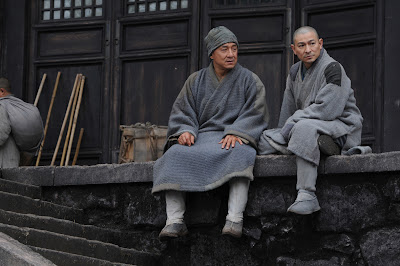
Shaolin

More recent samples of Chinese popular cinema came in the form of two big-budget Chinese epics that received their New York premieres at the festival, Benny Chan's Shaolin (2011) and Reign of Assassins (2010), directed by Taiwanese filmmaker Su Chao-pin with Hong Kong legend John Woo receiving a co-directing credit. Both are solid crowd-pleasers, offering the usual plate of impressively choreographed action sequences and mystical mumbo-jumbo. They both also share redemption as one of their mainthemes: In Shaolin, General Hou (Andy Lau) suffers a personal tragedy as a result of his ruthless, bloodthirsty ways, and decides his path to redemption lies with Buddha; in Reign of Assassins, for Drizzle, an assassin with a deadly way with a knife, redemption lies in a brand new face (shades of Woo's 1997 American action epic Face/Off?) and a nondescript existence in a village (Kelly Lin plays her pre-surgery, Michelle Yeoh plays her post-surgery). Anyone looking for the kind of nutty intensity and almost avant-garde inspiration of something like Zu: Warriors from the Magic Mountain will be disappointed; these films are almost classical in their visual elegance and focus on credible characterizations and coherent storytelling.


The aforementioned Su Chao-pin was the focus of a brief retrospective of his work during the festival, and while I wasn't able to see his 2002 film B.T.S. (Better Than Sex), I did see The Cabbie (2000), a comedy he wrote about a cab driver with an eccentric family and his even more eccentric attempts to woo a traffic cop (Rie Miyazawa). I sat through about half of The Cabbie thinking that I was watching tailor-made Sundance bait, its one-quirk-per-character preciousness bringing back not terribly fond memories of something like Little Miss Sunshine (2006); an English-language version of this film would, I bet, be a huge breakout hit. But the film offers some fascinating insights into the life of a cab driver—a passage in which the main character explains his way of determining what kind of passenger he's dealing with in each ride is especially funny and intriguing. And about halfway through, when the female traffic cop appears on the scene, the film finally latches onto a more interesting plot thread, about the titular cab driver's essential inability to relate the world outside the confines of his taxi in any "normal" way. Though his neuroses and naivete are generally played for lighthearted laughs, the film, in its last five minutes, takes a sudden turn toward darker waters (with an ending not unlike the last-minute shooting death that closes Jiri Menzel's Closely Watched Trains; the effect, in both cases, is akin to a filmmaker shaking its audience out of a collective complacent fog). When Su and directors Chang Hwa-kun and Chen Yi-wen decide to drop the cutesy stuff, The Cabbie becomes a briskly enjoyable human comedy with gestures toward territory more psychologically unsettling than its pleasant surface might indicate.


There's no hiding from the darkness of human nature, however, in Jang Cheol-su's Bedevilled (2011), which, from a plot summary, only seems like yet another revenge drama from South Korea (genre territory that was already playing out to diminished returns in Kim Jee-won's endless and nauseatingly nihilistic I Saw the Devil, released earlier this year in the U.S.). Oh, there is certainly vengeance in this film—sweet, brutal, gruesome, morally ambivalent vengeance. But the revenge Bok-Nam (Seo Yeong-Hee) eventually takes on her backwards hick clan is but one facet of a film that eventually reveals itself to be something of a parable for the dangers of passivity.

Though Bok-Nam is the most memorable character of the film by far, Bedevilled actually begins with Hae-Won (Ji Seong-Won), a childhood friend of hers. She's a city woman who has come upon some of her own professional and personal troubles, all of which come to a head in the film's opening 15 minutes, as a confluence of events eventually leads her to be fired from her bank-clerk job. The most telling thing that occurs in this opening passage, however, doesn't necessarily have anything to do with her personal problems. Right at the beginning, Hae-Won witnesses a mugging...but when the female victim runs up to her car to try to get help, she closes her window and drives on. She's later fingered as a witness and is forced to go to a police station and identify potential criminals in a lineup. When she sees the two muggers, what does she do? She lies to the police and pretends that those aren't the criminals, then demands that the police leave her alone regarding the mugging. Hae-Won embodies a familiar type: the tough-as-nails city dweller who has taken the idea of keeping to herself to an almost callous extreme. This turns out to be a necessary prologue, setting up a crucial decision she makes on Bok-Nam's behalf midway through the film that tragically paves the way her friend's violent mental collapse. If anything, though, Bedevilled is really Hae-Won's journey from self-interest to selflessness, summed up with a concluding dissolve that matches her torso with the shape of that fateful island.


Speaking of islands, Xue Xiaolu's Ocean Heaven (2010) details a more warmhearted emotional journey, centering around one father's (Jet Li) attempts to prepare his autistic son (Wen Zhang) for life without him after he dies. It's both as sentimental as the premise sounds, and not. With its sobbing Joe Hisaishi score (less insistent in tugging at your heartstrings than his music for the Oscar-winning Japanese films Departures, but still at times a bit more than necessary), its rather cheesy alignment of the son's autism with the freedom of sea creatures (however beautifully photographed by the great Christopher Doyle), and its too-neat resolution, Xue's conception of the disease often threatens to verge on Rain Man/A Beautiful Mind triteness. That it doesn't entirely to do so is a tribute both to Xue's low-key, straightforward direction and to the excellence of Li's performance; in his first non-action role, Li brings a quiet dignity and emotional honesty that occasionally elevates the sappy material into something more deeply moving. Ocean Heaven is ultimately more bland and inoffensive than actively terrible...but its opening scene—the father's failed attempt to kill both himself and his son—suggests the far edgier film this might have been.

Thankfully, the rest of the films I saw in this year's New York Asian Film Festival offered edge aplenty, whether visual, thematic, violent or otherwise. I'm already eagerly chomping at the bit to see what delirious wonders the guys at Subway Cinema have in store for all of us next year!

In the meantime, enjoy this year's festival trailer, which I saw about 12 times and which never failed to bring me to a smile or a chuckle: