Showing posts with label Fritz Lang. Show all posts

Friday, May 06, 2011

An Epic, Multi-Part Ebertfest Recap: Day One

EAST BRUNSWICK, N.J.—

DAY ONE: OPENING NIGHT (AND DAY)

The first screening of the 13th annual Ebertfest was scheduled for 7 p.m. (though, as I was soon to discover, none of the screenings ever actually started on time)...but, even as I made my way to Champaign's historic Virginia Theatre at around 4 p.m. to meet up with a few Twitter friends in person for the first time, I noticed a long line away going around the corner outside the theater. People were braving the rain to try to get the best seats in the house. The anticipation was in the wet, misty air!

My first day of the festival didn't begin with that evening screening, though. Instead, it began hours earlier, at around noon, when, upon Ali Arikan's invitation the night before, I decided to walk over to the Illini Union—University of Illinois Urbana-Champaign's student center—and meet up with him and a bunch of others to do what anyone visiting Champaign apparently is supposed to do as a matter of course: go to a Steak 'n Shake to consume burgers and milkshakes! Which I did, in the company of, among others, three more of Ebert's Far-Flung Correspondents: Michael Mirasol, representing the Philippines (even though he and his family currently live in Malaysia); Gerardo Valero, from Mexico City; and the 17-year-old wunderkind Krishna Shenoi, who comes from India but who currently lives with his family in Dubai. I was especially interested in meeting Michael, with whom I have had frequent online interactions over the past year since first hearing him speak, along with a bunch of other FFCs, at last year's Ebertfest via live-stream.

When we got to the Steak 'n Shake on Neil St., Michael was telling me about how, last year, the local media had swarmed onto that particular restaurant after Ebert had alerted people to that location on his Twitter feed. This time around, however, the coast looked clear...until we all noticed the one cameraman setting up near the entrance of the restaurant. 

Upon seeing this, Michael turned to me and his wife, Claire, and said, "Oh no, not again!" (He eventually did speak to this cameraman for an on-camera interview, though with vocal reluctance.)

As far as the lunch went...well, I wasn't totally blown away by the Western BBQ 'n Bacon Steakburger I had (though it was certainly far better than anything you'd get at McDonald's, to be sure), but the strawberry milkshake? Just look at the size of this thing!


This first day of Ebertfest would be marked by introductions to people I knew only from online interactions, in fact. Only a couple hours later, I would find myself standing in front of the Virginia Theatre, umbrella in hand, meeting with one Donald G. Carder—who heretofore had been known to me only as @theangrymick on Twitter—who was attending the festival with his wife Anne. I also met, for the first time, Moira (@PlaidGirl), Visha (@vanyc) and Greg (@litdreamer)—all of whom I would see again at various points in the next five days. (If nothing else, Ebertfest, by holding his festival in this one festival, helps foster lasting movie-connected friendships in ways that much larger festivals such as, say, South by Southwest can only dream of doing.) Along with Odie Henderson—the man the blogosphere knows best as Odienator—we all went to a nearby bar and hung out for a couple of hours before returning to the theater to try to get our seats for Ebertfest's opening night. Just before I went in, I was greeted by film critic/blogger Craig Simpson, who some of you may know as The Man from Porlock. (One of my regrets about this festival is that I didn't get as much of a chance to chat with him as I did with others. Sorry, Craig! Maybe next year?) And once I was in the theater about a half-hour before Ebertfest's first film began, I finally met in person film critic Mark Pfeiffer, who was sitting with a friend of his in what he said was his usual spot up in the balcony. (Mark turned out to be the one I relied on to offer some interesting historical context regarding past Ebertfests, I may end up sharing some of his tidbits of information later on.)

Noticeably absent from this roll call of film critics and Twitter buddies, by the way, were the estimable film critics/bloggers Jim Emerson and Marilyn Ferdinand, both of whom I was most excited to meet this year, and both of whom were unable to show up this year for various reasons. Sad face. Again, maybe next year?


And then, 7 p.m. struck. Roger Ebert and his wife Chaz came onstage about 10 minutes afterward and made some introductory remarks. Ebert himself came onstage with a white scarf; to me, he had the look of a high priest—a high priest of the cinema, at least for this event. They introduced film scholar Kristin Thompson—sans her equally distinguished husband David Bordwell, alas (laid low due to pneumonia contracted during his recent trip to the Hong Kong Film Festival)—to make some remarks of her own regarding the festival's first film. Then, the three members of the Alloy Orchestra—a group that is known for performing original scores to silent-film classics—took their places in the orchestra pit, and Fritz Lang's Metropolis (1927) began.


Naturally, we watched the recent "complete" version that premiered last year at Berlinale and which I saw during a two-week run at Film Forum. Thompson, as one would expect from a film scholar of her caliber, got into the nitty-gritty about how the extra footage that was discovered in Buenos Aires in 2008 ended up there in the first place (apparently, Argentina and many other South American countries were considered a big market by the German film industry at the time, so they often sent prints of their films there). For me, the extra footage—which includes one extra scene that adds an extra level of menace to a side character that, in previous versions, didn't seem play all that important a role to the action—neither diminishes the film nor makes it a much greater work; it's just longer now, but by no means is it any more sprawling. For a work of this scale, it's astonishing just how tightly constructed it is, really—especially in its third act, appropriately dubbed "Furioso" in this complete version.

The big news with the screening of the complete Metropolis at the Virginia Theatre that night was two-fold:

1. The digital print furnished by Kino International struck me as far more superior to the print I saw at Film Forum last year. With the latter, I was always aware I was watching a digital print; the one I saw at Ebertfest struck me as sharper and far more convincingly film-like. It can't be the larger screen deceiving my eyes, it can't be!

2. This is my first time seeing the famed Alloy Orchestra perform one of their of original silent-film scores live. Oh. My. God! My memory of seeing Gottfried Huppertz's original score accompanying the digital print seen at Film Forum is admittedly fuzzy, but I don't recall it having the same starkness and vividness of sonorities as this particular score conceived by members Terry Donahue, Ken Winokur and Roger Miller. In the film's first shot of the underground workers joylessly marching out of their jobs, all that their score called for were steady timpani thwacks—but the effect was as chillingly empty as the image surely calls for. Even more romantic moments that might have called for a more sweepingly upbeat approach—the moment the real Maria (Brigitte Helm) kisses Freder (Gustav Frohlich) after her rousing speech to the workers—still maintained an unsettling, almost doom-laden modernistic flavor to them. It was thrilling to hear this score accompany this, one of the grandest follies of the cinema, and still as amazing an achievement of the human imagination as ever...and if you missed it at Ebertfest, or last year at the TCM Film Festival in Los Angeles, you most likely won't be able to hear it! (That said, in a Q&A session after the screening, Terry and Roger said that this score was available on the Alloy Orchestra's website, but separately, not as an added soundtrack on home video. You'll have to sync the soundtrack to the film all by yourself.)


Apparently, it's rare for Ebertfest to feature two films on its opening night. But Ebert was one of the judges of the Narrative Feature Competition at South by Southwest in March, and apparently he was so smitten by Robbie Pickering's award-winning Natural Selection that, according to Chaz, he felt he had to try to get this film into his festival, without question.

I was not as big a fan of Natural Selection as Ebert and the other judges were, and I wrote so in this House Next Door dispatch. Nevertheless, when I discovered that Ebert had made this a last-minute selection in this year's Ebertfest, I figured I might as well sit through the film again to see if I could perhaps warm to it more. Let me put it this way: It wasn't an entirely unfruitful endeavor.

Perhaps the best way to look at the film is as a story of one woman's female empowerment (and it's real female empowerment, too, not the Zack Snyder/Sucker Punch male-fantasy bullshit) rather than as the facile satire of religious hypocrisy that it threatens to be in the film's choppy opening 15 minutes. Even in those opening moments, you can sense, in Linda West's behavior and facial expressions, a deep dissatisfaction with her lifestyle that she's possibly been repressing for years. Of course, even around supposed long-lost son Raymond (Matt O'Leary), Linda tries to hold onto that good-girl Christian image...and part of the fascination of Natural Selection, on a character-based level, lies in trying to determine just how much she truly buys into the goody-goody image. Is she secretly ready to cast it off, and is Raymond the one to help her finally do so? The brilliance of Rachael Harris's deservedly praised performance as Linda lies in her empathetic refusal to condescend to her character (unlike the way Pickering often condescends to the rest of her clan—though he said he intended nothing of the sort in the Q&A with him and Harris following the screening). You might find fundamentalist Christians of her ilk insufferable—and with the public prominence of groups like the Tea Party movement, it's arguably difficult for rational people not to find such behavior insufferable, on some level—but her brand of fundamentalism seems to come out of a heartfelt desire to do good—even for those (like her husband, we come to discover) who really don't deserve her charity.

I still can't say I'm crazy about Natural Selection, but I'll concede that there are elements in it worth celebrating. It sure as hell wasn't Metropolis, though...but then, what is?

And thus endeth the first day at Ebertfest.

Coming up next on this epic, multi-part Ebertfest recap: Two movies with dogs in them, another go-round with Lena Dunham's post-graduate malaise, and a raucous night of...what else? Karaoke, of course!

TO BE CONTINUED...

Monday, February 21, 2011

Darkness Falls: The (Black) Beauty of Film Noir

BROOKLYN, N.Y.—


Last year, the great film bloggers Marilyn Ferdinand of Ferdy on Films and Farran Smith Nehme of Self-Styled Siren hosted a fundraising blogathon geared toward film preservation. Called For the Love of Film, the blogathon raised about $30,000 for the National Film Preservation Foundation to help rescue a couple of silent short films from the 1910s. I contributed some of my hard-earned dough to that, and even contributed a blog post to it.

Now, those two intrepid bloggers are back with For the Love of Film (Noir), this time trying to raise film-preservation funds for the Film Noir Foundation. And unlike last time, we actually know from the outset the film that this latest blogathon is trying to restore: a 1950 crime drama directed by Cy Endfield called The Sound of Fury. I haven't seen the film, but for those who want to know more about it, you can read R. Emmet Sweeney's and Imogen Smith's posts about the actual film, then read the Siren's interview with Eddie Muller, founder of the Film Noir Foundation, here.

Maybe these blogathons just come at a bad time for me. My blog contribution to it last year came at the veeeeeery last minute, and this year, the week of For the Love of Film (Noir) has found me focusing more on scrambling to nail down reasonably priced housing and flights for South by Southwest next month. Believe it or not, yes, this has taken up much of my time this past week...though thankfully, I think I finally have secured both. But I've already missed one blogathon deadline this week because of all the attendant stress (it looks I won't be participating in this year's White Elephant blog-a-thon—a shame because I thoroughly enjoyed writing about the against-all-odds fascinating masterpiece of trash that was Michael Winner's 1984 film Scream for Help), and it looks like, while I won't technically be missing out on For the Love of Film (Noir), once again I'm holding my own contribution down to the wire. (For what it's worth, I've already made my donation...which you can do here.)

***

Ah, film noir! It's such a wide-ranging subject that honestly, I've had trouble coming up with a specific topic to write about for this latest blogathon, or at least one that I feel comfortable and authoritative enough to discuss at the moment. Perhaps, then, I'll start with what it is about film noir that fascinates me so much.

Maybe it's because of my own sheltered suburban upbringing that, over the years, I've developed a certain fascination with the kind of art that dares to shed light on the darker sides of human nature—the sides in all of us that we may suppress in the interest of good taste and decorum, but which often simmer underneath the surface. Film noir, at its most potent, is all about drawing out those buried tensions and exploring them to the limits, and sometimes even exploding them altogether.


I didn't get to see as many of the films in Film Forum's recent "Fritz Lang in Hollywood" series as I had initially hoped (blame my extended illness for that), but the Lang films I did see all made a deep impression on me for the depths with which Lang was willing to go to explore the forbidding corners of the human psyche. Neither Fury (1936) or You Only Live Once (1937), or, later in his American career, The Big Heat (1953) or Human Desire (1954)—all of those which I saw during the Film Forum retrospective—have a whole lot in common as far as the stories he tells. What makes them legit film noirs is, as Paul Schrader famously noted in his classic essay "Notes on Film Noir," "the subtle qualities of tone and mood. It is a film 'noir,' as opposed to the possible variants of film grey and film off-white." And indeed, all of those Lang films share a doom-laden mood suggested as much by his dark-hued expressionistic visual sensibility as by the deterministic bent of their respective plots. Witness, for instance, the near-surreal mist that envelops the prison that a desperate Eddie Taylor (Henry Fonda) tries to break out of in You Only Live Once, or the pool of shadow that engulfs Joe Wilson (Spencer Tracy) when his brothers first see him after his supposed death by lynch mob.

Such visual coups, though, are put in service of portraits of human nature that refuse to shy away from people's less savory potential. Fury, most notably, features as its protagonist a character who becomes so consumed by his increasingly inhuman sense of justice that he even threatens to cast off his devoted lover (Sylvia Sidney) when not even the conviction of the townspeople who "killed" him seems to bring him the satisfaction he desires. (The fact that his humane side eventually wins out doesn't lessen the pungent aftertaste left by Lang's otherwise pitiless depiction of mass hysteria and personal bloodlust.)


For me, though, it's not enough for a film to throw up appalling human behavior on the screen, surround the film with genre archetypes (hard-boiled gumshoes, femme fatales, and the like), bathe it all in an attractive visual style and call it a black-hearted noir. The best film noirs may feature disturbed characters and unsavory subject matter, but they have a sense of moral and spiritual anguish that adds genuine heft to their genre conventions. For all the world-weary wisecracking he does, Jeff Bailey, the trampled-on p.i. Robert Mitchum plays in Jacques Tourneur's Out of the Past (1947), seeks to be delivered from his troubled past; his sense of honor, in part, eventually pulls him back into the depths, as often happens in film noirs...but Tourneur and Mitchum manage to involve us emotionally in this character anyway, making you feel the full weight of his quest, and the pathos of his eventual, tragically inevitable failure.


Or consider Dix Handley (Sterling Hayden), one of the doomed thieves at the heart of John Huston's The Asphalt Jungle (1950). During the Great Depression, Dix's family lost control of their horse farm in Kentucky; Dix—who functions as the muscle for the heist masterminded by Erwin "Doc" Riedenschneider (Sam Jaffe)—sees this robbery as his ticket to buy back the farm and regain his lost livelihood. When the heist doesn't go as planned, however, a series of deceptions and double-crosses leads an injured Dix, towards the end of the film, to drive all the way down to that horse farm and eventually die, as horses surround hims dead body. Unlike Tourneur and Lang, Huston adopts a naturalistic style in his film; much of the film plays as cool-headed dissection of a heist gone wrong. Within that style, though, The Asphalt Jungle manages to lavish utmost attention on the desires that drive the various characters in this drama; we end up developing a genuine stake in seeing these characters succeed—a subversive feat regarding characters that, in real life, we might merely dismiss as mere lowlifes and hoodlums.

That's the beauty of not only film noir, but of cinema as a whole: the ability it has to bring us into the lives and desires of characters we may never think of observing or even sympathizing with, as well as the possibility of being drawn to consider a way of looking at the world that might disturb and discomfort. As long as humanity carries desires, however unsettling, that we mostly try to suppress, and which sometimes rise to the surface in terrifying fashion, there will always be a place for noir. Now and forever.

Monday, January 31, 2011

A Human Desire...to Ape Fritz Lang?

BROOKLYN, N.Y.—Here's a taste of the kind of weird connections the visual side of my brain is wont to make when it comes to the movies.

On Saturday, I took in a double bill of Fritz Lang's Human Desire (1954) and The Big Heat (1953), the first two films being shown in Film Forum's "Fritz Lang in Hollywood" series, in which all of the great Austrian director's Hollywood films are being screened. I had seen neither film previously, by the way; both turned out to be terrific, especially The Big Heat, which still carries a shocking, brutal charge decades later in its pull-no-punches depiction of a whole system of corruption, on both sides of the law. But Human Desire is quite good, too; it's an adaptation of the same Émile Zola novel that Jean Renoir adapted into La Bête Humaine (1938), and in some ways Lang's chilly determinism suits the material better than Renoir's warmer humanism. 

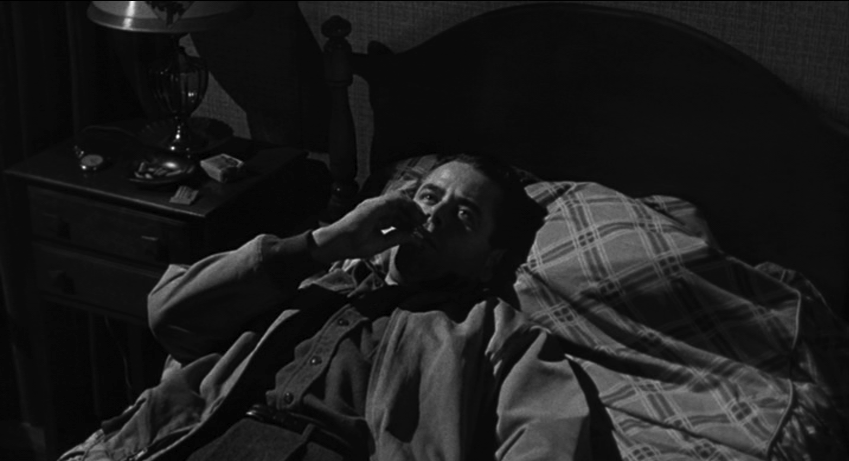
Anyway...at one point in Human Desire, there is a shot of Glenn Ford lying on a bed smoking, in a contemplative state of mind:


This composition looked rather familiar to me. Then my mind turned to this:


Yes, folks, that is Kevin Bacon from the original Friday the 13th (1980), enjoying a post-coital cigarette, completely unaware of the arrow he's about to get through his throat. Doesn't the mise-en-scène in that shot seem at least somewhat similar to that shot of Ford on the bed in Human Desire? Was Sean S. Cunningham possibly paying tribute to Lang with that shot?

Or is it just me?

Monday, May 10, 2010

"California! California! Here We Come!"

EAST BRUNSWICK, N.J.—By the time you all read this, most likely I will be (picture me wincing while I say this) up in the air, on my way to California for a week around the SoCal area—Los Angeles, principally, but perhaps other areas like San Diego.

I would like to try to update this blog during my venture, in order to give you all a reasonably live peek into what I'm doing/observing over there on a regular basis. We'll see if that pans out.

In the meantime, as a parting gift to you all...how about a clip from Metropolis?


On Saturday, I went to Film Forum in New York to see the new, near-complete restoration of Fritz Lang's 1927 sci-fi epic, and at the very least, it proved to be a thrilling and necessary palate cleanser after sitting through Iron Man 2 the night before. To be fair, Lang's vision of a futuristic society strictly divided into workers and planners is perhaps not much more nuanced than a comic book, in some ways—but man, what obsessive invention and visionary freedom Lang brings to this world compared to Jon Favreau's dull, uninspired image-making! And while some may find Lang's "hand and brain must have the heart as mediator" message to be somewhat cheesy in retrospect, the nutty conviction and sincerity he brings to the material easily outclasses the breezy, if admittedly often funny, snark of Iron Man 2. Metropolis was always a mad, passionate, glorious spectacle; now, thanks to 16mm. footage discovered at the Museo del Cine in Buenos Aires, there is more of it to savor (at least, amidst the heavy wear and tear of the new footage). 

See it, if this new version is playing in a theater near you, and remind yourself of what real cinematic daring, unencumbered by Hollywood box-office dictates, looks like.

In the meantime, I'm off to have my own potentially daring adventure on the other side of the States. I'll try to stay out of trouble, I promise!