Sunday, April 01, 2012

White Elephant Blogathon 2012: Preying for a Trash Masterpiece

BROOKLYN, N.Y.—[This is my contribution to the White Elephant Blogathon. What is the White Elephant Blogathon, you may be wondering? Well, here are some details.]


After accidentally missing the deadline to submit a title for last year's edition of the White Elephant Blogathon, I made it a point to participate this year.

Considering how many people have or have not wasted their time watching crappy movies assigned to them for this blogathon, why did I want to commit myself to it this year? Probably because I got a doozy of an assignment two years ago when I contributed to this online event, a film directed by Death Wish auteur Michael Winner called Scream for Help (1984), and one so bad in so many genuinely fascinating ways that, yes, I would actually go so far as to place it in the "so bad it's good" pantheon reserved for other legendary pieces of celluloid waste like Ed Wood's Plan 9 from Outer Space. (I'm serious when I say that it really is something to see; I refer you all to my review of it here.)

I was hoping that lightning might strike twice this time around, that I might get a chance to cut my teeth on something that was dreadful in ways that might actually inspire something like actual critical analysis. Did it happen?

Well...yes and no—mostly no, I'm afraid, though it does have one moment towards the very end that almost makes sitting through the rest worth your trouble.


This year, I was assigned to watch an action film called Deadly Prey (1987). You can tell this is from the 1980s right from the get-go with a wide shot of a silhouetted figure running up a hill and pumping a gun in the air, which leads into an opening-credits sequence that intercuts title cards with shots of all manner of weapons being loaded one at a time. 

An opening suspense sequence sets up the premise of director David A. Prior's film. A bunch of mercenaries—led by jacked-up sunglasses-wearing second-in-command Lt. Thornton (Fritz Matthews)—are hunting after some random chubby guy, looking to kill him. They eventually accomplish their mission, but not after the guy resourcefully knocks out one of the mercenaries; Thornton eventually kills this member, presumably for his failure to measure up to this covert army unit's high standards.

The next scene fleshes this opening scene out some more. We are introduced to Thornton's superior, Col. Hogan (David Campbell); we learn that the chubby guy was some random dude picked off the street for, essentially, target practice for these mercenaries-in-training. Now they need a new victim for their game. That's where our hero, Mike Danton (played by Ted Prior, David A. Prior's brother), comes in.

Before we get to Danton, however, allow me to draw attention to two things I noticed in these first two sequences:

1. Was some of the dialogue of this film recorded in post-production and synchronized after the fact? It sure sounds like it to my ears; there is a disembodied quality to some the line readings that sounds like something I usually hear in, say, old Italian films, when post-synchronized sound was the norm. So it may not just be the acting itself that's bad. (Was the budget for this film so low Prior couldn't even afford to record sound directly throughout the whole production?)

2. There's nothing technically wrong with the editing in the opening suspense sequence...and yet, strangely, the filmmaking still feels like pure amateur hour. There are barely any shots in which the predators and their prey occupy the same frame; for all I know, Prior could have shot the mercenaries and the chubby guy in two entirely different parts of this forest. Heck, even I've done that! Years ago, back when I was living in central New Jersey, I picked up a video camera one time and tried to make my own slasher flick, discovering quickly that, on a budget of zero dollars, all I needed to do to suggest someone getting killed was just juxtapose a shot of a sharp object with the pained expression on a victim's face. (And because I was under the influence of the Friday the 13th films at the time, I destroyed a fair amount of strawberries to simulate blood splattering.) It's the Kuleshov effect at its finest! It would be miraculous if it turned out the auteur behind this film and Killer Workout (1987) knew who Lev Kuleshov was; alas, when you see mercenaries shooting at the chubby victim and, in the next shot, hear no gunfire as the victim falls to the ground in pain, you realize that perhaps there are limits to Prior's grasp of continuity after all.

All right, back to Mike Danton.


Danton is introduced as an ordinary man struggling to get out of his bed (a water bed, by the way; people actually sleep on those things?) and taking out the trash before he is randomly kidnapped by two of Hogan's men for this deadly venture. Naturally, though, these men have no idea what they've just gotten into; Danton, it turns out, is a Vietnam veteran who has a way with, say, turning tree branches into weapons and staying alive by eating worms and cooking rats.

In essence, he's John Rambo redux, and Deadly Prey could be seen a low-rent variation on First Blood (1982), even if its good-versus-evil setup places it in more of an uncomplicated Rambo: First Blood, Part II (1985) mindset than in the more intriguingly ambiguous mold of Ted Kotcheff's original. (There's one shot of Danton pointing a machine gun up in the air and firing off a bunch of rounds that recalls a similar shot towards the end of Part II, except without Stallone's howl of testosterone-fueled frustration while he does it.) And just as Rambo's last name reminded Pauline Kael of his "namesake" Arthur Rimbaud, Danton's last name recalls Georges Jacques Danton, the Frenchman who is often credited for being one of the pivotal figures of the French Revolution. You could say that the Danton of Deadly Prey initiates his own revolution against Col. Hogan, Lt. Thornton and the rest of this sadistic band of mercenaries—though this Danton is hardly the more morally ambiguous Danton of French history (Georges Jacques was eventually convicted of financial corruption and killed by guillotine).


Beyond all that, alas, there isn't a whole lot to say about the rest of the film once Danton begins to fight back against his captors, one by one. There's little sense of geography or continuity underpinning the action sequences, and thus precious little in the way of coherence or sustained suspense; Danton just seems to materialize whenever and wherever he wants in that forest. Deadly Prey has the requisite macho action-movie misogyny, featuring a mere two female characters—Danton's helpless wife Jaimy (Suzanne Tara) and mercenary super-bitch Sybil (Dawn Abraham)—both of whom eventually meet ignominious ends.


It also features two legendary Hollywood actors among the cast: Actors' Studio veteran Cameron Mitchell, as Jaimy's policeman father; and former teen heartthrob Troy Donahue, as the rich backer of Col. Hogan's mercenary operation. Putting aside the predictable and not particularly interesting question of why these two actors bothered to appear in this junk in the first place, I would like to point out that, though the role these actors play in Deadly Prey both amount to glorified cameos, both are given top billing in the opening credits! Not even Glenn Ford was granted that honor when he appeared in the 1981 slasher film Happy Birthday to Me! Mitchell and Donahue do have one scene together, in which Mitchell delivers a speech decrying Donahue and the rest of his rich, inhumane ilk before blowing him away; maybe David A. Prior found the prospect of putting these two famous actors together exciting, but unfortunately, there isn't a whole lot in that scene worth writing home about, other than the fact that Mitchell brings more convincing emotion to that scene than Ted Prior brings to any one line reading as the hero.

And onward to that aforementioned one memorable moment of Deadly Prey. Should I spoil it? Let me put it this way: This may be the only film where you will see a man's arm being used as a bludgeoning weapon after it has been dismembered from his body. It's the only time in this cheesefest that I found myself laughing out loud, and possibly the only bit of inspired awfulness in what is an otherwise just plain bad, bad movie—and not even all that fun bad, either.

Wednesday, March 28, 2012

Artistic Consumption Log, March 19, 2012 - March 25, 2012

BROOKLYN, N.Y.—Apparently seeing six films in one day—as I did on Saturday—was enough to sap me of, well, energy in general. (I'm sure the mere five hours of sleep I got on Saturday night didn't help.) Thus, another week, another bare-bones artistic consumption log (and a late one at that). Plus, I've been quite the busy, busy bee over the past week, and I'm anticipating this coming week to be about as bursting with activity—not just artistically, but as far as my career hopes goes. And that is all I will say for the moment.

Distant Voices, Still Lives (1988)

Films

New Directors/New Films 2012, all screenings in New York:
Generation P (2011, Victor Ginzburg), seen at Museum of Modern Art
★ Twilight Portrait (2011, Angelina Nikonova), seen at Museum of Modern Art
★ Las Acacias (2011, Pablo Giorgelli), seen at Museum of Modern Art
Romance Joe (2011, Lee Kwang-kuk), seen at Museum of Modern Art
★ How to Survive a Plague (2011, David France), seen at Walter Reade Theater

★ Distant Voices, Still Lives (1988, Terence Davies), seen at Brooklyn Academy of Music in Brooklyn, N.Y.

★ Compline (2009, Nathaniel Dorsky), seen at Whitney Museum of American Art in New York
★ Aubade (2010, Nathaniel Dorsky), seen at Whitney Museum of American Art in New York
★ The Return (2011, Nathanie Dorsky), seen at Whitney Museum of American Art in New York [second viewing]

Music

★ The Man-Machine (1978, Kraftwerk)
★ Computer World (1981, Kraftwerk)

★ 我是一片雲 (1977, 鳳飛飛)

Literature

★ A Visit from the Goon Squad (2010, Jennifer Egan)

Art

★ Hearsay of the Soul (2011, Werner Herzog), seen as part of Whitney Biennial 2012 at Whitney Museum of American Art in New York

Monday, March 19, 2012

Artistic Consumption Log, March 5, 2012 - March 18, 2012: Extended Fortnight Edition

BROOKLYN, N.Y.—Where have I been and what have I been doing, some of you might be asking, that led me to abandon this blog for two whole weeks?

I've been in Austin, Texas, for the South by Southwest Film Festival, that's where!

Yes, my friends, I did another year of SXSW, and once again covered it for The House Next Door. If this year's experience felt a bit less exciting than last year's—well, perhaps that has less to do with the quality of this year's line-up (though overall, I did find the batch of films I saw this year more hit-or-miss than last year's) than with the inevitable fact that, now that I already had done this once before, the sheer novelty of my being at a film festival outside of New York was already gone before I flew back to Austin about a week and a half ago. So the first flushes of discovery were mostly absent this time around. Thankfully, some of the films I saw picked up the slack—that and that one night I happened to get into a free performance that featured a final cameo appearance by none other than The Boss himself, Bruce Springsteen!


I have a whole bunch of links to post on this blog of pieces I published while at SXSW in addition to a couple of other non-SXSW-related links. I'll get to those in a future post...soon, I hope. For now, here's my latest artistic consumption log, in mere list form:

Keyhole (2011)

Films

★ Goodbye (2011, Mohammad Rasoulof), seen at Museum of Modern Art in New York [second viewing]

South by Southwest Film Festival 2012, all films seen in Austin, Texas:
The Cabin in the Woods (2011, Drew Goddard), seen at Paramount Theatre
Girls Against Boys (2012, Austin Chick), seen at Alamo Ritz
★ Girl Model (2011, David Redmon & A. Sabin), seen at Alamo Drafthouse Ritz
★ Tchoupitoulas (2012, Bill & Turner Ross), seen at Alamo Ritz
Killer Joe (2011, William Friedkin), seen at Paramount Theatre
Gimme the Loot (2012, Adam Leon), seen at Alamo Lamar
★ Keyhole (2011, Guy Maddin), seen at Alamo Lamar
★ The Do-Deca-Pentathlon (2012, Jay & Mark Duplass), seen at Alamo Ritz
★ The Raid: Redemption (2011, Gareth Evans), seen at Paramount Theatre
Compliance (2012, Craig Zobel), seen at Stateside
★ 21 Jump Street (2012, Phil Lord & Chris Miller), seen at Paramount Theatre
★ Somebody Up There Likes Me (2012, Bob Byington), seen at Alamo Lamar
★ Under African Skies (2012, Joe Berlinger), seen at Alamo Lamar
Intruders (2011, Juan Carlos Fresnadillo), seen at Alamo Ritz
★ Black Pond (2011, Tom Kingsley & Will Sharpe), seen at Alamo Lamar
Bernie (2011, Richard Linklater), seen at Paramount Theatre
★ Last Call at the Oasis (2011, Jessica Yu), seen at Alamo Lamar
Los Chidos (2012, Omar Rodriguez-Lopez), seen at Alamo Ritz

Music

★ Trans-Europe Express (1977, Kraftwerk)

★ The Stranger (1977, Billy Joel) [second listen]

The Modern Beethoven: A Philharmonic Festival:
★ Beethoven: Symphony No. 1 in C major, Op. 21 (1799-1800) / Hartmann: Concerto funèbre for Solo Violin and String Orchestra (1939/1959) / Beethoven: Symphony No. 3 in E-flat major, Op. 55, Sinfonia eroica (1802-04), performed by Gil Shaham (violin), David Zinman (conductor) and the New York Philharmonic at Avery Fisher Hall in New York

Television

★ Girls (2012- ), seen at Paramount Theatre in Austin, Texas

Monday, March 05, 2012

Artistic Consumption Log, Feb. 27, 2012 - March 4, 2012

BROOKLYN, N.Y.—Wait...I actually had time to annotate my artistic consumption log? Wow, look at that!

Moses and Aaron (1975)

Films

★ Sleepwalk (1986, Sara Driver), seen at Walter Reade Theater in New York
As my undying love for Wong Kar-Wai's Fallen Angels attests, I have a weakness for moody movies set predominantly during the night, where an atmosphere of seductive mystery envelops an often dreamlike narrative, cloaking things under cover of alluring darkness. Sleepwalk is the latest entry in this personal canon of mine; this second feature from unheralded New York independent filmmaker Sara Driver dives us into a seemingly desolate Lower East Side, in which a working-class mother (Suzanne Fletcher) finds herself caught under the spell of an ancient Chinese manuscript she is tasked to translate that slowly transforms the world around her. Jim Jarmusch did the gorgeous cinematography for this film, and it does share a spiritual connection with his 1980 debut feature Permanent Vacation (Driver is also best known for her collaborations with Jarmusch as producer of Stranger than Paradise); one can also sense a kinship of sorts between this and Martin Scorsese's After Hours (1985), another surreal chronicle of increasingly oddball goings-on in New York at night.

Man, I live for films like this. I could dream about movies like this all day long.

But don't take my word for it, New Yorkers. At the end of the month, Anthology Film Archives is screening all of Driver's three major films (this, You Are Not I before it and When Pigs Fly after it), none of which are easily available on video (yet). I look forward to seeing her other work; the rest of you will have a chance to discover Sleepwalk in what I assume will be the same brand new, beautiful-looking 35mm print that screened at Film Comment Selects this past Wednesday. Maybe, when you come out of it, you'll feel the same sense of melting enchantment that I did.

★ Moses and Aaron (1975, Jean-Marie Straub and Danièle Huillet), seen on DVD in Brooklyn, N.Y.
A friend of mine gave me a copy of New Yorker Films's DVD edition of this screen adaptation of Arnold Schoenberg's unfinished twelve-tone opera to me as a birthday gift at the end of last year; on Thursday night, I found myself bored at home in Brooklyn and decided to finally watch it.

I hadn't seen any of the work of this famous avant-garde filmmaking couple previously beyond seeing them in Pedro Costa's excellent 2001 documentary about them, Where Does Your Hidden Smile Lie?, in which Straub and Huillet spend the first 10 minutes or so of the film arguing over the right moment to cut away from a particular image. That same precision marks Moses and Aaron, allied to a minimalist style that emphasizes long takes that, at some points, seem to visually search for the God that Schoenberg's Moses perceives but can't quite express. It's a style that suits the opera, which is composed of static tableaux that play more often like oratorio than drama.

The real discovery of Moses and Aaron, for me, was the opera itself. This is surely one of the greatest operas ever written! Its atonal language is, to my mind, a perfect—and yes, often beautiful—expression of the kind of spiritual and religious doubts that are at the heart of this work, supporting a deeply philosophical interpretation of these Bible episodes that climaxes, at the end of its second act, in an unsettling soaring F-sharp that underscores the moment that Moses collapses onto the ground and desperately cries out, "Oh word, thou word, that I lack!" Schoenberg's opera was supposed to be three acts, but he was never able to finish the last act; I can't a more perfect ending, however, than the note of profound self-doubt that concludes the second act.

I could go on—especially in regards to how Straub and Huillet manage to subtly transform Schoenberg's meditation on words and images into something completely cinematic in nature—but perhaps that is for another blog post. Certainly, there's much to parse on another viewing. Best birthday gift ever?

Music

★ Autobahn (1974, Kraftwerk)
★ Radio-Activity (1975, Kraftwerk)
Yes, I was among the many stooges that attempted, and failed, to buy tickets to the upcoming Kraftwerk concert series at Museum of Modern Art. My dirty little secret? I hadn't actually listened to any of the German electro-pop band's music beyond the title track of Trans-Europe Express (and I was only exposed to that, really, through the ringtone of one of my college roommates). Well, thanks to Spotify, I now have the bulk of their major albums at my fingertips...so I decided to finally start listening to some.

The two takeaways from hearing these two albums:

  1. "Kometenmelodie 2" from Autobahn gives me an uplifting rush every time I hear it, and offers a nice contrast to its more ominous preceding track, "Kometenmelodie 1."
  2. The title track of Radio-Activity is so haunting that, to my mind, it easily towers over the rest of the album, which is given more to sonic soundscapes than pop-y hooks. (It could easily have fit on the soundtrack of a movie like Sleepwalk, really—maybe without Ralf Hütter's vocals, though.)

Theater

★ Richard III (1591, William Shakespeare), performed at Brooklyn Academy of Music in Brooklyn, N.Y.
As Richard III, Kevin Spacey affects an exaggeratedly awkward gait and shouts and growls his lines about as often as he delivers them straight. In other words, he hams it up big time. It should be annoying, and I certainly wouldn't call it creepy or unsettling...and yet, somehow, it works in the context of this Sam Mendes-directed production, the last in Brooklyn Academy of Music's Bridge Project (bridging American and British actors together in productions of stage classics). Spacey's flamboyant, cartoonish villainy has the odd effect of drawing attention to himself whenever he's onstage but also decentralizing his character; he's so cartoonish that, whenever he isn't onstage, the spotlight naturally shines on the more human-scaled characterizations of the rest of the cast. The heart and soul of this production doesn't lie so much in Richard III—a magnificent bastard to the very end, notwithstanding that one moment late in the play where he's suddenly stricken with an attack of conscience—as in everyone his ruthless, vengeful machinations affects, especially Queen Elizabeth (Haydn Gwynne), who is one of the only characters who has the fortitude to stand up against him in that one electrifying tête-à-tête in which Richard tries to persuade her to give him her daughter's hand in marriage.

Beyond Spacey's performance, Mendes's production is notable mostly for some of its technical innovations: its economical use of one set, its richly varied lighting design, even its use of a live-video simulcast at a crucial juncture. It's modernized without being set in any specific time (this isn't a reinterpretation on the order of Ian McKellen's 1930s fascist-England Richard III); Mendes seems to be aiming for a vague sense of universality in this abstract take.

I'm not sure if I'd consider this a great Richard III, but at the very least, I found it a very entertaining one.

Sunday, March 04, 2012

A Linkthrough Catch-up, Or Stuff I've Published Recently

EAST BRUNSWICK, N.J.—At the beginning of the year, I made a resolution to, if nothing else, try to be more productive on the writing front. I don't know what happened last year or why, but I went through long stretches where I felt barely a desire to write any serious film criticism at all beyond those brief sketches of reviews I'd set out in my artistic consumption logs. 2012, however, feels like the year in which I need to make some kind of major change in my life; I'm still not really sure what that change would entail, but perhaps I could at least push that change along by making more of an effort to be productive as a critic/writer.

Thus, I've been a bit busier both at and outside of my day job...so busy, it seems, that I haven't even had time to put up links here at this blog to the stuff I've published recently!

So here, in list form, are some links for you all to peruse, if, for some reason, you haven't been following me on Facebook and/or Twitter:

The Snowtown Murders (2011, Justin Kurzel)—reviewed here [P.S. This film was originally called Snowtown, and some of you may have already heard about this film by that name. That title, in my opinion, should have remained.]
On the Ice (2011, Andrew Okpeaha MacLean)—reviewed here; I also did this interview of the director
Transfer (2010, Damir Lukacevic) and All Watched Over By Machines of Loving Grace (2011, Adam Curtis)—both reviewed here
We Have a Pope (2011, Nanni Moretti)—reviewed here

As I get more stuff published going forward, I will try to be more prompt with the linkthroughs. Considering that I will be heading off to Austin, Texas, once again for South by Southwest in a few days, I suspect the linkthroughs are about to get even more plentiful!

Wednesday, February 29, 2012

Artistic Consumption Log, Feb. 20, 2012 - Feb. 26, 2012: "Award Season Is Finally Over" Edition

BROOKLYN, N.Y.—A bout of sickness over the past weekend laid me low—or, at least, low enough that I didn't feel much energy in constructing my latest artistic consumption log even during the sick day I took from work on Monday. (I'm better, if not completely 100%, now, for those who were concerned; I'm assuming it was just a bad cold.)

Since I'm late with this log, once again it will go unannotated. Simply put: Philip Glass live ruled, the Oscars sucked, and Doug Wheeler's light-and-space installation at the David Zwirner Gallery offered a mind-expanding 10 minutes—which, in my case, was preceded by three hours of waiting in the cold. Another New York art event, another last-minute scramble to see it before it closes—an unfortunate pattern, that.

Philip Glass (center) and members of the Philip Glass Ensemble after a triumphant live performance of Glass's Music in 12 Parts at Park Avenue Armory Saturday evening

Films

Film Comment Selects 2012, all films screened at Walter Reade Theater in New York
★ Rebellion (2011, Mathieu Kassovitz)
Face to Face (1975, Ingmar Bergman)

★ Twin Peaks: Fire Walk With Me (1992, David Lynch), seen at 92YTribeca in New York [second viewing]

Music

★ Music in Twelve Parts (2007, The Philip Glass Ensemble)
★ Philip Glass: Another Look at Harmony - Part IV (2008, Choir of the 21st Century)
★ Music in 12 Parts, performed by The Philip Glass Ensemble live at Park Avenue Armory in New York

Dance

Romeo + Juliet (2007, Peter Martins), performed by New York City Ballet at David H. Koch Theater in New York

Art

★ Doug Wheeler: SA MI 75 DZ NY 12, seen at David Zwirner Gallery in New York

Television

The 84th Annual Academy Awards, seen in Brooklyn, N.Y.

Monday, February 20, 2012

Artistic Consumption Log, Feb. 13, 2012 - Feb. 19, 2012

BROOKLYN, N.Y.—This past week, I've found myself about as busy writing film reviews as I've been busy seeing films and experiencing other cultural events. So you'll all eventually hear about some of the works I list below. For now, I'm afraid I'll have to keep this barebones once again.

Just know that, for New Yorkers who are into the theater, Signature Theatre Company's current production of South African playwright Athol Fugard's early 1961 drama Blood Knot is worth seeing...especially at the price of $25 a ticket. (With Broadway prices as through the roof as they are, one would, I think, be foolish not to jump on such a deal and take a chance on something unfamiliar!) Its final 10 minutes turn a seemingly harmless game of role-playing into a nightmare fantasy of apartheid race relations in a manner that is truly sobering and devastating.

I wish I had been able to articulate those sentiments to Fugard himself...who was sitting a mere two seats away from me, up in the balcony of Pershing Square Signature Center's Griffin Hall. But alas, when presented with an opportunity to do so, I got rather starstruck and tongue-tied. I did get to pick up his hat and hand it to him as he left the audience chamber...which led him to ask me what I thought of the performance, upon which I responded that I thought it was great (and I meant it, too). But that was it, in the end.

Oh well. At least I can feel content at basking in the glow of a wonderful theatrical experience. Because, in the end, that's all that matters, right?

All Watched Over By Machines of Loving Grace (2011)

Films

Zelig (1983, Woody Allen), seen at IFC Center in New York

Film Comment Selects 2012:

★ Transfer (2010, Damir Lukacevic), seen on DVD in Brooklyn, N.Y.
We Have a Pope (2011, Nanni Moretti), seen at Walter Reade Theater in New York
★ All Watched Over By Machines of Loving Grace (2011, Adam Curtis), seen at Walter Reade Theater in New York

Music

★ 似火探戈 (1987, 梅艷芳) [umpteenth listen]

★ Genius of Modern Music, Vol. 2 (1952, Thelonious Monk)
Monk (1953, Thelonious Monk)
★ Thelonious (1954, Thelonious Monk)

Theater

★ Blood Knot (1961, Athol Fugard), performed at Pershing Square Signature Center in New York

Monday, February 13, 2012

Artistic Consumption Log, Feb. 6, 2012 - Feb. 12, 2012

BROOKLYN, N.Y.—I've suddenly found myself fairly busy, what with a bunch of film reviews and an interview blog post on the horizon...so this week's artistic consumption log will be another barebones effort. As you can see, though, the highlight was easily my first exposure to the gorgeous, haunting, ceaselessly changing textures of Steve Reich's Music for 18 Musicians via his 1978 ECM recording. Who says minimalism can't be beautiful?


Films

The Prefab People (1982, Béla Tarr), seen at Walter Reade Theater in New York

Snowtown (2011, Justin Kurzel), seen at Magno Review in New York

On the Ice (2011, Andrew Okpeaha MacLean), seen at WME Screening Room in New York

Michael (2011, Markus Schleinzer), seen at Film Forum in New York

"Academy Award-Nominated Animated Short Films 2012," all films seen at IFC Center in New York
★ Sunday/Dimanche (2011, Patrick Doyon)
★ A Morning Stroll (2011, Grant Orchard & Sue Goffe)
★ Wild Life (2011, Amanda Forbis & Wendy Tilby)
★ The Fantastic Flying Books of Mr. Morris Lessmore (2011, William Joyce & Brandon Oldenburg)
La Luna (2011, Enrico Casaroasa)
Skylight (2011, David Bass)
★ Hybrid Union (2011, Serguei Kouchnerov)
Nullarbor (2011, Alister Lockhart)
Amazonia (2011, Sam Chen)

"Academy Award-Nominated Documentary Short Films 2012," all films seen at IFC Center in New York
Incident in Baghdad (2011, James Spione)
★ Saving Face (2011, Daniel Junge & Sharmeen Obaid Chinoy)
★ The Tsunami and the Cherry Blossom (2011, Lucy Walker) [second viewing]
★ The Barber of Birmingham: Foot Soldier of the Civil Rights Movement (2011, Gail Dolgin & Robin Fryday)

"Academy Award-Nominated Live-Action Short Films 2012," all films seen at IFC Center in New York
★ Pentecost (2011, Peter McDonald & Eimear O’Kane)
Raju (2011, Max Zähle & Stefan Gieren)
★ The Shore (2011, Terry George)
★ Time Freak (2011, Andrew Bowler & Gigi Causey)
Tuba Atlantic (2011, Hallvar Witzø)

Music

★ Sonatas and Interludes for Prepared Piano (1998, John Cage, performed by Aleck Karis)

★ Music for 18 Musicians (1978, Steve Reich)

★ Einstein on the Beach (1993, Philip Glass/Robert Wilson)

Literature

Monday, February 06, 2012

Artistic Consumption Log, Jan. 30, 2012 - Feb. 5, 2012: "Sudden Obsession With Minimalism" Edition

BROOKLYN, N.Y.—During this past week, I suddenly found myself—thanks mostly to the Philip Glass 75th-birthday concert that I attended at Carnegie Hall on Tuesday—developing a fascination with musical minimalism.

After hearing Glass's latest symphony, his Ninth, at that concert (a pretty good piece, actually, though I found the accompanying work, Arvo Pärt's Lamentate, even more impressive), I decided to scour Spotify to see what other Glass works the streaming music service had in its library...and lo and behold, I discovered they had the complete 1993 recording of his seminal 1976 opera Einstein on the Beach. So I listened to some of it that night...and since then, I haven't been able to stop listening to bits and pieces of Einstein, finding myself strangely fascinated by the seemingly endless repetitions and variations. Say what you will about Glass's brand of minimalism, but his music somehow worms its way into your skull, whether you like it or not. I guess I kinda like it, because I haven't been able to listen to, or think about, much else this past week!

Then, thanks in part to both Jan Swafford's The Vintage Guide to Classical Music and Alex Ross's The Rest Is Noise, I decided to search in Spotify's library for recordings of the work of some of Glass's minimalist contemporaries...which led me to the Bang on a Can recording of Terry Riley's groundbreaking 1964 work In C that I listened to as I came home from Juilliard's final John Cage concert Friday night. (Though In C is famously known as the first minimalist composition, it also embraces Cage's conception of "chance music" as part of its make-up, leaving instrumentation and length up to the performers while offering up 53 phrases and a set of performing instructions from which to fashion a performance. So it made for a good fit for post-Cage listening.) I also gave myself a brief taste of Steve Reich's Music for 18 Musicians, which I hope to get around to listening to in full sometime this coming week.

In short, I suddenly find myself on a serious modern-classical-music kick—so much so that even the emotionally devastating brilliance of Béla Tarr's Werckmeister Harmonies, which I saw for the first time on Friday afternoon, seems but a dim memory now in the face of so many endlessly repeating musical arpeggios rippling through my mind. (But hey, speaking of minimalism: Tarr's latest and supposedly last film, The Turin Horse, opens this Friday...)

Here's the log (which I didn't have time this week to annotate properly, so this will be just a bare-bones list of things I saw/heard):

Werckmeister Harmonies (2000)

Films

★ Werckmeister Harmonies (2000, Béla Tarr), seen at Walter Reade Theater in New York

The Forgiveness of Blood (2011, Joshua Marston), seen at Broadway Screening Room in New York

★ Bridesmaids (2011, Paul Feig), seen on DVD at home in Brooklyn, N.Y.

★ Pretty Poison (1968, Noel Black), seen at Film Forum in New York

Music

Yes (2009, Pet Shop Boys)

★ Genius of Modern Music, Vol. 1 (1952, Thelonious Monk)

"Sounds Re-Imagined: John Cage at 100":
★ Program II: Launching the Percussion Revolution, seen at Peter Jay Sharp Theater at The Juilliard School in New York
Program VI, seen at Alice Tully Hall in New York

★ American Composers Orchestra: Philip Glass 75th Birthday Concert, seen at Isaac Stern Auditorium/Ronald O. Perelman Stage at Carnegie Hall in New York


★ Terry Riley: In C (2001, Bang on a Can)

Monday, January 30, 2012

Artistic Consumption Log, Jan. 23, 2012 - Jan. 29, 2012

BROOKLYN, N.Y.—The list of films I saw this past week might have been longer had Saturday not been so beautiful a day that even thinking about seeing four films that day, as I had initially planned, filled me with a kind of existential despair. So, impulsively, I decided to nix the last two films I had planned to watch and went up to celebrate a friend's birthday at the Dave & Buster's in the Palisades Center Mall in West Nyack, N.Y.

Boy, that mall is huge! And flashy. See?


Plus, there's a Ferris wheel in it!


Thankfully, there were no telekinetic people lurking in the mall a la Robin Sandza from Brian De Palma's The Fury, threatening to send that wheel flying into oblivion.

As ever in my life these days, I'm not so much trying to balance work and play as trying to strike a balance between the different kinds of play at my disposal.

Anyway...the log!

John Cage

Films

Haywire (2011, Steven Soderbergh), seen at AMC Loews 34th Street 14 in New York
Maybe I went into this in the wrong frame of mind? Going into Steven Soderbergh's previous film Contagion, I was prepared enough for his by-now-typical aloofness that I found the experience of watching it strangely comforting, for all the disease, selfishness and industrial-toned imagery on display. Perhaps, then, I should have expected that he'd try something similarly cold and theoretical in what, in other hands, might have made for an overblown Hollywood action extravaganza. Soderbergh seems to deliberately suck the thrill out of seeing MMA star Gina Carano kick righteous ass, playing everything for drab "realism" as if he felt that was the only way he could approach such a banal script (written by Lem Dobbs). And yet, every once in a while, his detached approach yields disturbances—shots of Mallory's father (Bill Paxton) staring with a vaguely stunned expression at her daughter beating up on someone; overhead shots of duplicitous Kenneth (Ewan McGregor) panicking in the midst of certain doom—that puncture the sleek surface, adding interesting complications to the straightforward genre material, none of which Soderbergh or Dobbs bother to explore in any depth. Mostly, Haywire is as crushing in its general sense of indifference as Carano's fighting abilities are to her opponents. As for Carano: she doesn't set the world on fire as an actress, but she is indubitably an impressive physical performer and a suitably memorable presence. Maybe next time around, she'll have a more emotionally invested filmmaker directing her?

★ Come Back, Africa (1959, Lionel Rogosin), seen at Film Forum in New York
A valuable historical document of South Africa in the age of apartheid. It's a bit less successful as drama, and its final plot turn makes an unconvincing sudden lurch toward melodrama. But there are still some fascinating bits of documentary footage here (Rogosin shot this covertly on location using nonprofessional actors), and there is one keeper of a scene involving a bunch of black Africans arguing over politics and philosophy that interrupts the heady conversation with two musical numbers sung by legendary South African singer Miriam Makeba. (Seeing this reminds me: I still need to see Rogosin's previous film, the New York-set semi-documentary On the Bowery (1957).)

★ Rosetta (1999, Jean-Pierre & Luc Dardenne), seen at IFC Center in New York
This is the one post-La Promesse fiction feature from these Belgian filmmaking siblings that I had not seen; now that I've seen it (as part of this retrospective of the Dardennes' work), for me it places at or near the peak of their achievements (their subsequent feature, The Son (2002), runs it close). Unlike many other recent American indie films (Ballast and Frozen River are two films that immediately come to my mind) that are content merely to rub our faces in the misery of protagonists of Rosetta's kind—working-class, barely scraping by, struggling to make ends meet—Rosetta, while hardly stinting on depicting the unpleasant particulars of its main character's existence (constantly looking for a job, trying to support herself and her alcoholic mother), emphasizes her struggle to maintain her dignity and self-respect in spite of it all. The whole thing culminates in an astonishing 10-minute stretch that vaults the Dardennes' astonishingly physical directorial style into the realm of the spiritual; Rosetta's effortful progress with a gas tank suggests a modern variant of Jesus Christ's stations of the cross, trying to maintain composure even as Rosetta/Christ bears mockery all around her/him. Its destination is humane, transcendent, hard-won and genuinely inspiring without a hint of sentimentality. Why this wonderful film has still not made it to Region 1 DVD is beyond me.

"David Cronenberg," all films directed by David Cronenberg and seen at Museum of the Moving Image in Queens, N.Y.
Transfer (1966)
From the Drain (1967)
★ They Came from Within (1975)
They Came from Within—which is often referred to by its original title, Shivers—was David Cronenberg's first feature, and already he was making his obsessions with sexual body horrors apparent in ways that are as deliriously visceral as they are disturbingly clinical. The scenario—an apartment building in Montreal becomes Ground Zero for an infestation of parasites that turn their victims into sex-crazed "zombies"—is merely a springboard for Cronenberg to play around with all sorts of variations on the idea of sex as being akin to death. (The parasite is given an explicitly phallic look to it, and the ways in which they enter and exit hosts suggest all sorts of sexualized penetration—emphasized most memorably when one of these penis-shaped creatures propel their way into Barbara Steele's vagina while she's taking a bath.) Later films of his have arguably explored similar themes in a less overtly hysterical and reactionary manner; still, there are sparks of invigorating transgression here that horrify and exhilarate in the moment.

Before the feature, Museum of the Moving Image screened a couple of Cronenberg's 16mm student shorts. Both of them are rough around the edges and mostly pretty negligible, but they do suggest some of Cronenberg's later thematic interests. Transfer—with its goofy take on psychoanalysis as a patient tracks down his analyst, who is hiding away from the world—is interesting to see in light of his most recent film, A Dangerous Method, while From the Drain—with its vaguely Samuel Beckett-ish scenario of two characters with barely hinted-at traumatic backstories conversing while sitting in a bathtub—climaxes in a bout of bloodletting that could be seen as an apt curtain-raiser for They Came from Within.

Music

★ Bilingual (1996, Pet Shop Boys)
Nightlife (1999, Pet Shop Boys)
★ Release (2002, Pet Shop Boys)
★ Fundamental (2006, Pet Shop Boys)
The songs in Release suggest this British pop duo settling down into something approaching domesticity, with its surfeit of lyrical ballads and general de-emphasis on their usual gay iconography. It may also be my second favorite Pet Shop Boys album after Behaviour; I guess that's a testament to just how gorgeous some of those ballads are. The whole album is pretty lovely, really—especially "The Night I Fell in Love," the only cut that explicitly deals with homosexuality.

"Sounds Re-Imagined: John Cage at 100":
★ Program I, seen at Peter Jay Sharp Theater at The Juilliard School in New York
The Juilliard New Music Ensemble is celebrating the 100th birthday of revolutionary 20th-century composer John Cage with this week-long series of free concerts—and being that they were free (always a good thing for this 20-something New Yorker trying to save as much dough as possible!), I decided I might as well take some chances, having not heard Cage's music at all but knowing his reputation, and check out some of the programs. (I have a ticket for one other program tonight and will most likely try to get into another, sold-out performance later in the week).

For those who haven't heard of John Cage (no, folks, not the Mortal Kombat character) or his music, the best way I can describe his impact is this: He changed the way many people thought of "music," challenging traditional notions of what music could be and where it could be found. If composers like Arnold Schoenberg and the rest of his Second Viennese School peers were exploding conventional notions of tonality in the early part of the 20th century with their twelve-tone method and other innovations, Cage dared to obliterate tones altogether. I mean, who before Cage had ever thought of "composing" a piece like 4'33"—in which a pianist basically sits down and does nothing for four minutes and 33 seconds, opening up the possibility that whatever noises manifest themselves within that block of time could be the actual "music"? Or what about Imaginary Landscape No. 4, one of the pieces performed at the opening Friday night program, a work scored for twelve radios with volumes and frequencies adjusted according to Cage's instructions? No notes, simply whatever came on these radios whenever Cage indicated.

Such an openness to the music inherent in our everyday lives led Cage to eventually embrace the idea of "chance music"—music more dependent on the inspiration of performers than on the composer setting out fixed notes on a page. That's not the same thing as improvisation, however: Cage offered guidelines in these "chance" compositions but expected the performers to use them as a guide to fashion a composition of his/her own and rehearse it before a performance rather than come up with one on the spot. A good example of this is Theatre Piece (1960), also part of Friday night's program, and a work whose "score" consisted mostly of instructions to performers based on given nouns and/or verbs as well as numbers indicating volume levels and so on. Thus, each performance of such a piece could conceivably be different. The possibilities are endless!

Not all of Cage's innovations were quite so radical; sometimes he was content to simply be playful. Witness yet another work of his on Friday night's program Living Room Music, a brief 1940 four-movement piece featuring performers making rhythmic music out of kitchen utensil, books and so on. Apparently Cage quietly anticipated Stomp 50 years before that percussive musical troupe was even formed!

There's a lot more to say about John Cage's singular art, at least on the basis of both what I've read about him and on this one performance. So for now, I will just say that I found Friday night's concert to be a thrilling, sometimes funny and altogether revelatory experience. I'm eager to hear more of what came out of Cage's puckish, mischievous and outside-the-box musical mind.

For now...well, here's proof, via his 1948 piano piece In a Landscape, that Cage was also capable of more traditionally harmonic music of great beauty:

Friday, January 27, 2012

Maurizio Cattelan: All: A Multi-Media Post-Mortem

BROOKLYN, N.Y.—If nothing else, the work of Italian artist Maurizio Cattelan—whose work was recently the subject of a near-complete retrospective, titled Maurizio Cattelan: All, at the Solomon R. Guggenheim Museum in New York, one which ended Sunday (yes, as with the Museum of Modern Art's Willem de Kooning retrospective, I waited until the last minute to see this)—more often than not provokes us into an internal conversation as to how serious this guy actually is.

The "layout" of the exhibit itself clues you in as to Cattelan's sensibility:


Instead of the usual stately art-hanging-on-walls approach, Cattelan decided to "hang" all of his art from the Guggenheim's ceiling. A mere gesture of "look-at-me" irreverence, or something more deeply subversive? Considering that much of Cattelan's art has been site-specific in nature, his approach to All suggests an attempt to radically decontextualize his work and allow the viewer to determine how his work stands up by itself.

Perhaps this accounts for the extreme unevenness of the art on display. Works of bracing surreal creepiness—much of his taxidermy, for instance (are there other modern artists who have worked so extensively with taxidermy? I ask as an art novice, mostly)—and even occasional beauty alternate between other, thinner visual conceits that smack of an artist having a private joke of our expense. But perhaps some of the latter works resonated more within their original surroundings?

Still, there is something to be said for the kind of exuberant bomb-throwing spirit that was on display at the Guggenheim in this exhibit. At the very least, give me this kind of provocation over yet another boring still life any day!

I'll let these photos speak for themselves, from here on in (hardly an exhaustive selection, but some of the most memorable pieces, to my mind:

Untitled (2009)

La Nona Ora (1999)

Ave Maria (2007)

L.O.V.E. (2010)

Untitled (1995)/Not Afraid of Love (2000)

Stephanie (2003)

Mother (1999) [left]/Charlie Don't Surf (1997) [center]/Frau C. [right]

Him (2001)

And finally, some video of the experience! Two shots: one of Untitled (2001), which is not much more than a miniature elevator; the other taken at the top of the Guggenheim looking down into the morass of Cattelan art.

Monday, January 23, 2012

Artistic Consumption Log, Jan. 16, 2012 - Jan. 22, 2012

BROOKLYN, N.Y.—I don't have much to say about this past week beyond what I consumed artistically, so I might as well just get right into it.

Four Nights of a Dreamer (1971)

Films

"Bresson," all films directed by Robert Bresson and seen at Film Forum in New York
Une Femme Douce (1969)
★ L'Argent (1983)
★ Four Nights of a Dreamer (1971)
★ A Man Escaped (1956)
Holy shit, Four Nights of a Dreamer! It's as if Robert Bresson had seen into my soul and made a film out of what he saw. A Man Escaped, Pickpocket and Au Hasard Balthazar might be "better" films, but Bresson's take on the same Dostoyevsky story that Visconti turned into Le Notti Bianche (and that James Gray unofficially adapted into Two Lovers) shows the French filmmaker at least partially surrendering to his romantic impulses, and the result is, to my mind, as sublime as I was hoping it would be, especially in the lovely new 35mm print I saw Thursday night. Folks, I am that "dreamer"; I really don't think I can be even a little bit objective about this film, so thoroughly did I identify with its main character, for better and for worse.

★ Camera (2000, David Cronenberg), seen at Museum of the Moving Image in Queens, N.Y.
★ At the Suicide of the Last Jew of the World in the Last Cinema in the World (2007, David Cronenberg), seen at Museum of the Moving Image in Queens, N.Y.
These two short films—the latter a contribution to a larger anthology series called To Each His Own Cinema—were screened as part of a live conversation with the great Canadian filmmaker on Saturday. I hadn't seen Camera—which he made for the Toronto International Film Festival in 2000—before then, but it's actually a rich and wistful little meditation on cinema and aging. The second short is less rich—more a brief lark in which Cronenberg imagines himself standing at the precipice of the declining movie-going experience, waving a gun around and putting it in his mouth as television announcers do play-by-play of this momentous event—but it's amusing in its own black-comic way. Both are available to watch online, the former here, the latter here. More about the event itself below.

Music

★ Introspective (1988, Pet Shop Boys)
★ Behaviour (1990, Pet Shop Boys)
★ Very (1993, Pet Shop Boys)
I mostly have Cantopop singer Prudence Liew to thank for inspiring me to get into The Pet Shop Boys; she did a cover of the British electropop duo's 1987 hit "What Have I Done to Deserve This?" (a cover that substituted some of the synthesizer lines with actual horns—for those who care). I'm generally enjoying their music; there are always genuine emotional undercurrents coursing through the ostensibly upbeat, glitzy arrangements and through Neil Tennant's fey singing voice. The one that I found myself responding to most positively—ecstatically, in fact—however, is Behaviour, which has a mournful, dreamy quality to it that I viscerally respond to in something like...Four Nights of a Dreamer, actually. It also has "My October Symphony," which apparently was inspired by Dmitri Shostakovich's Second Symphony, entitled "To October." When's the last time you heard a pop song inspired by Shostakovich?

Very is also quite good, though I don't feel quite the same affection for it as I do Behaviour; still, their Village People's "Go West" is oddly affecting.

Literature

★ Catch-22 (1961, Joseph Heller)
I wrote a bit about this literary classic here; I finally finished it—after having to endure a week without it after having accidentally left my copy of it in a friend's purse—and its conclusion brings it all home in a rather beautiful, lightly existential and exhilaratingly irreverent way. Catch-22 fully deserves its reputation.

Art

"Maurizio Cattelan: All," seen at Solomon R. Guggenheim Museum in New York
As a result of the ton of photos I took at this exhibition, I think this warrants a whole separate post; perhaps then, I'll pool my rough impressions of this alternately invigorating and frustrating show. Stay tuned...

Other

"A Conversation with David Cronenberg," seen at Museum of the Moving Image in Queens, N.Y.
I don't have much to say about this event, really; it wasn't exactly heavy on revelatory insights into his fascinating body of work or his working methods. (Honestly, I'm already forgetting about a lot of it, a mere day or two after the fact.) Still, it was nice to be in the presence of a filmmaker as articulate about his own work, and as formidably intelligent, as Cronenberg is. His demeanor is fully in tune with the films he's made: clinical in its fascinated gaze toward ideas and images that most of us normally wouldn't want to contemplate.

Monday, January 16, 2012

Artistic Consumption Log, Jan. 9, 2012 - Jan. 15, 2012: "Robert Bresson Immersion" Edition

NEW YORK—As you could probably glean from the log below, this past week in artistic consumption was dominated mostly by Robert Bresson, as a complete retrospective of the legendary French director's work rolls along at Film Forum. A fuller consideration of Bresson's singular art perhaps awaits here on this blog; for now, I'll just offer these two observations/thoughts:

  • Apparently Bresson pretty much had, if not his style, then his thematic concerns figured out right from the get-go with his first "official" feature, Les Anges du Péché, with its nunnery setting, its anti-psychological approach and its preoccupation with themes of spirituality and religious transcendence. But the difference stylistically speaking between that film and The Devil, Probably—the latest Bresson feature I've seen thus far—is vast indeed.
  • So far, my favorite Bressons of the ones I've seen are two consensus faves, Au Hasard Balthazar and Pickpocket. To my surprise, though, the aforementioned The Devil, Probably is, as of now, not running too far behind. I'm still not entirely sure what to make of its take on one youth's societal disconnection, but at the very least, I found it more consistently engaging and fascinating to ponder than Lancelot of the Lake (great in its own way, though I admit to finding some stretches rather tedious). Plus, it has this brilliant piece of montage in the middle (though its brilliance might make more sense in context and with more than a passing familiarity with Bresson's late style).

The other major highlight of my week? Seeing the Brooklyn Art Song Society perform all 114 of Charles Ives's 114 Songs in one four-and-a-half hour marathon. It's quite a rich collection of tunes, ranging from Americana to settings of French/German poetry, playful little ditties to reflective religious meditations, and from tonal melodies to dissonant impressionistic evocations. Thankfully, there's enough variety in these songs to make those four-and-a-half hours pass by fairly quickly. I had never heard of the Brooklyn Art Song Society before hearing about this event through New Yorker classical-music critic Alex Ross's Twitter feed; I will have to investigate their music-making some more, after this well-wrought feat.

Oh...and the Golden Globe Awards were mostly a snooze. I didn't watch Ricky Gervais's controversial hosting job last year, but I guess I missed out on an edgier performance than what he offered last night. Plus, there weren't a great many surprises in any of the film categories. And that's all I have to say about that.

The log, please...

Pickpocket (1959)

Films

"Bresson," all films directed by Robert Bresson, seen at Film Forum in New York:
★ Les Anges du Péché (1943)
★ Lancelot of the Lake (1974)
★ Pickpocket (1959)
★ The Devil, Probably (1977)

Music

★ High Time (1971, MC5)

★ Please (1986, Pet Shop Boys)
Actually (1987, Pet Shop Boys)

★ Charles Ives: 114 Songs, performed by Brooklyn Art Song Society at Galapagos Art Space in Brooklyn, N.Y.

Television

The 69th Annual Golden Globe Awards, seen on NBC in Brooklyn, N.Y.

Tuesday, January 10, 2012

Literary Interlude, "Film Critic's Statement of Purpose" Edition

BROOKLYN, N.Y.—Recently, I decided to finally start reading some of the criticism of the late British-Canadian film critic Robin Wood...and right on the first page of his prologue introducing Hollywood from Vietnam to Reagan...and Beyond, I came across this passage that instilled me with utter delight with its insights and eloquence:

I am a critic. As such, I see my work as in many respects set apart from that of theorists and scholars (though it is of course frequently dependent upon them). The theorist and the scholar are unburdened of any necessity to engage intimately and on a personal basis with any specific work; they can hide behind their screens of theory and scholarship, they are not compelled to expose the personal nature of their work because they deal in facts, abstract ideas, and data. Any critic who is honest, however, is committed to self-exposure, a kind of public striptease: s/he must make clear that any authentic response to a work of art or entertainment is grounded not only in the work itself but in the critic's psychological makeup, personal history, values, prejudices, obsessions. Criticism arises out of an intense and intimate personal relationship between work and critic. If it is the critic's duty to strive for "objectivity" (in the negative sense of avoiding distortions), s/he knows that it is an objectivity that can never be fully achieved, because even when one is convinced that one "sees the work as it is," the relationship to it has still to be established. I have not the right to say, for example, "David Lynch makes bad movies": many people for whom I have great respect admire them, and they can certainly be defended on grounds of imagination, accomplishment, originality, strong personal commitment. I do, however, have the right to say, "I find Lynch's films extremely distasteful; my sense of value repudiates them."

The critic, it follows, must never set him- or herself up as some kind of infallible oracle. The relationship between critic and reader must always be one of debate. One might invoke here F. R. Leavis's famous definition of the ideal critical exchange: "This is so, isn't it?" / "Yes, but..." All interesting criticism is founded in the critic's beliefs and values, political position, background, influences, and these should be made explicit or so clearly implied as to leave no room for ambiguity. The theorist and scholar can (up to a point) conceal any personal commitment behind a cloak of objectivity. The personal element will always be there (in such matters as choice of material to be pursued and analyzed, choice of premise from which to work), but it can only be exposed with precisely that "reading between the lines" that the apparent perfect objectivity is there to deflect.

—Robin Wood, Hollywood from Vietnam to Reagan...and Beyond (2003)

As someone who, even now, still considers himself a student of cinema (and film criticism) rather than an authority on the art form by any means, Wood's explication of the role of a film critic especially resonates with me. I am only one voice, and I can only bring my own personal experiences and emotional makeup to bear on assessing the value of a work of art. Whether my voice is of any value to anyone is, I guess, up to the individual.

Naturally, I hope that my critical voice is of interest to someone out there...which is partly why I'm finding Wood's politically minded brand of criticism to be so refreshing and even important—possibly a model to aspire to. I want my criticism to matter, dammit!

Sorry. After the firing of veteran film critic J. Hoberman from the Village Voice last year, I can't help but reflect once again on how best to forge ahead in this film-criticism path I'm trying to navigate. Maybe I really need to just drop out of the daily grind altogether and just return to academia or something. I don't know. I suppose 2012 will be the year I figure all that out.

Until then, perhaps I should frame Robin Wood's words above and absorb it as a mantra. Needless to say, I'm looking forward to the more specific insights he has in store for me in the rest of this and other books of his.

Monday, January 09, 2012

Artistic Consumption Log, Jan. 2, 2012 - Jan. 8, 2012

BROOKLYN, N.Y.—What at first looked to be a fairly quiet weekend in artistic consumption became a much more active one when, on Thursday, I received an email from the Museum of Modern Art reminding me that its blockbuster retrospective of Dutch-born Abstract Expressionist artist Willem de Kooning was ending Monday (today). That's all I needed to hear: I had to carve out time this weekend to go check it out.

Thus it came to be that I found myself wandering around MoMA's sixth floor on Saturday. I'm glad I went, finding the experience of touring through the various stages of de Kooning's artistic life positively head-spinning; the effect of seeing so many challenging works of art in one space is enough to give an attentive viewer a headache—a "good" kind of headache, I'd say. Boy, that de Kooning sure didn't stop experimenting, did he? Even his later, sparer works from the 1980s—at least in the context of this eye-opening exhibit—bear the signature of a man who, even in ailing health, remained restless in his creativity and expansive in his vision.

You know who else had as expansive a vision as de Kooning? Gustav Mahler—whose valedictory Ninth Symphony I got to see performed live that same day by the New York Philharmonic under the direction of music director Alan Gilbert. It was a less illuminating affair (Gilbert doesn't challenge Leonard Bernstein in the dynamism department when it comes to Mahler), but it was nevertheless a satisfying performance, with Gilbert showing moments of liberating interpretive freedom in some of this work's wilder passages (especially in its inner movements).

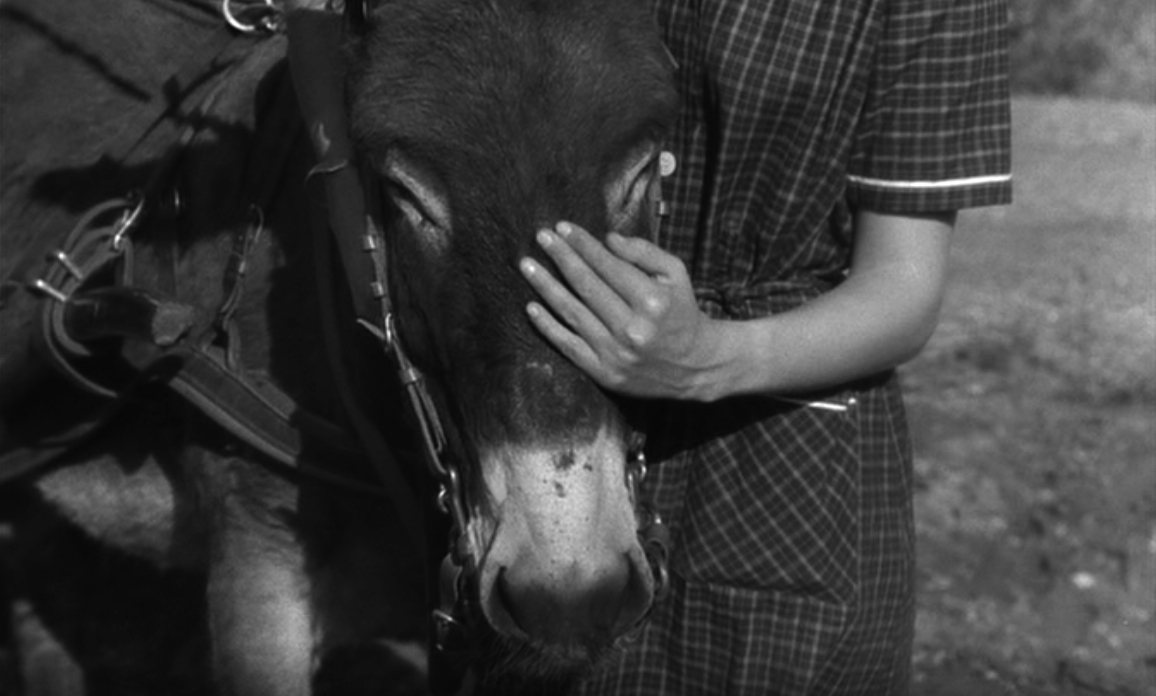
The other noteworthy highlight of this past week in artistic consumption: being so stunned into submission by my first-ever viewing of Robert Bresson's Au Hasard Balthazar—the opening film in a near-complete Bresson retrospective unfurling right now at Film Forum—that I felt unable to speak to anyone else after the screening. And yet how is it possible that a film with such depressing content can have the power to inspire its viewers to maybe be nicer to one's fellow man? I am already looking forward to seeing what other revelations Bresson has in store for me in this series.

Here's this week's log:

Au Hasard Balthazar (1966)

Films

★ Greed (1924, Erich von Stroheim), seen at Film Forum in New York [second viewing]

★ Au Hasard Balthazar (1966, Robert Bresson), seen at Film Forum in New York
★ Les Dames du Bois de Boulogne (1945, Robert Bresson), seen at Film Forum in New York

★ Almayer's Folly (2011, Chantal Akerman), seen at Museum of the Moving Image in Queens, N.Y.

Music

★ Kick Out the Jams (1969, MC5)
★ Back in the USA (1970, MC5)

★ Mahler: Symphony No. 9 (1984, Herbert von Karajan & Berlin Philharmonic) [umpteenth listen]
★ "Mahler's Ninth Symphony," performed by Alan Gilbert & New York Philharmonic at Avery Fisher Hall in New York

★ "Heroes" (1977, David Bowie) [second listen]
Just because it was Bowie's birthday yesterday. And because I wanted to make sure I didn't underrate this one in light of its predecessor, Low (I concluded that I didn't). Plus, the title cut is still pretty awesome.

Art

★ "de Kooning: A Retrospective," seen at Museum of Modern Art in New York